| |
| Piú viste |

SOL639-PIA03201_fig1.jpg"Phobal" eclypse (2) - Sol 63979 visiteJim Bell, the astronomer in charge of the rover's panoramic camera (Pancam), suggested calling it a "Phobal" eclipse rather than a lunar eclipse as a way of identifying which of the dozens of moons in our solar system was being cast into shadow.
With the help of the Jet Propulsion Laboratory's navigation team, the Pancam team planned instructions to Spirit for acquiring the views shown here of Phobos as it entered into a lunar eclipse on the evening of the rover's 639th martian day, or sol (Oct. 20, 2005) on Mars. This image is a time-lapse composite of eight Pancam images of Phobos moving across the martian sky. The entire eclipse lasted more than 26 minutes, but Spirit was able to observe only in the first 15 minutes. During the time closest to the shadow crossing, Spirit's cameras were programmed to take images every 10 seconds.
In the first three images, Phobos was in sunlight, moving toward the upper right. After a 100-second delay while Spirit's computer processed the first three images, the rover then took the fourth image, showing Phobos just starting to enter the darkness of the martian shadow. At that point, an observer sitting on Phobos and looking back toward the Sun would have seen a spectacular sunset! In the fifth image, Phobos appeared like a crescent, almost completely shrouded in darkness.
In the last three images, Phobos had slipped entirely into the shadow of Mars. However, as with our own Moon during lunar eclipses on Earth, it was not entirely dark. The small amount of light still visible from Phobos is a kind of "Mars-shine" -- sunlight reflected through Mars' atmosphere and into the shadowed region.
Rover scientists took some images later in the sequence to try to figure out if this "Mars-shine" made Phobos colorful while in eclipse, but they'll need more time to complete the analysis because the signal levels are so low. Meanwhile, they will use the information on the timing of the eclipse to refine the orbital path of Phobos. The precise position of Phobos will be important to any future spacecraft taking detailed pictures of the moon or landing on its surface. In the near future it might be possible for one of the rovers to take images of a "Deimal" eclipse to learn more about Mars' other enigmatic satellite, Deimos, as well.
|
|

Aurora Borealis~0.jpgAurora Borealis over North Dakota79 visiteDa "NASA - Picture of the Day" del 20 Novembre 2005:"This aurora was a bit of a surprise. For starters, on this Friday morning in August 2002, no intense auroral activity was expected at all. Possibly more surprising, however, the aurora appeared to show an usual structure of green rays from some locations. In the above image, captured from North Dakota, USA, a picket fence of green rays stretches toward the horizon. Mirroring the green rays is a red band, somewhat rare in its own right. Lights from the cities of Bismarck and Mandan are visible near the horizon. Large sunspot groups indicate that activity from an active Sun is relatively likely, possibly causing other streams of energetic particles to cascade onto the Earth and so causing more auroras".
|
|

SOL690-2R187625923EFFAJ2EP1312L0M1.jpgMartian "bird" (or UFO) on sight! (1) - Sol 69079 visiteQuesto è un caso più unico che raro e quindi abbiamo ritenuto opportuno evidenziare l'Anomalìa in maniera netta ed esplicita: nella cerchiatura verde, infatti, si può vedere - secondo noi piuttosto bene - un minuscolo oggetto scuro che appare sia in questo frame, sia nel successivo (così formando uno stereo-pair unico nel suo genere).
Mentre opererete le Vostre valutazioni, ricordate che le due immagini sono state ottenute solo teoricamente nello stesso istante (in realtà esiste uno scarto di circa 1/4 di secondo) e che, a quanto ne sappiamo, questa è la prima volta che una possibile Anomalìa del Cielo di Marte appare in due "scatti" consecutivi, mutando la propria posizione, ma non le caratteristiche apparenti.
Escludendo - come ipotesi di partenza - che si tratti di un photoartifact (a noi, questa volta, pare proprio di no), che cosa potrebbe mai essere?!?
Original caption:"Left Rear Haz-Cam Non-linearized Full frame EDR acquired on Sol 690 of Spirit's mission to Gusev Crater at approx. 13:32:05 MLT".
|
|
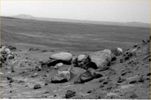
SOL691-2N187708926ESFAJ2EP1561L0M1-1.jpgHanging Rock - Sol 69179 visiteQuanto sono ingannevoli le immagini e quanto di questa ingannevolezza deriva dal nostro desiderio di vedere qualcosa di "speciale"?
Difficile rispondere ma, se ora osservate bene questo frame del Sol 691, Vi renderete conto, ancora una volta e molto bene, di quanto le immagini in arrivo da Marte sìano "strane".
Hanging Rock, infatti, in questo specifico frame, ci sembra che giustifichi completamente il nome che le abbiamo dato.
O no?!?
|
|

M-016-95.jpgM 16 - Stellar "Eggs" Emerge from Molecular Cloud (the "Evaporating Globules" of M 16)79 visite"...Sine Cerere et Libero, friget Venus..."
(Terenzio)
"...Senza cibo nè vino, anche il desiderio (d'amore) si raffredda..."
|
|

SOL712-2R189580613EFFALBUP1311L0M1.jpgFront-View - Sol 71279 visitenessun commento
|
|

SOL713-2F189670116EFFALHQP1212R0M1.jpgDeep tracks and strange features - Sol 71379 visiteCerchiatura Rossa: il puntino luminoso è un ciottolo luccicante (non è un photoartifact); accanto ad esso una possibile alterazione digitale - non necessariamente attuata con intenti capziosi - del frame;
Cerchiatura Verde: accanto ai solchi provocati dalle ruote di Spirit, si può vedere una fenditura ad arco sulla sabbia che presenta caratteristiche assolutamente incongruenti rispetto alla generale morfologia del luogo e che non crediamo sia stata provocata dal passaggio del Rover, nè dall'uso di alcuna delle sue dotazioni scientifiche. Pertanto, si potrebbe trattare:
1) di una configurazione superficiale anomala oppure
2) di un photoartifact (ipotesi poco credibile) oppure
3) di un "cedimento" delle sabbie (compatte) latistanti alla porzione di superficie interessata dal passaggio del Rover oppure
4) di una manipolazione del frame effettuata "alla fonte" e per motivi ignoti.
|
|
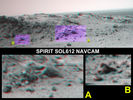
SOL612.jpgHoles and Synapsis... (3D) - Sol 61279 visiteUn frame da guardare, da studiare e poi da usare per cercare di capire che cosa sìano, in realtà, queste "rocce Marziane mutanti"...
|
|
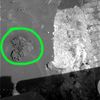
SOL723-2P190546930EFFAMFHP2542L4M1-1.jpgFossil-like feature? - Sol 72379 visiteDifficile non fare paragoni fra la "roccia" che vediamo emergere dalle sabbie sul lato Sx dell'immagine e le "madrepore" terrestri (o, se si vuole rimanere su Marte, possiamo rinviarVi alle "razorblades-like rocks" di Meridiani Planum).
Si tratta, dunque, di un antico fossile?
O forse questo rilievo è solo il risultato finale di una curiosa combinazione di elementi esterni (piogge, venti e chissà cosa) i quali flagellarono la superficie di Marte in epoche remote?
Comunque, data e premessa l'indubitabile similitudine fra questa roccia (apparentemente porosa e lamellare) e le "razorblades-like rocks" di Maridiani, la domanda sorge spontanea: Meridiani - NASA docet - un tempo era un Oceano e le forme delle rocce che vediamo laggiù sono il risultato dell'azione dell'acqua. Ma che dire di Gusev Crater, allora? Gusev Crater era un lago forse? La NASA sembra essere "neutralmente scettica" su questa teoria ma, logica alla mano, "uguali configurazioni chiamano uguali cause". Almeno di regola.
Voi che dite?!?
|
|

SOL736-2M191701749EFFANHEP2936M2M1.jpgDetails of "Bubble Rock" (1) - Sol 73679 visiteUna serie di quattro spettacolari dettagli della roccia che abbiamo battezzato "Bubble Rock" e che fa parte, a nostro parere, della Famiglia delle pseudo-rocce.
Le forme che vediamo - checchè la NASA ne possa dire - ci richiamano alla mente, ancora una volta, le "Creature delle Scogliere" (spugne, coralli o qualcosa del genere); in ogni caso, si tratta di forme che NON sembrano proprio per nulla (a nostro modesto parere) il risultato di un qualche sub-processo vulcanico.
Caption originale:"Microscopic Imager Non-linearized Full frame EDR acquired on Sol 736 of Spirit's mission to Gusev Crater at approximately 11:35:26 MLT. Microscopic Imager dust cover commanded to be OPEN".
|
|

Chamaeleon.jpgSpace Chamaleon79 visite"...Pereant qui crastina curant..."
(Virgilio)
"...(E) che vadano in rovina coloro che pensano (soltanto) al domani..."
|
|
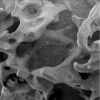
SOL736-PIA02157.jpgThird Strike! - Sol 73679 visiteTerzo strike di Lunar Explorer! Per la terza volta in pochissimi giorni, infatti, la NASA ha speso qualche parola per spiegare un frame sul quale ci eravamo soffermati anche noi, operando delle speculazioni. Come sempre, quello che la NASA dice è completamente diverso da quello che diciamo noi (ma non fa niente, anzi!...) e, come sempre, le spiegazioni NASA, seppur logicamente accettabili, secondo noi fanno a pugni con le evidenze delle quali disponiamo.
Ad ogni modo, noi siamo molto contenti e Vi rimandiamo a quello che ci viene raccontato da Pasadena: la teoria "più accettabile", decidetela - come sempre - Voi stessi!
Original caption:NASA's MER Spirit used its MI to capture this spectacular jagged mini-landscape on a rock called "GongGong" Measuring only 3 cm(about 1,2") across, this surface records two of the most important and violent forces in the history of Mars -- volcanoes and wind.
GongGong formed billions of years ago in a seething, stirring mass of molten rock. It captured bubbles of gases that were trapped at great depth but had separated from the main body of lava as it rose to the surface. Like taffy being stretched and tumbled, the molten rock was deformed as it moved across an ancient Martian landscape. The tiny bubbles of gas were deformed as well, becoming elongated. When the molten lava solidified, the rock looked like a frozen sponge.
Far from finished with its life, the rock then withstood billions of years of pelting by small sand grains carried by Martian dust storms that sometimes blanketed the planet. The sand wore away the surface until, little by little, the delicate strands that enclosed the bubbles of gas were breached and the spiny texture we see today emerged.
Even now, wind continues to deposit sand and dust in the holes and crevices of the rock.
Similar rocks can be found on Earth where the same complex interplay of volcanoes and weathering occur, whether it be the pelting of rocks by sand grains in the Mojave desert or by ice crystals in the frigid Antarctic.
GongGong is one of a group of rocks studied by Spirit and informally named by the Athena Science Team to honor the Chinese New Year (the Year of the Dog). In Chinese mythology, GongGong was the god-king of water in the North Land. When he sacrificed his life to knock down Mount BuZhou, he defeated the bad Emperor in Heaven, freed the sun, moon and stars to go from east to west, and caused all the rivers in China to flow from west to east.
Spirit's microscopic imager took this image during on the rover's 736th day, or sol, of exploring Mars (Jan. 28, 2006). The rock lies in the "Inner Basin" between "Husband Hill" and "McCool Hill" in Gusev Crater. Spirit acquired the image while the rock was fully shadowed, with diffuse illumination mostly from the top in this view.
|
|
| 25353 immagini su 2113 pagina(e) |
 |
|
|
|
|
798 | |
|
|
|
|
|
|





