| Piú viste |

SOL551-2P175274684EFFAD40P2514R1M1.jpgMore unusual rocks from Sol 551 (5) - close up79 visitenessun commento
|
|

SOU-SOL006-81093_full.jpgRocks and dust - Sol 679 visiteOriginal caption:"Full-color image of Wedge and Flat Top, showing the accumulation of dust on the latter rock".
|
|

SOU-SOL007-81316_full.jpgYogi on Mars! (in true colors) - Sol 779 visiteOriginal caption:"Color image from the rover with a close-up view of Yogi".
|
|
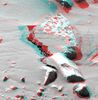
SOL448.jpgA recent, VERY recent crack! - Sol 44879 visiteUna spettacolare - davvero! - immagine tridimensionale di un modesto crepaccio (diciamo pure una fessurina del terreno o poco più) incrociato dal Rover Spirit durante la sua peregrinazione fra le pietraie e gli outcrops di Gusev Crater. E' evidente che basta usare gli occhialini rosso-verdi ed un pizzico di buon senso ed esperienza per vedere che questo, ribadiamo, modesto crack del suolo è estremamente recente. Ciò premesso, bisognerebbe ora cercare di capire che cosa lo ha provocato ed è proprio qui, su questo aspetto - come potete immaginare - che iniziano a porsi i problemi...
|
|

SOL582-1A_P2299_L456-A590R1_br2.jpgTennessee Valley: View from Husband's Summit (1)79 visiteOriginal NASA caption:"This postcard or 2-inch mini-panorama was taken by NASA's Spirit Rover on Sol 582 (August 23, 2005), just as the Rover finally completed its intrepid climb up Husband Hill. The Summit appears to be a windswept plateau of scattered rocks, little sand dunes and small exposures of outcrop. The breathtaking view here is toward the North, looking down into the drifts and outcrops of the 'Tennessee Valley', a Region that Spirit was not able to visit during its climb to the top of the hill.
The approximate true-color postcard spans about 90° and consists of images obtained by the Rover's PanCam during 18 individual pointings. At each pointing, the Rover used three of its panoramic filters (600, 530 and 480 nanometers)".
|
|
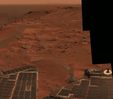
SOL582-2A_P2299_L456-A590R1_br2.jpgTennessee Valley: View from Husband's Summit (2)79 visiteMentre osserviamo affascinati questa immagine della "Tennessee Valley" desideriamo fare qualche puntualizzazione sulla scalata di Spirit verso il Summit di Husband Hill: una scalata che ha creato non pochi malintesi in noi Ricercatori.
In effetti, osservando le immagini in arrivo da Spirit - e relative ai Soles 585-589 -, la sensazione che il Summit fosse stato già raggiunto (o che si trovasse veramente 'ad un passo'...) era forte -, ma il silenzio del Centro Controllo Missione ci ha lasciati nell'incertezza e, come sempre, nel buio. La mancanza di note di commento ai raw frames, unita al cronico ritardo con cui vengono resi diponibili al Pubblico tutti gli updates sulla Missione, hanno completato l'opera.
Ad ogni modo il Summit di questa collinetta Marziana è stato raggiunto: lo spettacolo - effettivamente - è molto bello e suggestivo e, sebbene molti aspetti di questa nuova conquista debbano essere ancora chiariti, già in molti guardano oltre.
Adesso dove andrà Spirit?...
|
|

Amalthea-PIA01074.jpgFour views of Amalthea79 visiteThese 4 images of Amalthea were taken by Galileo's Solid State Imaging System at various times between February and June 1997. North is approx. up in all cases. Amalthea, whose longest dimension is about 247 Km (154 miles) across, is tidally locked (like Thebe) so that the same side of the moon always points towards Jupiter. In such a tidally locked state, one side of Amalthea always points in the direction in which Amalthea moves as it orbits about Jupiter. This is called the "leading side" of the moon and is shown in the top 2 images. The opposite side of Amalthea, such as the "trailing side," is shown in the bottom pair of images. The Sun illuminates the surface from the left in the top left image and from the right in the bottom left image. Such lighting geometries, similar to taking a picture from a high altitude at sunrise or sunset, are excellent for viewing the topography of the satellite's surface such as impact craters and hills. In the two images on the right, however, the Sun is almost directly behind the spacecraft. This latter geometry, similar to taking a picture from a high altitude at noon, washes out topographic features and emphasizes Amalthea's albedo (light/dark) patterns. It emphasizes the presence of surface materials that are intrinsically brighter or darker than their surroundings. The bright albedo spot that dominates the top right image is located inside a large south polar crater named Gaea.
|
|

The Rings-PIA07611.jpgDeep inside the "C-Ring"79 visiteOriginal caption:"This close-up view shows an inner region of Saturn's C-Ring. It covers a radial location on the rings located approx. 78.000 to 80.500 Km (about 48.500 to 50.000 miles) from the center of the Planet. Saturn itself has a radius of 60.330 Km (that is about 34.490 miles).
A bright feature, informally referred to as a "plateau", arcs across the image center. The plateau is not high in terms of elevation, but rather in terms of particle density (seen here as brightness). The density is fairly uniform within the bright band, and some five times higher than in the surrounding ring structure. Although the many plateaus in Saturn's Rings appear unchanged over 25 years of observations, scientists do not know what determines their locations or maintains their sharp boundaries.
The image was taken in visible light with the Cassini spacecraft narrow-angle camera on Sept. 5, 2005, at a distance of approx. 418.000 Km(such as about 260.000 miles) from Saturn. The image scale is 2 Km per pixel".
|
|

ZB-T-Surface map of Pluto.jpgSurface Map of Pluto79 visiteQuando si parla del Sistema Plutone-Caronte in molti (anche noi...) parlano - a nostro avviso impropriamente - di "Sistema Binario", con ciò intendendo il fatto che i due corpi celesti in questione hanno dimensioni similari e si muovono ad una modesta (sempre in termini cosmici) distanza media l'uno dall'altro. In realtà il rapporto che lega Plutone a Caronte è comunque un rapporto di "maggiore" a "minore" o, se preferite, di "Parent Planet" a "moon" (o "satellite") e quindi parlare di Sistema Binario è errato.
Per Sistema Binario, infatti, si dovrebbe intendere un rapporto "alla pari" fra i 2 corpi il quale - prescindendo anche dalle loro effettive dimensioni - si fonda su un principio di "Equilibrio Gravitazionale" fra di essi. Un "equilibrio" in virtù del quale non c'è nè un Parent Planet, nè una moon, bensì 2 corpi celesti "connessi ma indipendenti", i quali si muovono armonicamente e sincronicamente l'uno rispetto all'altro secondo traiettorie definite dalle loro reciproche interazioni gravitazionali.
|
|

SOL639-PIA03201_fig1.jpg"Phobal" eclypse (2) - Sol 63979 visiteJim Bell, the astronomer in charge of the rover's panoramic camera (Pancam), suggested calling it a "Phobal" eclipse rather than a lunar eclipse as a way of identifying which of the dozens of moons in our solar system was being cast into shadow.
With the help of the Jet Propulsion Laboratory's navigation team, the Pancam team planned instructions to Spirit for acquiring the views shown here of Phobos as it entered into a lunar eclipse on the evening of the rover's 639th martian day, or sol (Oct. 20, 2005) on Mars. This image is a time-lapse composite of eight Pancam images of Phobos moving across the martian sky. The entire eclipse lasted more than 26 minutes, but Spirit was able to observe only in the first 15 minutes. During the time closest to the shadow crossing, Spirit's cameras were programmed to take images every 10 seconds.
In the first three images, Phobos was in sunlight, moving toward the upper right. After a 100-second delay while Spirit's computer processed the first three images, the rover then took the fourth image, showing Phobos just starting to enter the darkness of the martian shadow. At that point, an observer sitting on Phobos and looking back toward the Sun would have seen a spectacular sunset! In the fifth image, Phobos appeared like a crescent, almost completely shrouded in darkness.
In the last three images, Phobos had slipped entirely into the shadow of Mars. However, as with our own Moon during lunar eclipses on Earth, it was not entirely dark. The small amount of light still visible from Phobos is a kind of "Mars-shine" -- sunlight reflected through Mars' atmosphere and into the shadowed region.
Rover scientists took some images later in the sequence to try to figure out if this "Mars-shine" made Phobos colorful while in eclipse, but they'll need more time to complete the analysis because the signal levels are so low. Meanwhile, they will use the information on the timing of the eclipse to refine the orbital path of Phobos. The precise position of Phobos will be important to any future spacecraft taking detailed pictures of the moon or landing on its surface. In the near future it might be possible for one of the rovers to take images of a "Deimal" eclipse to learn more about Mars' other enigmatic satellite, Deimos, as well.
|
|

Aurora Borealis~0.jpgAurora Borealis over North Dakota79 visiteDa "NASA - Picture of the Day" del 20 Novembre 2005:"This aurora was a bit of a surprise. For starters, on this Friday morning in August 2002, no intense auroral activity was expected at all. Possibly more surprising, however, the aurora appeared to show an usual structure of green rays from some locations. In the above image, captured from North Dakota, USA, a picket fence of green rays stretches toward the horizon. Mirroring the green rays is a red band, somewhat rare in its own right. Lights from the cities of Bismarck and Mandan are visible near the horizon. Large sunspot groups indicate that activity from an active Sun is relatively likely, possibly causing other streams of energetic particles to cascade onto the Earth and so causing more auroras".
|
|

SOL690-2R187625923EFFAJ2EP1312L0M1.jpgMartian "bird" (or UFO) on sight! (1) - Sol 69079 visiteQuesto è un caso più unico che raro e quindi abbiamo ritenuto opportuno evidenziare l'Anomalìa in maniera netta ed esplicita: nella cerchiatura verde, infatti, si può vedere - secondo noi piuttosto bene - un minuscolo oggetto scuro che appare sia in questo frame, sia nel successivo (così formando uno stereo-pair unico nel suo genere).
Mentre opererete le Vostre valutazioni, ricordate che le due immagini sono state ottenute solo teoricamente nello stesso istante (in realtà esiste uno scarto di circa 1/4 di secondo) e che, a quanto ne sappiamo, questa è la prima volta che una possibile Anomalìa del Cielo di Marte appare in due "scatti" consecutivi, mutando la propria posizione, ma non le caratteristiche apparenti.
Escludendo - come ipotesi di partenza - che si tratti di un photoartifact (a noi, questa volta, pare proprio di no), che cosa potrebbe mai essere?!?
Original caption:"Left Rear Haz-Cam Non-linearized Full frame EDR acquired on Sol 690 of Spirit's mission to Gusev Crater at approx. 13:32:05 MLT".
|
|
| 25353 immagini su 2113 pagina(e) |
 |
|
|
|
|
797 | |
|
|
|
|





