| Piú viste |
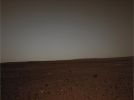
SOL010-2N127266333ESF0224P1513R0M1-PCF-LXTT.jpgTAU Monitoring - Sol 10 (Absolute Natural Colors; credits for the additional process. and color.: Dr Paolo C. Fienga - Lunexit Team)80 visitenessun commentoMareKromium
|
|
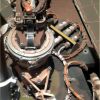
OPP-SOL2811-2-2.jpgThe always "Spotless" Cables of Opportunity - Sol 2811 (Natural Colors; credits for the additional process. and color.: Dr Gianluigi Barca - Lunexit Team)80 visitenessun commentoMareKromium
|
|
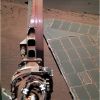
OPP-SOL2811-1-2.jpgCables, Solar Panel and Surface - Sol 2811 (Natural Colors; credits for the additional process. and color.: Dr Gianluigi Barca - Lunexit Team) 80 visitenessun commentoMareKromium
|
|
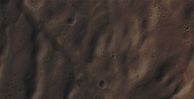
ESP_024955_1390_RED-PCF-LXTT-01.jpgFeatures of Icaria Region (CTX Frame "B" - Absolute Natural Colors; credits for the additional process. and color.: Dr Paolo C. Fienga - Lunexit Team)80 visiteMars Local Time: 14:49 (early afternoon)
Coord. (centered): 40,5° South Lat. and 257,0° East Long.
Spacecraft altitude: 247,9 Km (such as about 155,0 miles)
Original image scale range: 49,6 cm/pixel (with 2 x 2 binning) so objects ~ 1 mt and 49 cm across are resolved
Map projected scale: 50 cm/pixel
Map projection: EQUIRECTANGULAR
Emission Angle: 0,4°
Sun - Mars - MRO (or "Phase") Angle: 67,2°
Solar Incidence Angle: 67° (meaning that the Sun is about 23° above the Local Horizon)
Solar Longitude: 33,5° (Northern Spring)
Credits: NASA/JPL/University of Arizona
Additional process. and coloring: Lunar Explorer ItaliaMareKromium
|
|

ESP_024952_2250_RED-PCF-LXTT-01.jpgLow Albedo Surface Features in Acidalia Planitia (CTX Frame "B" - Absolute Natural Colors; credits for the additional process. and color.: Dr Paolo C. Fienga - Lunexit Team)80 visiteMars Local Time: 14:27 (early afternoon)
Coord. (centered): 44,4° North Lat. and 326,8° East Long.
Spacecraft altitude: 304,0 Km (such as about 190,0 miles)
Original image scale range: 60,8 cm/pixel (with 2 x 2 binning) so objects ~ 1 mt and 82 cm across are resolved
Map projected scale: 50 cm/pixel
Map projection: EQUIRECTANGULAR
Emission Angle: 6,9°
Sun - Mars - MRO (or "Phase") Angle: 50,3°
Solar Incidence Angle: 44° (meaning that the Sun is about 46° above the Local Horizon)
Solar Longitude: 33,4° (Northern Spring)
Credits: NASA/JPL/University of Arizona
Additional process. and coloring: Lunar Explorer ItaliaMareKromium
|
|
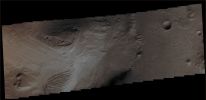
Craters-Gale_Crater-PIA15311-PCF-LXTT.jpgFeatures of Gale Crater (Absolute Natural Colors; credits for the additional process. and color.: Dr Paolo C. Fienga - Lunexit Team)80 visiteOrbit Number: 44524
Latitude: 4,640° South
Longitude: 137,685° East
Instrument: VIS
Captured: December, 28th, 2011
Mars Local Solar Time: 07:29 (Early Morninh Hours)MareKromium
|
|
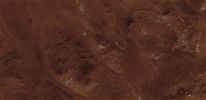
PSP_004277_1530_RED-PCF-LXTT-01.jpgFeatures of Holden Crater's Rim (CTX Frame "B" - Absolute Natural Colors; credits for the additional process. and color.: Dr Paolo C. Fienga - Lunexit Team)80 visiteHiRISE image PSP_004277_1530 covers a portion of the rim of Holden Crater, revealing breaches created when water over-topped the Rim and incised a series of Channels as it flowed down the Crater Wall.
The water responsible for the Channels was impounded outside of the rim of Holden in Uzboi Vallis (Holden Crater itself is approx. 150 Km in diameter).
Uzboi Vallis was interrupted when Holden Crater formed and the Rim formed an effective, temporary damn to flow farther to the North. Once the Uzboi Basin filled, water began flowing into Holden again, creating a series of low fan-shaped Deltas, alluvial deposits and a shallow, but relatively short-lived lake.
The Channels in this image were only active for a short time, as a Channel just to the East cut quickly into the Rim and became responsible for most of the drainage into the Crater.
The fact that most of the fan-shaped Deltas radiate from the Dominant Channel to the East rather than those in this image supports this scenario. MareKromium
|
|

ESP_025665_1825-PCF-LXTT-00.jpgUnnamed Crater with Layers of Water-deposited Sediments (CTX Frame - Absolute Natural Colors; credits for the additional process. and color.: Dr Paolo C. Fienga - Lunexit Team)80 visiteMars Local Time: 14:56 (Early Afternoon)
Coord. (centered): 2,317° North Lat. and 307,960° East Long.
Spacecraft altitude: 269,9 Km (such as about 168,7 miles)
Original image scale range: 54,0 cm/pixel (with 2 x 2 binning) so objects ~ 1 mt and 62 cm across are resolved (with 4 x 4 binning)
Map projected scale: 50 cm/pixel
Map projection: EQUIRECTANGULAR
Emission Angle: 2,3°
Sun - Mars - MRO (or "Phase") Angle: 48,9°
Solar Incidence Angle: 47° (meaning that the Sun is about 43° above the Local Horizon)
Solar Longitude: 58,1° (Northern Spring/Southern Fall)
Credits: NASA/JPL/University of ArizonaMareKromium
|
|

Titan-MF-EB-LXTT-00.jpgNot an Aurora! (Extremely Enhanced Natural Colors; credits for the additional process. and color.: Elisabetta Bonora and Marco Faccin - Lunar Explorer Italia/IPF)80 visiteL'ipotesi "Aurorale" del bizzarro Fenomeno occorso alle estreme Latitudini Sud di Titano è tramontata. Nuove ipotesi? Diciamo questo: accanto a quelle "classiche" (e cioè 1) nube alta di gas "pesanti" e 2) "nuvola colonnare" derivante da un impatto meteorico) ce ne potrebbe essere un'altra. Si potrebbe trattare, a nostro parere, di un Fenomeno Meteorologico Ciclico, collegato al verificarsi di una specifica configurazione spaziale tra Sole, Saturno e Titano. Nulla di esotico, sia chiaro: solo una particolare configurazione di "fase" che, da un lato, consente la creazione "fisica", su Titano, di una formazione nuvolosa semi-permanente e, dall'altro, consente la individuazione "ottica" della nuvola stessa (ovviamente a condizione di avere uno strumento "in loco" o quasi...). Pensiamoci sopra...MareKromium
|
|

Titan-PIA14919.jpgTitan's South Polar Vortex (True Colors; credits: NASA/JPL-Caltech/Space Science Institute)80 visiteCaption NASA:"This frame (taken by the NASA - Cassini Spacecraft) shows us a South Polar Vortex or, in other words, a swirling Mass of Gas (and, perhaps, even other - heavier - Elements), which is located in the Upper Atmosphere, and approximately over the South Pole, of the Saturnian moon Titan. This Swirling Mass appears to complete one full rotation in about 9 (nine) hours - meaning a much faster period than the moon's 16 (sixteen)-days Rotation Period. The South Pole of Titan (which is about 3200 miles, or 5150 Km, across) is right under the Vortex.
Since the NASA - Cassini Spacecraft arrived in the Saturnian System, in 2004, Titan has shown a visible "Hood", such as an area of denser (when compared to the rest of the moon's Atmosphere) High Altitude Haze, high above the North Pole, but this is the first time that a similar phenomenon is seen above its South Pole. As a matter of fact, it was Northern Winter on Titan at the time of the arrival of the Cassini Spacecraft, and therefore much of its High Northern Latitudes was then in the darkness. But the Hood was high enough to still be illuminated by Sunlight. However, seasons have been changing since Saturn's August 2009 Equinox, which signaled the beginning of Spring in the Northern Hemisphere and the start of Fall (---> Autumn) in the Southern one, both for Saturn and for its very many moons. As a consequence of this season's changing, now the High Southern Latitudes are the ones moving into darkness, and the formation of this Vortex at Titan's South Pole may be related to the incoming Southern Winter and - maybe - the subsequent beginning of what could well be a South Polar Hood.
These new, more detailed images are only possible because of the NASA - Cassini Spacecraft newly inclined orbits, whose re-definition is part of the next phase of the Cassini Solstice Mission. Previously, Cassini was orbiting along the Equatorial Plane of Titan, and so the imaging team's pictures of the Polar Vortex (in the period between late March and mid-May), were taken from over Titan's Equator. At that time, however, the images taken by the Spacecraft only showed a brightening (or yellowing) of the detached Haze Layer located on the Limb (or Edge) of the Visible Disk of Titan, right over its South Polar Regions".MareKromium
|
|
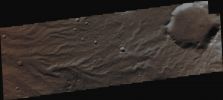
Channels-Unnamed_Channels_near_Huygens_Crater-PIA16322-PCF-LXTT-IPF.jpgUnnamed Channel near Huygens Crater (Absolute Natural Colors; credits for the additional process. and color.: Dr Paolo C. Fienga/Lunar Explorer Italia/Italian Planetary Foundation)80 visiteOrbit Number: 47248
Latitude: 16,8887° South
Longitude: 61,3382° East
Instrument: VIS
Captured: August, 8, 2012MareKromium
|
|

SOL0132-EB-MF-LXTT-IPF-2.jpgYellowknife's Rocks... - Sol 132 (an Image-Mosaic in Calibrated Natural Colors; credits for the additional process. and color.: Elisabetta Bonora and Marco Faccin/Lunar Explorer Italia/Italian Planetary Foundation)80 visitenessun commentoMareKromium
|
|
| 25353 immagini su 2113 pagina(e) |
 |
|
|
|
|
792 | |
|
|
|
|





