| Piú viste |

OPP-SOL291-1N154005002EDN37MIP1580L0M1.jpgBig clouds over Endurance Crater (2 - True Colors; credits: Lunexit)80 visitenessun commentoMareKromium
|
|
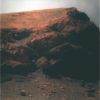
OPP-SOL1457-2.jpgLooking inside Victoria - Sol 1457 (natural colors + MULTISPECTRUM; credits: Dr Gianluigi Barca & Lunexit)80 visitenessun commentoMareKromium
|
|
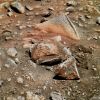
SOL430-1.jpgRocks - Sol 430 (Natural Colors; credits: Dr Gianluigi Barca)80 visitenessun commentoMareKromium
|
|

OPP-SOL1489-90-NAVCAM_2opp-001.jpgVictoria's "Hues" - Sol 1484 (True Colors + MULTISPECTRUM; credits: Dr M. Faccin & Lunexit)80 visitenessun commentoMareKromium
|
|
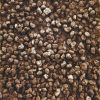
SOL607.jpgGreenish "dust" and pebbles - Sol 607 (Superdefinition; credits: Dr G. Barca)80 visitenessun commentoMareKromium
|
|
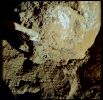
AP_15_AS_15-86-11570.jpgAS 15-86-11570 - The "Lunar Pearls" of Station 2 Boulder (special processing by Dr M. Faccin)80 visiteUn'elaborazione in "colori naturali" operata dal Dr Faccin che, oltre a mostrare la Superficie della Luna come non era mai stata vista prima, ci offre anche degli spunti di riflessione sulle "perle" che, simili a gocce (alcune opache, altre limpide) di cristallo, appaiono sul lato visibile di questo macigno che, purtroppo (ed almeno "ufficialmente"...) NON è stato MAI indagato a fondo.MareKromium
|
|

OPP-SOL015-1.jpgExtremely Unusual Surface Feature - Sol 15 (Superdefinition; credits: Dr G. Barca)80 visitenessun commentoMareKromium
|
|
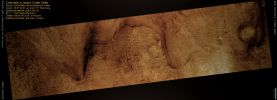
PSP_007925_1990_RED_abrowse-00.jpgChannels in Jezero Crater Delta (context frame - MULTISPECTRUM; credits: Lunexit)80 visiteBillions of years ago, this water-carved channel in Nili Fossae Region transported sediments across the Martian Surface and deposited them on the floor of an impact crater just south of this image.
The sediments were deposited in a delta-like mound on the floor of Jezero Crater, suggesting that the crater may have contained a lake at the time.MareKromium
|
|
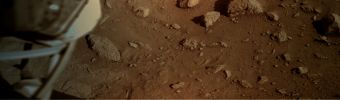
ZE-I-Viking1-PIA10738.jpgMars Surface near Viking Lander 1 Footpad (MULTISPECTRUM; credits: Lunexit)80 visiteCaption NASA:"This image, which has been flipped horizontally, was taken by Viking Lander 1 on August 1st, 1976, 12 Soles after the landing. Much like images that have returned from Phoenix, the soil beneath Viking 1 has been exposed due to exhaust from thruster engines during descent.
This is visible to the right of the struts of Viking's surface-sampler arm housing, seen on the left".MareKromium
|
|

ZZ-Z-O-JC1-MERB_Traverse_Sol1487.jpgOpportunity Traverse Map, up to Sol 145780 visitenessun commentoMareKromium
|
|
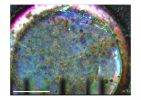
PHOE-SOL017-lg_4869.jpgParticles of Soil on Silicone - Sol 17 (2 - credits: NASA/Univ. of Arizona)80 visite"We've seen no major dust clouds at the landing site during the mission so far," Renno said. "That's not a surprise because we landed when dust activity is at a minimum. But we expect to see big dust storms at the end of the mission. Some of us will be very excited to see some of those dust storms reach the lander".
Studying dust on Mars helps scientists understand atmospheric dust on Earth, which is important because dust is a significant factor in global climate change.
"We've learned there is well-mixed dust in the Martian Atmosphere, much more mixed than on Earth, and that's a surprise," Renno said. Rather than particles settling into dust layers, strong turbulence mixes them uniformly from the surface to a few kilometers above the surface.
Scientists spoke at a news briefing today at the University of Arizona, where new color views of the spacecraft's surroundings were shown.
"We are taking a high-quality, 360-degree look at all of Mars that we can see from our landing site in color and stereo," said Mark Lemmon, Surface Stereo Imager lead from Texas A&M University, College Station.
"These images are important to provide the context of where the lander is on the surface. The panorama also allows us to look beyond our workspace to see how the polygon structures connect with the rest of the area. We can identify interesting things beyond our reach and then use the camera's filters to investigate their properties from afar".MareKromium
|
|
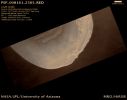
PSP_008161_2505_RED_abrowse.jpgLouth Crater (MULTISPECTRUM; credits: Lunexit)80 visitenessun commentoMareKromium
|
|
| 25353 immagini su 2113 pagina(e) |
 |
|
|
|
|
787 | |
|
|
|
|





