| Piú viste |

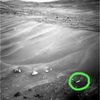
SOL690-2N187626189EFFAJ2EP0715L0M1.jpgHanging in the "air" - Sol 69080 visiteA noi piace andare a cercare "il pelo nell'uovo": i Ricercatori esistono proprio per questo. Ma, scherzi e battute a parte, a noi farebbe molto più piacere capire come fa la roccia cerchiata in verde a...restare in equilibrio!
Ma su che cosa poggia?!? E se poggia su qualcosa...come è appoggiata?
|
|
SOL716-3-mg.jpgThe "Sword" - Sol 71680 visitenessun commento
|
|
SOL723-2F190570590EDNAMFHP1121L0M1.jpgWhat is that? (1) - Sol 72380 visiteOriginal caption:"Left Front Haz-Cam Non-linearized Downsampled EDR acquired on Sol 723 of Spirit's mission to Gusev Crater at approximately 17:43:27 MLT".
|
|

D-RAD.jpgDeinococcus Radiodurans: the "Terra-Farmers"...80 visiteThese bacteria could survive on another planet. In an Earth lab, Deinococcus Radiodurans (D. Rad) survive extreme levels of radiation, extreme temperatures, dehydration, and exposure to genotoxic chemicals. Amazingly, they even have the ability to repair their own DNA, usually within 48 hours.
Known as an extremophile, bacteria such as D. Rad are of interest to NASA partly because they might be adaptable to help human astronauts survive on other worlds. A recent map of D. Rad's DNA might allow biologists to augment their survival skills with the ability to produce medicine, clean water and oxygen.
Already they have been genetically engineered to help clean up spills of toxic mercury. Likely one of the oldest surviving life forms, D. Rad was discovered by accident in the 1950s when scientists investigating food preservation techniques could not easily kill it.
In the picture above: Deinococcus radiodurans grow quietly in a dish.
|
|

HH-0049_-_SST.jpgHH 49/5080 visite"...Multa ferunt anni venientes commoda secum;
Multa recedentes adimunt..."
(Orazio)
"...Gli anni che arrivano (e cioè il futuro che diviene presente) portano con sè tante cose belle; ma molte ne portano via, allorchè declinano (e cioè quando il presente, diviene passato)..."
|
|

SOL744-2F192418673EFFAO00P1212L0M1.jpgA new "needle" of rock and a strange "triangle" - Sol 74480 visiteCerchiatura Verde: uno spuntone di roccia che ricorda tanto un rilievo che incontrammo, qualche mese fa, sulla via del Summit di Husband Hill e che battezzammo "needle of rock" (ago di roccia);
Cerchiatura Verde con punto Rosso: c'è forse una sorta di "disegno" o di "incisione", sulla sommità della roccia cerchiata? Ci sembra una sorta di "triangolo", ma l'immagine non è definita bene per consentirci una visione almeno discreta. Forse si tratta di un photo-artifact e forse è solo un parto della nostra fantasia: comunque sia, il rilievo appare in tutti e 4 i frames della Front Haz-Cam che riprendono la roccia in questione.
|
|

SOL748-2N192766225ESFAO55P1928L0M1.jpgSmoke or tampering? - Sol 74880 visiteCerchiatura Verde: un dettaglio individuato per puro caso, ma grazie ad una notevole acutezza visiva. Si tratta di uno "sbuffo" di fumo nero, di un corpo in movimento rapidissimo e ripreso per puro caso oppure siamo - ancora una volta... - davanti ad una manipolazione digitale?
Impossibile dirlo, ma una cosa è certa: c'è qualcosa di strano, in questo frame...
Caption originale:"Left NavCam Non-linearized Sub-frame EDR acquired on Sol 748 of Spirit's mission to Gusev Crater at approx. 11:25:56 MLT".
|
|

N 44.jpgN 44 - Emission Nebula80 visite"...Thus says the Lord,
who gives the Sun for light by day
and the fixed order of the Moon and the Stars
for light by night,
who stirs up the sea so that its waves roar?
The Lord of hosts is His name..."
Jeremiah 31:35
|
|

OPP-SOL324-3D.jpgHeat-Shield...in 3D! - Sol 32480 visitenessun commento
|
|

OPP-SOL740-1N193877640EFF64NVP0715R0M1.jpgMini-craters...once more! - Sol 74080 visiteCerchiature Rosse: si tratta ancora una volta di mini-crateri (ma anche la NASA sembra aver abbandonato questa costruzione - a nostro parere davvero improbabile, come già detto ampiamente in passato), oppure di cedimenti del suolo (si veda il bellissimo articolo del Dr Pullini - Martian Sandglasses - su TruePlanets) o magari di evidenze di un qualche tipo di attività (sulla superficie o appena al di sotto di essa)?
Voi che dite?
|
|

Voyagers-Heliosphere5b.JPGThe Voyagers at the "Final Frontier"80 visiteThe twin Voyager 1 and 2 spacecrafts continue exploring where nothing from Earth has flown before. In the 25th year after their 1977 launches, they each are much farther away from Earth and the Sun than Pluto is and approaching the boundary region - the heliopause - where the Sun's dominance of the environment ends and Interstellar Space begins. Voyager 1, more than twice as distant as Pluto, is farther from Earth than any other human-made object and speeding outward at more than 17 Km per second (38.000 miles per hour). Both spacecraft are still sending scientific information about their surroundings through the Deep Space Network (DSN).
The primary mission was the exploration of Jupiter and Saturn.
After making a string of discoveries there - such as active volcanoes on Jupiter's moon Io and intricacies of Saturn's rings - the mission was extended. Voyager 2 went on to explore Uranus and Neptune, and is still the only spacecraft to have visited those outer Planets. The adventurers' current mission, the Voyager Interstellar Mission (VIM), will explore the outermost edge of the Sun's domain. And beyond.
|
|

Kane Crater - Light Ray (1).jpgLight rays inside Kane Crater (1)80 visitenessun commento
|
|
| 25353 immagini su 2113 pagina(e) |
 |
|
|
|
|
783 | |
|
|
|
|





