| |
| Piú viste |

Craters-Martz_Crater-PIA16273-PCF-LXTT-IPF.jpgFeatures of Martz Crater (Absolute Natural Colors; credits for the additional process. and color.: Dr Paolo C. Fienga/Lunar Explorer Italia/Italian Planetary Foundation)81 visiteThis picture, taken by the NASA - Mars Odyssey Orbiter during its 49.480th orbit around the Red Planet, shows us a small portion of the Inner Rim of the ancient Martz Crater, heavily dissected by a great number of small Channels.
Martz Crater is located in the Southern Hemisphere of Mars, in a Region known as Terra Cimmeria; it is almost 100 Km (such as a little more than 62 miles) wide and approximately 1,5 Km (such as about 0,9 miles) deep. Martz Crater is well known among Planetary Scientists because of its very prominent and steep Complex Central Peak (which is approx. 1500 meters - or 5000 feet - tall): a Central Peak that formed, like you know, at the same time of the Crater (and as a consequence of a phenomenon known as "Rebound Effect"), right after a medium-sized Celestial Object (probably something in between 0,5 to 1 Km - such as from 0,31 to 0,62 miles - across) impacted the Surface of Mars.
Latitude (centered): 34,614° South
Longitude (centered): 143,722° East
Instrument: VIS
Captured: February, 8th, 2013
This frame (which is an Original Mars Odyssey Orbiter b/w frame published on the NASA - Planetary Photojournal with the ID n. PIA 16273) has been additionally processed and then colorized in Absolute Natural Colors (such as the colors that a human eye would actually perceive if someone were onboard the NASA - Mars Odyssey Orbiter and then looked down, towards the Surface of Mars), by using an original technique created - and, in time, dramatically improved - by the Lunar Explorer Italia Team.MareKromium
|
|

ZZ-Mercury-Volcanic_Features-Vent-GC-PIA16990-PCF-LXTT-IPF-1.jpgVolcanic Vent? (Absokute Natural Colors; credits for the additional process. and color.: Dr Paolo C. Fienga/Lunar Explorer Italia/Italian Planetary Foundation)81 visiteThis picture is a NASA - MESSENGER Spacecraft frame that shows us a potential Volcanic Vent located within the Mercurian Impact Crater Glinka. The resolution of this image (which is approx. 46 Km - such as about 28,566 miles - across) is more than two times better than the one of quite a few previous images of the same area, but there are still many doubts among Planetary Scientists that the Depression of the Surface that we see here is actually a Volcanic Vent (---> as a matter of fact, it could also easily be an unusually-looking Collapse Pit, for instance...). The Impact Crater Glinka was named after the Russian composer Mikhail Glinka (1804 - 1857), who is regarded as one of the Fathers of the Russian Classical Music.
Date acquired: November 26th, 2012
Image Mission Elapsed Time (MET): 262402263
Image ID: 3026496
Instrument: Narrow Angle Camera (NAC) of the Mercury Dual Imaging System (MDIS)
Center Latitude: 14,96° North
Center Longitude: 247,40° East
Resolution: 44 meters/pixel
Solar Incidence Angle: 67,5° (meaning that the Sun, at the time that the picture was taken, was about 22,5° above the imaged Local Mercurian Horizon)
Emission Angle: 3,1°
Sun-Mercury-Messenger (or "Phase") Angle: 64,5°
This image (which has been cropped from an Original NASA - MESSENGER Spacecraft Map Projected b/w frame published on the NASA - Planetary Photojournal with the ID n. PIA 16990) has been additionally processed and then colorized in Absolute Natural Colors (such as the colors that a human eye would actually perceive if someone were onboard the NASA - MESSENGER Spacecraft and then looked down, towards the Surface of Mercury), by using an original technique created - and, in time, dramatically improved - by the Lunar Explorer Italia Team. Different colors, as well as different shades of the same color, mean, among other things, the existence of different Elements (Minerals) present on the Surface of Mercury, each having a different Albedo (---> Reflectivity) and Chemical Composition.MareKromium
|
|

North_Polar_Regions-North_Polar_Erg-PIA17866-PCF-LXTT-IPF-1.jpgSpring over the North Polar Erg (Absolute Natural Colors; credits for the additional process. and color.: Dr Paolo C. Fienga - Lunar Explorer Italia/Italian Planetary Foundation)81 visiteIn this VIS image, taken by the NASA - Mars Odyssey Orbiter on December, 1st, 2013, and during its 53.077th orbit around the Red Planet, we can see, once again, the Erg (---> Sea/Ocean of Dunes) that surrounds the North Polar Cap of Mars. It is Springtime, now, at the North Pole (---> in the Northern Hemisphere of Mars) and the Dunes are starting to lose their Frost cover. As the season continues towards Summer, the Dunes will appear darker and darker, as the Frost sublimates.
Specifically, throughout the accurate observation (and, even more, after the colorization) of the landscape that is shown here, we are able to easily notice that, in this portion of the North Polar Erg (a portion that is positioned a little more towards the South of the Northern Hemisphere - as compared to the Latitude of the Region observed during the 53.076th orbit of the NASA - Mars Odyssey Orbiter), there has been more Frost lost from the Dunes, and this circumstance caused them to appear darker than the Dunes that were shown in yesterday's APOD.
Latitude (centered): 79,990° North
Longitude (centered): 128,365° East
Instrument: VIS
This image (which is an Original Mars Odyssey Orbiter b/w and Map-Projected frame published on the NASA - Planetary Photojournal with the ID n. PIA 17866) has been additionally processed, magnified, contrast enhanced, Gamma corrected and then colorized in Absolute Natural Colors (such as the colors that a human eye would actually perceive if someone were onboard the NASA - Mars Odyssey Orbiter and then looked down, towards the Surface of Mars), by using an original technique created - and, in time, dramatically improved - by the Lunar Explorer Italia Team.MareKromium
|
|

Z-04-IMG_20211016_111048508.jpgA look into the "Unknown"...81 visitenessun commentoMareKromium
|
|

XX-Energy.jpgPlay again!81 visiteSolito "Gioco Ottico". Quello che si vede è fermo e "noi" ci illudiamo di vederlo in moto, o vice-versa? Enjoy!...MareKromium
|
|

Luna-10.jpgThe "Dark Side of the Moon": the Surface81 visitePoco più di un anno fa, la sonda cinese Chang'e 4 è diventata la prima ad atterrare sul lato della Luna non visibile dal nostro pianeta: per celebrare questo anniversario, la Cina ha rilasciato una serie di dati scientifici e immagini catturate dal veicolo spaziale. Dal suo atterraggio il Rover ha in realtà percorso poco più di 350 metri studiando le formazioni rocciose del nostro satellite, e grazie a una "Terrain Camera" montata nella parte superiore del Lander ha fornito scatti ad altissima definizione, come potete vedere nelle foto di questa Gallery. La speciale macchina fotografica, morta alla fine del primo giorno lunare (circa 29,5 giorni terrestri), era in grado di ruotare di 360° e ha fornito dettagliati e interessanti materiali di studio per gli scienziati.MareKromium
|
|

Z-True_Anomaly_Angle.jpgAnomaly does not necessarily mean "strange"!81 visiteThe term "Anomaly", in Astronomy, originally defines the non-uniform (i.e: anomalous or, better yet, discontinuous) apparent motion of a given Celestial Body (usually a planet). Today, three kinds of Anomaly are well distinguished to describe the position of a planet, a satellite, a star (in a binary system) during its (their) motion or "orbit". What follows here relates to the orbit of a single planet. The True Anomaly Angle s the angle "V" that is found between lines drawn from the Centre of Mass (such as near the centre of a given Star "S"), to a planet "P", and to the Perihelion Point "B", such as where the planet comes closest to the aforementioned Star. But this is not all. As a matter of fact we also have the so-called "Mean Anomaly Angle" which is the angle between lines drawn from a given Star to the Perihelion "B" and to a point (not shown here) moving in the orbit at a uniform rate corresponding to the Period of Revolution of the planet, while the so-called "Eccentric Anomaly" is the angle "E" found between the Perihelion "B", the Centre of the Ellipse at "C", and the point "P", which is located by drawing a perpendicular to "AB" that passes through the planet and intersects a circle having a diameter equal to "AB".
§§§
L’Angolo definito T.A.A. (True Anomaly Angle, in Lingua Inglese, o A.K.A.V., come acronimo in Lingua Italiana, di Angolo Kepleriano di Anomalia Vera) assieme ad altri due angoli, noti come “Anomalia Eccentrica” ed “Anomalia Media”, è uno dei tre Parametri (Angolari) che servono a definire (e cioè ad individuare, in un qualsiasi momento dato) la posizione di un Corpo Celeste lungo la sua orbita.
La premessa fondamentale per l’applicazione dei tre summenzionati Parametri Angolari (T.A.A. incluso, ovviamente) è che il Corpo Celeste in questione si muova lungo un’Orbita di Tipo Kepleriano, ossìa Ellittica, Parabolica o Iperbolica.
Tralasciando le orbite Paraboliche ed Iperboliche (che, per definizione, sono curve aperte ed infinite, e laddove la questione dell'Angolo Kepleriano di Anomalia va a farsi oltremodo complessa e meramente teorica), diciamo che il T.A.A. è l’Angolo esistente fra la posizione attuale (o corrente, e cioè “fissata in un determinate istante del suo Periodo Orbitale”) di un Corpo Celeste, e la sua direzione di Periasse - o Periapside -, così come visto da quel “Punto dello Spazio intorno al quale il Corpo Celeste stesso orbita" (ossia dal suo "Fuoco").
Il T.A.A. è indicato dal simbolo (Fi o “F”).
Una curiosità: in Astronomia, con il termine “Anomalia”, spesso, si intende un qualcosa, che esiste nello Spazio (Interplanetario, o Interstellare, o Intergalattico), ma che non è (ancora) visibile e/o identificabile correttamente. Una Supernova, ad esempio, ancorché visibile, ma prima che ne venga stabilita la sua vera natura, può essere correttamente definita, d’acchito (ossìa al Primo Avvistamento), come Anomalia. Un Corpo Errante (una nuova Cometa; o un Asteroide o, addirittura, un Planetoide etc.) che si manifesta all’improvviso (e che viene identificato NON visivamente, bensì mediante un semplice argomento deduttivo – per esempio: mediante il riscontro di Aberrazioni Gravitazionali e, in seguito, anche dalle conseguenti (ancorché minime) variazioni orbitali di uno o più Corpi Celesti, SI PUO' DEDURRE che un altro Corpo Celeste – di massa quantomeno considerevole – si sta avvicinando ad esso/i, e ne sta influenzando il moto, ergo il comportamento orbitale), viene pure – a mio parere correttamente – definito Anomalia.
In Astrofisica (e, come sopra detto, in Meccanica Celeste), invece, l’espressione “Anomalia” è (ma, a mio umile parere, in maniera alquanto fuorviante) talvolta usata come sinonimo di Parametro di Misurazione Angolare. I summenzionati Angoli Kepleriani di Anomalia Vera, Eccentrica e Media sono solo esempi.
In Scienze Planetarie (ed anche nella Neo-Scienza nota come Eso-Archeologia – o anche Eso-Archeografia), con il termine “Anomalia” si intende un rilievo od un oggetto, situato su un dato Corpo Celeste, il quale, in ragione della sua particolare posizione, configurazione apparente, colore o albedo, appare AVULSO (e cioè COMPLETAMENTE DISTINTO ed ISOLATO) dall’ambito (contesto) al quale esso tuttavia va ad accedere. MareKromium
|
|
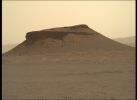
SOL0410-Mars_Perseverance_ZR0_0410_0703339797_332EBY_N0220000ZCAM03343_0340LMJ.pngSliced... - Sol 41081 visitenessun commentoMareKromium
|
|

SOL007.jpgDeflated Airbags and Spirit's nest - Sol 7 (Approximate True Colors; credits: NASA/JPL-Caltech)80 visite...Probabilmente ne deduciamo che l'atmosfera Marziana non è poi così polverosa come si dice e si teme. O almeno non lo è sempre. Forse lo è solo ai cambi di stagione: periodi durante i quali venti impetuosi spazzano il Pianeta - letteralmente - da cima a fondo e lo "nascondono" agli occhi indiscreti delle nostre videocamere.
O forse anche questa è un'impressione ingannevole e la "chiarezza" con cui vediamo l'orizzonte più prossimo dipende (soprattutto) dall'alta qualità degli "occhi" di Spirit...
|
|

N 159.jpgN 159 (Papillon Nebula in the Large Magellanic Cloud) - HST80 visite"...Egli creò per lei cascate fatte con la rugiada del mattino, e con i ciottoli colorati d'un greto tra i campi costruì una collana più bella che se fosse stata di smeraldi, più imponente d'un filo di perle. Ella lo afferrò nella sua rete di serici capelli, lo trascinò giù, giù in acque silenti e profonde, al di là dell'oblio. Egli le mostrò stelle di ghiaccio ed un sole fuso, come liquefatto; ella gli regalò lunghe ombre intrecciate e la musica dell'infinito..."
R. Sheckley - "Mindswap" - 1966
|
|

NGC-1818-01.jpgNGC 1818 - Globular Star Cluster80 visite"...Nullus dolor est quem non longiquitas temporis minuat ac molliat..."
(Cicerone)
"...Non v'è dolore che il Tempo non possa comunque attenuare ed addolcire..."
|
|

NGC_2264-2.jpgNGC 2264 - The "Cone Nebula"80 visite"...Una dies aperit, conficit una dies..."
(Ausonio)
"...In un istante si apre a noi la Vita, ed in un istante Essa a noi si chiude..."
|
|
| 25353 immagini su 2113 pagina(e) |
 |
|
|
|
|
780 | |
|
|
|
|
|
|





