| Piú viste |
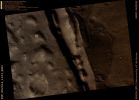
PSP_002014_1415_RED_abrowse-00.jpgTrough in Gorgonum Fossae (Absolute Natural Colors; credits for the additional process. and color.: Dr Paolo C. Fienga - Lunexit Team)81 visitePSP_002014_1415 shows Gullies in a Trough that is near Gorgonum Chaos, a Region filled with Gullies.
The Trough Gullies, like many of the Gullies on nearby Gorgonum Chaos' Mesas, appear to originate at a distinct Layer. There are Mounds within the Trough that have Layers exposed near their Peaks. The Layers in the Mound and on the Trough Walls are resistant, meaning they do not break up mostly into small particles that the wind can easily carry away.
Instead, they are breaking up into Boulders up to several meters wide that HiRISE can see (the fact that the Layers are eroding as boulders tells us that the material is not easily broken up into smaller and smaller pieces, so it is therefore termed "resistant to erosion").
However, it is not completely resistant to erosion as we can see by the Boulders rolling down the Slopes.
Gullies are thought by many to require liquid water to form and a major debate is whether this water comes from the surface (i.e., melting surface ice or melting snow) or the subsurface (i.e., from an aquifer).
Gullies are often found to originate at layers, like those seen here.
The subsurface water theory states that water travels under the surface to slope faces where it flows down the slope to form gullies. Visible layers are suggested to be impermeable, such that water cannot penetrate them, which is why the gullies originate from beneath the layers.
Often Gullies will originate between Layers, which suggests that there is a permeable Layer trapped between impermeable Layers.
It is also possible that the Layer preferentially traps ice or snow that may melt to form Gullies, thus providing a surface source of water to form the Gullies.
Please note that the stripe-like features on the lower side of the image are camera artifacts and not real features.MareKromium
|
|

ZI-Viking1-21g132-2-MF-LXTT.jpgAnother "Brick" in the Wall... (CTX Frame 2 - credits for the additional process.: Dr Marco Faccin - Lunexit Team)81 visitenessun commentoMareKromium
|
|

The_Sun-489332main_euvfilament-20101016-1.jpgIntense Solar Activity on the Sun: Sunspot 1112 and Solar Flares81 visiteOn Saturday, October 16, 2010, NASA’s Solar Dynamics Observatory captured this stunning image of one of the most intense, Solar Flares seen in the past few months. So far there have been no reports of energetic particles from this M-class Flare interfering with NASA Spacecraft or making their way to Earth.MareKromium
|
|

False_Impression.jpgFalse Impression (by Dr Gianluigi Barca)81 visitenessun commentoMareKromium
|
|
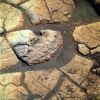
OPP-SOL2401-EB-TrueColors1.jpgThe always beautiful Martian Paving - Sol 2401 (True Colors; credits for the additional process. and color.: Elisabetta Bonora - Lunexit Team)81 visitenessun commentoMareKromium
|
|

ESP_019521_1750_RED_abrowse-PCF-LXTT.jpgCandor Chasma (Natural Colors; credits for the additional process. and color.: Dr Paolo C. Fienga - Lunexit Team)81 visitenessun commentoMareKromium
|
|

ESP_019669_2450_RED_abrowse.jpgMega-Polygons in Vastitas Borealis (Absolute Natural Colors; credits for the additional process. and color.: Dr Paolo C. Fienga - Lunexit Team)81 visitenessun commentoMareKromium
|
|

PSP_002932_1445_RED_abrowse-01.jpgSection of the Outer Rim of Hale Crater (EDM - Absolute Natural Colors; credits for the additional process. and color.: Dr Paolo C. Fienga - Lunexit Team)81 visitenessun commentoMareKromium
|
|
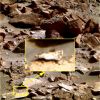
OPP-SOL2161-GB-IT-LXXT3.jpgExtremely unusually-looking Surface Feature: The "Shard" (CTX Frame - credits for the additional process. and color.: Ivana Tognoloni - Lunexit Team)81 visitenessun commentoMareKromium
|
|
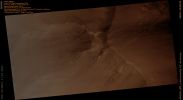
PSP_004805_1710_RED_abrowse.jpgOn the Edge of Ganges Chasma (Absolute Natural Colors; credits for the additional process. and color.: Dr Paolo C. Fienga - Lunexit Team)81 visiteThe Troughs and Chasms of the Valles Marineris Canyon System contain Light-Toned Deposits of enigmatic origin. The light materials, often layered, have variously been proposed to be Volcanic Ash or Sediments laid down by Rivers, Lakes or Sand Dunes.
One aspect of the Light-Toned material that has remained unclear is the timing of its deposition relative to canyon formation - was the material deposited in the Troughs, or does it crop out in the Walls, indicating that it existed before the Valles Marineris Canyon System formed?
This HiRISE image shows a part of the wall of Ganges Chasma. (This image, taken during the major Dust Storms which have raged through the summer of 2007, is grainy and low-contrast because of Dust in the Atmosphere). The Plateau above the Chasm is on the right side of the image, with the Wall of the Trough descending to the North. A few fine Layers, likely Basalt Flows, form the cap layers.
In the Spur, at the center of the image, light material appears to crop out, contrasting with the relatively dark material elsewhere in the Wall of the trough. At least some of this material is inherently lighter than other Wallrock; changes in tone occur at several sites where there are no breaks in Slope.
The light material appears be forming Spurs and Ridges similar to the surrounding rock, suggesting that it comprises at least some part of the Walls. However, darker, bouldery material occurs at the same level just to the West (up) of the light patch, indicating that the light outcrop may not extend very far.
Images like this provide clues to help unravel the history of deposition and deformation in Valles Marineris, and may eventually tell a complex story. In order to fully understand what this image means, several questions must be addressed: is this light material the same as intensively Layered Deposits observed elsewhere?
How extensive are light Wall Materials?
Are these materials conformable (part of a continuous sequence) with the rest of the Wall?
More HiRISE imaging will help address these questions. MareKromium
|
|
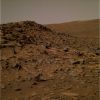
SOL2116-EB-LXTT-01.jpgRocky Landscape and "Open Mouth" Rock - Sol 2116 (CTX Frame - possible True Colors; credits for the additional process. and color.: Elisabetta Bonora - Lunexit Team)81 visitenessun commentoMareKromium
|
|

ESP_019595_1890_RED_abrowse-00.jpgDiverse Bedrock Exposures on the Floor of Nii Patera (Absolute Natural Colors; credits for the additional process. and color.: Dr Paolo C. Fienga - Lunexit Team)81 visitenessun commentoMareKromium
|
|
| 25353 immagini su 2113 pagina(e) |
 |
|
|
|
|
777 | |
|
|
|
|





