| Piú viste |

Abell_21.jpgAbell 21 - The "Medusa Nebula"81 visite"Vale. - Valete Omnes. - Vive Valeque."
"Stà bene. - State bene tutti. - Vivete e state bene."
(forme usuali di saluto, comuni in chiusura di lettere)MareKromium
|
|
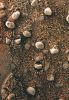
SOL1008-MIC-02.jpgPebbles in the "wet" (?) Martian Sand... - Sol 1008 (True Colors + MULTISPECTRUM; credits: Dr M. Faccin & Lunexit)81 visitenessun commentoMareKromium
|
|
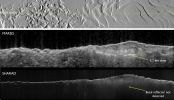
SHARAD-2.jpgUnder the Ice... (2)81 visiteTwo complementary Radar Sounder Instruments work together to discover hidden Martian secrets. They are the Mars Advanced Radar for Subsurface and Ionospheric Sounding (MARSIS) on the European Space Agency's Mars Express orbiter and the Shallow Subsurface Radar (SHARAD) on NASA's Mars Reconnaissance Orbiter.
MARSIS was designed to penetrate deep and it has delivered on its promise. This figure shows the base of Mars' South Polar Layered Deposits at the deepest recorded point of 3,7 Km (2,3 miles).
In contrast, SHARAD was designed as a High-Resolution Radar for a maximum penetration of 1 Km (0,6 mile) has difficulty detecting the base of these layered deposits.
MARSIS was funded by NASA and the Italian Space Agency and developed by the University of Rome, Italy, in partnership with NASA's Jet Propulsion Laboratory, Pasadena, Calif. Italy provided the instrument's digital processing system and integrated the parts. The University of Iowa, Iowa City, built the transmitter for the instrument, JPL built the receiver and Astro Aerospace, Carpinteria, Calif., built the antenna. JPL is a division of the California Institute of Technology in Pasadena. Additional information about Mars Express is at www.esa.int/marsexpress.
SHARAD was provided by the Italian Space Agency (ASI). Its operations are led by the University of Rome and its data are analyzed by a joint U.S.-Italian science team. JPL, a division of the California Institute of Technology, Pasadena, manages the Mars Reconnaissance Orbiter for the NASA Science Mission Directorate, Washington.MareKromium
|
|
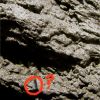
SOL633.jpgImage artifact or a "Martian Butterfly"? - Sol 633 (Superdefinition; credits: Dr G. Barca)81 visite...Forse si tratta solo di un image artifact derivato dal nostro processo di Superdefinizione...Ma va detto che il particolare è, quanto meno, intrigante!
E complimenti (GRANDI!) al Dr Barca!MareKromium
|
|

OPP-SOL661-1.jpgMars in 16:9: Martian Paving and Front Wheels - Sol 661 (processed by Dr M. Faccin + MULTISPECTRUM by Lunexit)81 visitenessun commentoMareKromium
|
|
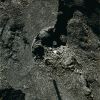
OPP-SOL026-1.jpgDo you see the "circle"? - Sol 26 (Superdefinition + MULTISPECTRUM; credits: Dr G. Barca & Lunexit)81 visitenessun commentoMareKromium
|
|

ZZ-Z-O-JC1-MERB_Traverse_Sol1487.jpgOpportunity Traverse Map, up to Sol 145781 visitenessun commentoMareKromium
|
|
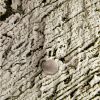
OPP-SOL142-1.jpgSeeing the Light! - Sol 142 (Superdefinition; credits: Dr G. Barca)81 visiteLa "capocchia" di un Fungo Marziano sta sbucando da una roccia stratificata e ricca, nei suoi interstizi, di "polveri" (o di "terriccio"?!?) verdastre...Vizio di processing (e dunque errore di Lunexit) o - e finalmente! - uno "sprazzo di Verità"?
Decidete Voi... Noi possiamo solo dire che il Lavoro del Dr Barca, anche in questo caso, è stato semplicemente fantastico!MareKromium
|
|
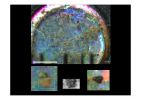
PHOE-SOL017-lg_4867.jpgParticles of Soil on Silicone - Sol 17 (1 - credits: NASA/Univ. of Arizona)81 visiteNew observations from NASA's Phoenix Mars Lander provide the most magnified view ever seen of Martian Soil, showing particles clumping together even at the smallest visible scale.
In the past two days, two instruments on the lander deck -- a microscope and a bake-and-sniff analyzer -- have begun inspecting soil samples delivered by the scoop on Phoenix's Robotic Arm.
"This is the first time since the Viking missions three decades ago that a sample is being studied inside an instrument on Mars," said Phoenix Principal Investigator Peter Smith of the University of Arizona, Tucson.
Stickiness of the soil at the Phoenix site has presented challenges for delivering samples, but also presents scientific opportunities. "Understanding the soil is a major goal of this mission and the soil is a bit different than we expected," Smith said. "There could be real discoveries to come as we analyze this soil with our various instruments. We have just the right instruments for the job".
Images from Phoenix's Optical Microscope show nearly 1,000 separate soil particles, down to sizes smaller than one-tenth the diameter of a human hair. At least four distinct minerals are seen.
"It's been more than 11 years since we had the idea to send a microscope to Mars and I'm absolutely gobsmacked that we're now looking at the soil of Mars at a resolution that has never been seen before," said Tom Pike of Imperial College London. He is a Phoenix co-investigator working on the lander's Microscopy, Electrochemistry and Conductivity Analyzer.
The sample includes some larger, black, glassy particles as well as smaller reddish ones. "We may be looking at a history of the soil," said Pike. "It appears that original particles of Volcanic Glass have weathered down to smaller particles with higher concentration of Iron".
The fine particles in the soil sample closely resemble particles of airborne dust examined earlier by the microscope.
Atmospheric dust at the Phoenix site has remained about the same day-to-day so far, said Phoenix co-investigator and atmospheric scientist Nilton Renno of the University of Michigan, Ann Arbor. MareKromium
|
|
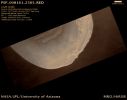
PSP_008161_2505_RED_abrowse.jpgLouth Crater (MULTISPECTRUM; credits: Lunexit)81 visitenessun commentoMareKromium
|
|
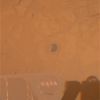
SOL1480-20080624_image1.jpgMonochrome Mars - Sol 1480 (natural colors; credits: NASA)81 visite...Ogni commento su questo frame in "colori naturali" (secondo la NASA) ci sembra del tutto superfluo...MareKromium
|
|
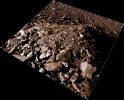
PHOE-SOL134-lg39407-39408-39409-3.jpgThe Little (Man-Made) Mound near Phoenix: perspective View - Sol 134 (Superdefinition and possible True Colors; credits: Dr G. Barca)81 visitenessun commentoMareKromium
|
|
| 25353 immagini su 2113 pagina(e) |
 |
|
|
|
|
773 | |
|
|
|
|





