| Piú viste |

SOL748-2N192766225ESFAO55P1928L0M1.jpgSmoke or tampering? - Sol 74881 visiteCerchiatura Verde: un dettaglio individuato per puro caso, ma grazie ad una notevole acutezza visiva. Si tratta di uno "sbuffo" di fumo nero, di un corpo in movimento rapidissimo e ripreso per puro caso oppure siamo - ancora una volta... - davanti ad una manipolazione digitale?
Impossibile dirlo, ma una cosa è certa: c'è qualcosa di strano, in questo frame...
Caption originale:"Left NavCam Non-linearized Sub-frame EDR acquired on Sol 748 of Spirit's mission to Gusev Crater at approx. 11:25:56 MLT".
|
|
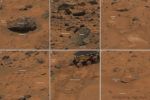
SOU-SOL035-1.jpgThe colors of the soil near Pathfinder81 visitenessun commento
|
|

OPP-SOL794-1N198675080EFF6900P0675R0M1.jpgMars Panorama, at one mile from Victoria... (5) - Sol 79481 visiteCerchiature Blu: da 1 a 3, piallature digitali o vere e proprie Anomalìe di Superficie"?
Appena percepibile la n. 1, la quale potrebbe anche essere il risultato di una pessima definizione del frame; netta la n. 2 - notate la pixellatura completamente incoerente rispetto al resto del frame; bizzarra la n. 3 (che è anche la più interessante): essa potrebbe essere il risultato della presenza di un qualcosa di "non sabbioso" sulla superficie del Pianeta - una curiosa macchia scura la quale, operando un notevole stretching dell'immagine, mostra caratteristiche tali da farci pensare alla presenza di una sostanza oleosa che si spande sulle sabbie circostanti.
Potrebbe trattarsi dell'affioramento di un liquido di un qualche genere?
|
|

SOL855-2N202268135EFFAS00P1986R0M1.jpgPanorama (3) - Sol 85581 visiteRettangolo Fucsia: photoartifact
Cerchiatura Verde: fossili o razor-blades?
|
|
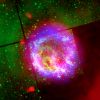
N76-PIA08516-1.jpgSupernova Remnant in N 76 Nebula81 visite"...Ed è l'Ingegno, simile a una barca
Che corre rischio uguale per naufragio,
E quando è vuota e quando è troppo carca..."
(Borsini - "Noviss. Galateo")
|
|

8-Venus_from_Venus_Express-VIRTIS_COB05_vis_397_b.jpgVenus, from Venus Express (natural colors)81 visiteCaption ESA originale:"Views of the Southern Hemisphere of Venus in visible and ultraviolet light show interesting atmospheric stripe-like structures.
Spotted for the first time by Mariner 10 in the 1970s, they may be due to the presence of dust and aerosols in the atmosphere, but their true nature is still unexplained. "Venus Express has the tools to investigate these structures in detail. Studies have already begun to dig into the properties of the complex wind fields on Venus, to understand the atmospheric dynamics on local and global scales".
Venus Express also made use for the first time ever from orbit of the so-called 'infrared windows' present in the atmosphere of Venus – if observed at certain wavelengths, it is possible to detect thermal radiation leaking from the deepest atmospheric layers, revealing what lies beneath the dense cloud curtain situated at about 60 Km altitude".
|
|

SOU-SOL015-marspath_yogi_rov.jpgYogi and Soujourner - Sol 1581 visiteCaption NASA originale:"The Soujourner Rover is taking its Alpha Proton X-Ray Spectrometer measurement.
It clearly shows the "two-toned" surface of this large rock.
The nature of this color difference is not known, however.
It might consist of wind-blown dust accumulated on the surface (the rock is leaning into the prevailing wind) or might be evidence of a break from a larger boulder as it was deposited in the ancient flood that scoured this area".
|
|

ZZ-ZZ-ZZ-ZZ-ZZ-ZZ-ZZ-ZZ-The Moon.jpgMare Imbrium, from Galileo81 visiteCaption NASA originale:"Checking out the Galileo spacecraft's cameras during its December 1992 fly-by of Earth's Moon, controllers took this dramatically illuminated picture through a violet filter. The view looks down on the Moon's North Polar Region with the Sun shining from the left at a low angle and the direction toward the Moon's North Pole toward the lower right.
Across the image upper left stretches the smooth volcanic plain of the Mare Imbrium. Pythagoras crater, 65 miles wide, is near the center of the image -- mostly in shadow, its central peak just catches the sunlight (...)".
|
|

QB-VikingOne-PIA08616-01.jpgViking One: the Landing Site, 30 years after the landing... (2)81 visiteCaption NASA originale:"The suite of pictures shown here describes the best MOC view of the Landing Site. These were previously released in May 2005, but the MOC team felt that 20 July 2006 is an appropriate time to review this story.
The 1st figure (1) visually tells how the Lander was found. The initial observations of the location of Viking 1, as originally determined by members of the Viking science team based on sightlines to various crater rims seen in the Lander images (black lines), did not show the detailed features we knew from the Lander pictures (2) to be in the area.
Using geodetic measurements, the late Merton Davies of the RAND Corporation, a MGS-MOC Co-Investigator, suggested that we should image areas to the East and North of where Viking 1 was thought to be. Timothy J. Parker of the JPL (Pasadena, California), using sightlines to crater rims seen in the Lander images (white lines), deduced a location very close to that suggested by Davies".
|
|
In the Mind-1.jpgIn the mind81 visitenessun commento
|
|
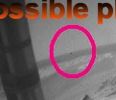
OPP-SOL898-1F207903990EFF74ZTP1151R0M1-B.jpgAlien "Probe" or photoartifact? (detail mgnf) - Sol 89881 visitenessun commento
|
|
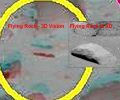
SOL391-D-site_AA3_navcam_180_cyp_A-A391R1-D.jpg3D or not 3D? That is the question... (4) - Sol 39181 visiteE' anche evidente - e lo si può riscontrare esaminando il 3D originale e ad HR - l'esistenza di cuciture (seam) approssimative tra i vari pezzi che poi formano l'immagine di partenza e si vede pure - diremmo come sempre - qualche "taglio tattico" (tampering), ma la sostanza non muta: una roccia infossata in 2D è diventata una roccia "volante" in 3D.
Conclusioni: non sono le immagini (a 2 o 3 o "n" dimensioni) a fare la differenza (!), ma gli occhi (più o meno allenati, attenti e pragmatici) di colui o coloro che queste immagini le guardano, le studiano, le analizzano, le scompongono e ricompongono e così via.
La "vista" è un senso ingannevole: l'Amico Feltri ha ragione; ma se gli occhi possono ingannare (come, di fatto, ingannano), noi riteniamo che l'esperienza e l'attenzione dei Ricercatori sono ampiamente in grado di supplire alle deficienze di questo nobile e meraviglioso "senso".
Per qualcuno sarà più facile supplire usando immagini in 3D; per qualche altro, invece, sarà meglio usare frames bidimensionali: non c'è un "Best Method". C'è solo la capacità, la competenza, l'esperienza e, su tutto, la prudenza di chi studia e poi propone i risultati del proprio lavoro agli altri.
Naturalmente con tutto il rispetto per i Cultori del 3D, da Alessio Feltri, a Mars Unearthed...
|
|
| 25353 immagini su 2113 pagina(e) |
 |
|
|
|
|
770 | |
|
|
|
|





