| Piú viste |

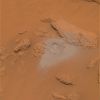
Craters-Unnamed_Crater_in_Noachis_Terra-PIA07202_modest.jpgUnnamed Crater in Noachis Terra (Original NASA/MGS/MSSS b/w Frame)82 visiteCaption NASA originale: "This Mars Global Surveyor (MGS) Mars Orbiter Camera (MOC) image shows an impact crater, a little over 2 Km (> 1,2 mi) in diameter, located in Noachis Terra near 50.4°S, 14.3°W. The crater's bouldery ejecta blanket has protected underlying material from being eroded away by wind, leaving the ejecta up on a low pedestal. This picture covers an area about 3 km (1.9 mi) across, and is illuminated by sunlight from the upper left".
|
|

Craters-Lomonosov_Crater.jpgLomonosov Crater in Wintertime82 visiteCaption NASA originale:"On April 20, 2000 (Wintertime on Mars), the Mars Orbiter Camera (MOC) onboard Mars Global Surveyor (MGS) captured this view of a chilly Lomonosov Crater. The rims of the crater appear white because they are covered with wintertime frost. A dark patch just right of center on the crater floor is a sand dune field. Both low-lying ground fogs (fuzzy, patchy areas around the lower perimeter of the crater) and higher cloud layers (fuzzy white arcs seen within the crater and towards the upper right) obscure much of the surface. The Sun, only 12° above the horizon, bathes the scene in a reddish-brown hue. Lomonosov Crater is about 150 Km (93 mi) across and located on the martian northern plains at 64.8° N, 8.8° W. The crater is named for the 18th Century Russian chemist, Mikhail V. Lomonosov (1711-1765)".
|
|

Craters-Pollack_Crater-01.jpgThe "White Rock" inside Pollack Crater82 visiteCaption NASA originale:"The layering in White Rock suggests that the material is sediment deposited at some time in the distant past within Pollack Crater. The fact that the material erodes to form steep cliffs suggests that it is hard like rock. Thus, White Rock is interpreted to be an outcrop of sedimentary rock. It is probably a small remnant of a larger body of rock that may have once covered the entire floor of Pollack Crater; this view is supported by the observation that more extensive layered rocks are seen in other craters across the surface of the Red Planet (e.g., the crater at 8°N, 7°W)".
|
|

SOL358-2N158150223EFFA273P0645L0M1.jpgTracks... (2)82 visitenessun commento
|
|

B-Mercury-PIA02240.jpgThe components of the surface of Mercury82 visiteCaption NASA originale:"Updated calibration and subsequent mosaicing have led to substantial improvements in the Mariner 10 color image data. This color composite was formed to especially highlight differences in opaque minerals (such as Ilmenite), Iron content and soil maturity.
K - Crater Kuiper shows color consistent with fresh material excavated from a subsurface unit that may have an "unusual" composition;
D - relatively dark and blue unit consistent with enhanced Titanium content;
B - bright red unit that may represent primitive crustal material
F - color unit that follows plains boundaries, interpreted as lava flows".
|
|

SOL059-061-Spirit_Legacy_1-L256-A392R1_br2-03.jpgLegacy Panorama - Soles 59 to 61 (Approximate True Colors; credits: NASA/JPL-Caltech)82 visiteC'è anche un'altra possibilità e, per amore della chiarezza e dell'onestà intellettuale, la (ri)menzioniamo: può darsi che Marte CAMBI radicalmente i propri colori a seconda delle ore del giorno e che quindi, fotograficamente, il suo paesaggio si manifesti in maniera profondamente diversa (dal punto di vista del colore) a seconda che le immagini vengano scattate la mattina presto, di pomeriggio o verso sera. Se ricordate, ne avevamo già parlato di questa eventualità, ma le differenze che si vedono tra una foto e l'altra (e che vanno dal "colore di fondo", alla "consistenza" ed alla "densità cromatica" etc.) a noi appaiono troppo grandi per trovare la loro comune origine in una semplice (e tecnicamente correggibile!) "differenza di luminosità". E poi non dimentichiamo le immagini a "colori veri" e "quasi veri" dei Viking Landers e del Soujourner! Insomma: troppe contraddizioni ed incongruenze per non pensare che le idee sìano confuse (se volontariamente o di proposito lo lasciamo giudicare a Voi!)
|
|
SOL381.jpgAnother hole in the wall... - Sol 381 (Natural Colors; credits: NASA/JPL-Caltech)82 visiteCaption NASA originale:"NASA's Mars Exploration Rover Spirit has been analyzing sulfur-rich rocks and surface materials in the "Columbia Hills" in Gusaev Crater on Mars. This image of a very soft, nodular, layered rock nicknamed "Peace" in honor of Martin Luther King Jr. shows a 4.5-cm-wide (1.8-inch-wide) hole Spirit ground into the surface with the rover's rock abrasion tool. The high sulfur content of the rock measured by Spirit's alpha particle X-ray spectrometer and its softness measured by the abrasion tool are probably evidence of past alteration by water. Spirit's panoramic camera took this image on Sol 381 (such as Jan. 27, 2005). The image represents the PanCam team's best current attempt at generating a true color view of what this scene would look like if viewed by a human on Mars. The image was generated from a combination of six calibrated, left-eye PanCam images acquired through filters ranging from 430 to 750-nnmt wavelengths".
|
|

ZZ-Sun Halo.jpgA Sun "Halo" in Tennessee82 visiteDal "NASA - Picture of the Day" del 9 Marzo 2005:"Sometimes it looks like the Sun is being viewed through a large lens. In the above case there are actually millions of lenses: ice crystals. As water freezes in the upper atmosphere, small, flat, six-sided, ice crystals might be formed. As these crystals flutter down, much time is spent with their faces flat, parallel to the ground. An observer may pass through the same plane as many of the falling ice crystals near sunrise or sunset. During this alignment, each crystal can act like a miniature lens, refracting sunlight into our view. Dramatically visible behind neighborhood houses and trees and above the cloud deck is the 22° halo created by sunlight reflecting off of atmospheric ice crystals".
L'alone è spiegato in modo preciso ed accurato, ma esso non è l'unico fenomeno visibile in questa foto: alla Vostra Sx si vedono - e bene! - 2 scie chimiche. E quelle come le spieghiamo? Vapori e cristalli?!?
|
|

CygnusX1.jpgCygnus X-1 and Cygnus OB382 visiteDa "NASA - Picture of the Day" del 2 Aprile 2005:"The formation of a Black Hole from the collapsing core of a massive star is thought to be heralded by a spectacular supernova explosion. Such an extremely energetic collapse is also a leading explanation for the mysterious cosmic Gamma-Ray bursts. But Researchers now suggest that the Milky Way's most famous black hole, Cyg X-1, was born when a massive star collapsed without any supernova explosion at all. Their dynamical evidence is summarized in this color image of a region in Cygnus, showing Cyg X-1 and a cluster of massive stars (yellow circles) known as Cygnus OB3. Arrows compare the measured direction and speed of Cyg X-1 and the average direction and speed of the massive stars of Cyg OB3. The similar motions indicate that Cyg X-1's progenitor star was itself a cluster member and that its path was not altered at all when it became a Black Hole. In contrast, if Cyg X-1 were born in a violent supernova it would have likely received a fierce kick, changing its course. If not a supernova, could the formation of the Cyg X-1 black hole have produced a dark gamma-ray burst in the Milky Way? ".
|
|

OPP-SOL058-xpe_pubeng_approved_032204_outside_eagle-B058R1.jpgOutside Eagle Crater: small Side-Winders, back-shell & parachute - Sol 5882 visiteCaption NASA originale:"This image from Opportunity is part of the first set of pictures that was returned to Earth after the Rover exited Eagle Crater. Scientists are busy analyzing Opportunity's new view of the plains of Meridiani Planum. The plentiful ripples are a clear indication that wind is the primary geologic process currently in effect on the plains. On the left of the image are two depressions - each about 1 mt across - that feature bright spots in their centers. One possibility is that the bright material is similar in composition to the rocks in Eagle Crater's outcrop and the surrounding darker material is what's referred to as "lag deposit," or erosional remnants that are much harder and more difficult to wear away".
Nota: alcuni Ricercatori hanno pensato che quelle 2 depressioni con 'qualcosa' che emerge dal loro centro sìano due affioramenti di acqua. La NASA, al riguardo, oltre a quello che avete letto nella "Caption", non ha - per quanto ne sappiamo - mai aggiunto altro.
|
|

SOL516-2N172172864EFFABAKP0715R0M1.jpgMore anomalous rocks around Spirit (2) - Sol 51682 visiteScusateci per la 'cerchiatura' in rosso, ma la piccola Singolarità che abbiamo notato è davvero difficile da indicare senza circoscrivere una porzione del paesaggio. Portate il frame sino a full-size e poi guardate nel cerchio rosso: c'è una specie di 'ponte' che unisce le due rocce? E' una struttura in formazione? Un difetto dell'immagine o una cancellatura venuta male?
Noi sappiamo e vediamo che c'è 'qualcosa' fra le due rocce.
Ma cosa?
|
|

Chasmas-Melas_Chasma-04.jpgSample scarp edge in layered unit in Melas Chasma or... Frozen Waterfalls on Mars? (4)82 visiteAvete mai visitato le Grotte di Postumia o le Carlsbad Caverns?
Se non ci siete mai stati, Vi suggeriamo di andarne a vedere almeno una (le Grotte di Postumia sono vicine, in Slovenia, a poco più di un'ora di macchina dal confine); se la risposta è 'si', invece, allora siamo certi che non Vi sarà sfuggita la somiglianza fra queste enormi strutture che vengono riprese dalla Sonda MGS (e che Vi proponiamo - debitamente ingrandite - in questo frame e nei due successivi) e le grandi 'colonne' che ricoprono una buona parte delle pareti delle due splendide grotte che abbiamo prima menzionato. Il lento sgocciolare di un'acqua ricchissima di minerali ed il tempo, nel caso di Postumia e di Carlsbad, ha creato una versione 'in miniatura' di quello che vediamo in questi frames MGS.
Si tratta, come suggerisce il Dr Skipper, di 'cascate ghiacciate'? Noi ne dubitiamo, sinceramente, ma che si tratti di rilievi i quali meritano una grandissima attenzione, a noi sembra un dato evidente.
|
|
| 25353 immagini su 2113 pagina(e) |
 |
|
|
|
|
756 | |
|
|
|
|





