| |
| Piú viste |

Titan-N00188978-86-MF-EB-LXTT-IPF-1.jpgPossible Aurora at Titan (Superdefinition; credits for the additional process. and color.: Elisabetta Bonora and Marco Faccin/Lunexit Team)83 visitenessun commentoMareKromium
|
|

Titan-W00074172-79-CB3Filter-MF-EB-LXTT-IPF.jpgFull Titan (Superdefinition and Enhanced Natural Colors; credits for the additional process. and color.: Elisabetta Bonora and Marco Faccin/Lunexit Team)83 visitenessun commentoMareKromium
|
|

SOL0001-673758main_PIA15974-43_full.jpgLinearized Rear-View - Sol 1 (RAW Absolute Natural Colors; credits for the additional process. and color.: Dr Paolo C. Fienga - Lunexit Team)83 visiteCaption NASA:"This is a version of one of the first images taken by a Rear Hazard-Avoidance Camera (HazCam) on NASA's Curiosity Rover, which landed on Mars the evening of Aug. 5 PDT (morning of Aug. 6 EDT), 2012. It was taken through a "fisheye" wide-angle lens but has been "linearized" so that the Horizon looks flat rather than curved. The image has also been cropped. It is one-half of full resolution. Part of the Rim of Gale Crater, which is a feature the size of Connecticut and Rhode Island combined, stretches from the top middle to the top right of the image. One of the Rover's Wheels can be seen at bottom right. As planned, the Rover's early engineering images are taken at Low Resolution". MareKromium
|
|

The_Rings-PIA08306-PCF-LXTT-IPF.jpgThe beautiful and colorful Rings of Saturn (Absolute Natural Colors; credits for the additional process. and color.: Dr Paolo C. Fienga - Lunar Explorer Italia/Italian Planetary Foundation) 83 visiteThis is a spectacular view - obtained by the NASA - Cassini Spacecraft - that shows us the subtle golden and gray/whitish colors which characterize the Outer B-Ring, the Cassini Division and the inner part of the A-Ring of the Giant Gas-Planet Saturn. In this viewing geometry, the brightest feature in the Cassini Division is the (relatively) recently discovered diffuse Ringlet which lies near the Outer Edge of the Division (and this diffuse Ringlet shows a quite peculiar bluish cast). The colors of the Rings, as they look in this picture, appear more golden than ever because of the Viewing Geometry that was adopted: as a matter of fact, an increased scattering in the ice and rock particles forming the Rings was brought about not only by the high Phase Angle (such as the angle drawn and defined by the Sun, the Rings and the NASA - Cassini Spacecraft), but also by the circumstance that this view was obtained while the Spacecraft was watching towards the Unlit Side of the Rings, from about 30° above the Ring-Plane. The images used to create this frame were acquired by the NASA - Cassini Spacecraft narrow-angle camera on Sept. 29, 2006, at a distance of approx. 1,8 MKM (about 1,13 MMs) from the Rings of Saturn and the image scale is roughly 11 Km (such as about 7 miles) per pixel.
Remember that the NASA - CASSINI Original b/w frame has been additionally processed and then re-colorized, according to an informed speculation carried out by Dr Paolo C. Fienga (LXTT-IPF), in Absolute Natural Colors (such as the colors that a human eye would actually perceive if someone were onboard the NASA - Cassini Spacecraft and then looked outside, towards the Rings of Satun), by using an original technique created - and, in time, dramatically improved - by the Lunar Explorer Italia Team. Different colors, as well as different shades of the same color, mean, among others, the existence of different Elements in the Rings of Satun, each having a different Albedo (---> Reflectivity) and Chemical Composition.MareKromium
|
|

ZZ-Mercury-Craters-Rustaveli_Crater-PIA16359-PCF-LXTT-IPF.jpgRustaveli Crater (Absolute Natural Colors; credits for the additional process. and color.: Dr Paolo C. Fienga/Lunar Explorer Italia/Italian Planetary Foundation)83 visiteThis Absolute Natural Color Image-Mosaic shows the Rustaveli Crater, a newly named Impact Basin located in the Northern Hemisphere of Mercury. The Basin has a smooth, filled Floor with little weathering and a Peak-ring Structure. Shota Rustaveli was a Georgian poet who lived from 1172-1216. He is well known for writing the Georgian National Epic Poem, "The Knight in the Panther's Skin". He is also the namesake of the coveted Shota Rustaveli State Prize, the highest honor a Georgian artist or writer can achieve.
Date acquired: July 18, 2011
Image Mission Elapsed Time (MET): 219478808, 219478804, 219478800
Image ID: 519956, 519955, 519954
Instrument: Wide Angle Camera (WAC) of the Mercury Dual Imaging System (MDIS)
WAC filters: 9, 7, 6 (996, 748, 433 nanometers) in red, green, and blue
Center Latitude: 52,40° North
Center Longitude: 81,79° East
Resolution: 187 meters/pixel
Scale: the diameter of Rustaveli basin is roughly 180 Km (such as approx. 112 miles).
Solar Incidence Angle: 59,8° (meaning that the Sun was about 30,2° above the imaged Local Horizon at the time that the picturs were taken)
Emission Angle: 30,6°
Sun-Mercury-MESSENGER (or "Phase") Angle: 90,4°MareKromium
|
|

Titan-PIA14634-PCF-LXTT-IPF.jpgSeasonal or Permanent? (Absolute Natural Colors; credits for the additional process. and color.: Dr Gianluigi Barca/Lunar Explorer Italia/Italian Planetary Foundation)83 visiteEven though it is still nighttime at the South Pole, the Vortex, which swirls high in the Sky of Titan, is already illuminated by the Sunlight and stands out (relatively) brightly against the other - and possible Water-Ice - Clouds that can be seen to the left of the Terminator (still near the South Polar Regions of Titan, but on the daytime side of this complex and fascinating Saturnian moon). The NASA - Cassini Spacecraft, as you have noticed, keeps monitoring very carefully the development of this South Polar Vortex (a true Titanian Oddity anyway), so to help Scientists and Researchers from all over the World to better understand the (perhaps just) seasonal changes that occur in the Atmosphere of Titan.
This outstanding view looks toward the Trailing Hemisphere of Titan; North is up and rotated 9° to the left. The image was taken with the NASA - Cassini Spacecraft Narrow-Angle Camera on Aug. 31, 2012, using a Spectral Filter sensitive to Wavelengths of Near-InfraRed Light, centered at 938 nanometers. The view was acquired at a distance of approximately 750.000 miles (such as about 1,2 Million KiloMeters - MKM) from Titan and at a Sun-Titan-Spacecraft, or Phase, Angle of 74°. Image scale is about 4 miles (such as approx. 6,4 Km) per pixel.
This picture (which is an Original NASA - Cassini Spacecraft b/w frame published on the NASA - Planetary Photojournal with the ID n. PIA 14634) has been additionally processed and then colorized, according to an informed speculation carried out by Dr Paolo C. Fienga (LXTT-IPF), in Absolute Natural Colors (such as the colors that a human eye would actually perceive if someone were onboard the NASA - Cassini Spacecraft and then looked outside, towards the Saturnian moon Titan), by using an original technique created - and, in time, dramatically improved - by the Lunar Explorer Italia Team. Different colors, as well as different shades of the same color, mean, among others, the existence of different Elements present in the Atmosphere of Titan, each having a different Albedo (---> Reflectivity) and Chemical Composition.MareKromium
|
|

ZZ-Mercury-Craters-Geddes_Crater-PIA16302-PCF-LXTT-IPF-2.jpgCollapse Pit inside Geddes Crater (Absolute Natural Colors; credits for the additional process. and color.: Dr Paolo C. Fienga/Lunar Explorer Italia/Italian Planetary Foundation)83 visiteGeddes Crater (so named, in March 2010, in honor of Wilhelmina Geddes (1887 - 1955), an Irish stained glass and graphic artist) is well known to be a Mercurian extremely geologically interesting Impact Feature. As you know, the Ridge of Antoniadi Dorsum bisects the Crater, and in the center of the Crater's Floor there is a large Depression with a distinctive orangish hue: a color similar to the one seen in other areas (still on Mercury and elsewhere in the Solar System, such as, for instance, on our Moon) which are (better yet: were) associated with Explosive Volcanism or other phenomena of (perhaps Sulphurous-rich) Outgassing. This recently acquired image reveals new, High-Resolution detail of such a potentially Volcanic Depression (---> a Volcanic - in origin - Collapse Pit, to be more specific, which might have formed as a consequenc of the progressive withdrawal of Subsurface Magma), including the presence of many Hollows (a Surface Feature that, as we know now, is extremely common and that can be found all over the Surface of Mercury and which do not seem to be only related, in our opinion, as IPF, to the verification of Impact Events).
Date acquired: October, 11th, 2012
Image Mission Elapsed Time (MET): 258458455
Image ID: 2745982
Instrument: Narrow Angle Camera (NAC) of the Mercury Dual Imaging System (MDIS)
Center Latitude: 27,15° North
Center Longitude: 330,4° East
Resolution: 28 meters/pixel
Solar Incidence Angle: 74,1° (meaning that the Sun, at the time that the picture was taken, was about 15,9° above the imaged Local Mercurian Horizon)
Emission Angle: 33,2°
Sun-Mercury-Messenger (or "Phase") Angle: 107,3°
This picture (which is an Original NASA - MESSENGER Spacecraft b/w frame published on the NASA - Planetary Photojournal with the ID n. PIA 16302) has been additionally processed and then colorized in Absolute Natural Colors (such as the colors that a human eye would actually perceive if someone were onboard the NASA - MESSENGER Spacecraft and then looked down, towards the Surface of Mercury), by using an original technique created - and, in time, dramatically improved - by the Lunar Explorer Italia Team. Different colors, as well as different shades of the same color, mean, among other things, the existence of different Elements (Minerals) present on the Surface of Mercury, each having a different Albedo (---> Reflectivity) and Chemical Composition.MareKromium
|
|

Saturn-North_Pole-Vortex-Cassini-EB-MF-LXTT-IPF.gifPeering into the Storm (a GIF-Movie by Elisabetta Bonora and Marco Faccin/Lunar Explorer Italia/Italian Planetary Foundation)83 visite...Splendido e Affascinante...MareKromium
|
|
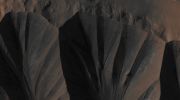
Gullies-ESP_020661_1440-PCF-LXTT-IPF.jpgGullies in Gasa Crater (Absolute Natural Colors; credits for the additional process. and color.: Dr Paolo C. Fienga/Lunar Explorer Italia/Italian Planetary Foundation)83 visiteThe so-called "Gully Landforms" - just like the ones shown here, in this NASA - Mars Reconnaissance Orbiter image - can often be found in the Inner Rims (or even below, along the Inner Slopes) of many Impact Craters that are located at the Martian Mid-Latitudes. Some changes in these Gully Landforms were first seen in frames taken by the NASA - Mars Global Surveyor - Mars Orbiter Camera (MGS-MOC) in the AD 2006, and studying such activity has been a high priority for HiRISE ever since (and, in fact, many examples of New Deposits located inside Gully Landforms are now well known).
This frame shows a New Deposit inside some Gully Landforms located on the Inner Rim of Gasa Crater; a very (relatively speaking) "fresh" approx. 7-Km diameter Impact Crater that is found in the Southern Mid-Latitudes of the Red Planet (to be precise, at 35,72° South Latitude and 129.45° East Longitude). Said New Deposit appears of a distinctive gray color, with some patches of white Material too, in this Absolute Natural Color version of the NASA - Mars Reconnaissance Orbiter image n. ESP_020661_1440. The picture was acquired during the Southern Spring of Mars, but the Flow that formed the Deposit occurred in the preceding Winter.
As a matter of fact, the current Gully Activities appear to be concentrated in periods going from the late Winter to the early Spring of Mars, and this circumstance may be a consequence of the Sublimation of the Seasonal Carbon Dioxide (CO2) Frost (which, by the way, is well visible in several Gully "Alcoves" during Wintertime).
Mars Local Time: 15:49 (Middle Afternoon)
Coord. (centered): 35,729° North Lat. and 129,386° East Long.
Spacecraft altitude: 258,2 Km (such as about 160,3 miles)
Original image scale range: 25,8 cm/pixel (with 1 x 1 binning) so objects ~ 78 cm across are resolved
Map projected scale: 25 cm/pixel
Map projection: EQUIRECTANGULAR
Emission Angle: 11,0°
Sun-Mars-Spacecraft (or Phase) Angle: 47,6°
Solar Incidence Angle: 58° (meaning that the Sun was about 32° above the Local Horizon at the time the picture was taken)
Solar Longitude: 203,7° (Northern Fall - Southern Spring)
Credits: NASA/JPL/University of Arizona
Additional process. and coloring: Lunar Explorer Italia
This picture (which is an Original Mars Reconnaissance Orbiter EDM enhanced color frame, identified by the serial n. ESP_020661_1440) has been additionally processed and then re-colorized in Absolute Natural Colors (such as the colors that a human eye would actually perceive if someone were onboard the NASA - Mars Reconnaissance Orbiter and then looked down, towards the Surface of Mars), by using an original technique created - and, in time, dramatically improved - by the Lunar Explorer Italia Team.MareKromium
|
|

Dione_and_Mimas-PIA14619-PCF-LXTT-IPF-1.jpgSo close, and yet so far... (Absolute Natural Colors; credits for the additional process. and color.: Dr Paolo C. Fienga/Lunar Explorer Italia/Italian Planetary Foundation)83 visiteThe Saturnian moon Mimas peeps out from behind the larger moon Dione in this suggestive view of a so-called "Mutual Event" as it was seen from and recorded by the NASA - Cassini Spacecraft. Mimas (which is approx. 246 miles - such as a little less than 396 Km - across) is near the bottom center of the image. This view looks toward the anti-Saturn side of Dione (which is about 698 miles - such as approx 1123,3 Km - across). North on Dione is up and rotated 20° to the right.
The image was taken in Visible Light with the NASA - Cassini Spacecraft Narrow-Angle Camera on December 12, 2011, at a distance of approximately 377.000 miles (such as about 606.721 Km) from Mimas and approximately 56.000 miles (such as a little more than 90.000 Km) from Dione, at a Sun-Dione-Cassini Spacecraft , or Phase, Angle of 42°. Image scale is 1773 feet (such as about 540,41 meters) per pixel on Dione.
This frame (which is a crop from an Original NASA - Cassini Spacecraft b/w image published on the NASA - Planetary Photojournal with the ID n. PIA 14619) has been additionally processed and then colorized in Absolute Natural Colors (such as the colors that a human eye would actually perceive if someone were onboard the NASA - Cassini Spacecraft and then looked outside, towards the Saturnian moons Dione and Mimas), by using an original technique created - and, in time, dramatically improved - by the Lunar Explorer Italia Team. Different colors, as well as different shades of the same color, mean, among others, the existence of different Elements present on the Surface of Dione and Mimas, each having a different Albedo (---> Reflectivity) and Chemical Composition.MareKromium
|
|

Titan-PIA17151-PCF-LXTT-IPF.jpgTitanian Restlessness (Absolute Natural Colors; credits for the additional process. and color.: Dr Paolo C. Fienga/Lunar Explorer Italia/Italian Planetary Foundation)83 visiteTitan's restless Upper Atmosphere puts on a display with the "detached" Haze to the North (---> the so-called "North Polar Hood" - top of image) and the Polar Vortex to the South.
This view looks toward the Saturn-facing Hemisphere of Titan; North is up and rotated 24° to the left. The image was taken with the NASA - Cassini Spacecraft Narrow-Angle Camera on August 20, 2013 using a Spectral Filter sensitive to Wavelengths of Near-InfraRed Light centered at 889 nanometers. The view was obtained at a distance of approximately 1,6 Million Miles (such as a little less than 2,575 Million KiloMeters) from Titan; the image scale is roughly 9 miles (such as approx. 14,484 Km) per pixel.
This frame (which is an Original NASA - CASSINI Spacecraft's b/w and NON Map-Projected image published on the NASA - Planetary Photojournal with the ID n. PIA 17151) has been additionally processed, contrast enhanced, magnified to aid the visibility of the details, Gamma corrected and then colorized - according to an educated guess (or, if you wish, an informed speculation) carried out by Dr Paolo C. Fienga - in Absolute Natural Colors (such as the colors that a human eye would actually perceive if someone were onboard the NASA - Cassini Spacecraft and then looked outside, towards the Saturnian moon "Titan"), by using an original technique created - and, in time, dramatically improved - by the Lunar Explorer Italia Team. Different colors, as well as different shades of the same color, mean, among other things, the existence of different Elements (Gases) present in the Atmosphere of Titan, each having a different Albedo (---> Reflectivity) and Chemical Composition.
Note: it is possible (but we, as IPF, have no way to be one-hundred-percent sure of such a circumstance), that the actual luminosity of Titan - as it is in this frame - would appear, to an average human eye, a little bit lower than it has been shown (or, better yet: interpreted) here.MareKromium
|
|

SOL0528-PIA17931-PCF-LXTT-IPF-3.jpgBizarre-looking Rocks - Sol 528 (Absolute Natural Colors; credits for the additional process. and color. Dr Paolo C. Fienga/LXTT/IPF)83 visiteDue rocce decisamente curiose (specie quella posta alla Sx dell'Osservatore), le quali presentano una caratterizzazione superficiale assolutamente peculiare. Se Gale Crater, effettivamente ed in un'era remota, fu veramente un Lago, allora quello che si vede sulle due rocce potrebbe essere il residuo - fossile - di vegetazione sub-lacuale. E non solo! Sulla roccia di Sx, si vede NETTAMENTE l'esistenza di un foro il quale, come già ipotizzammo in passato - per un caso simile - potrebbe essere un Predatory Borehole.
Ovviamente la NASA, su questo ed altri rilievi similari, ha detto il solito. E cioè nulla. Voi che ne pensate?!?
p.s.: guardate la roccia "porosa", "irregolare" e "forata" a Dx ed osservate come essa sembra essere "parte integrante" della roccia stratificata sottostante. Sono tutt'uno? Sono l'una "appoggiata" all'altra? Si sono "incollate" nelle ere?.... Che ne dite?MareKromium
|
|
| 25353 immagini su 2113 pagina(e) |
 |
|
|
|
|
755 | |
|
|
|
|
|
|





