| Piú viste |

Cygnus_Region~0.jpgThe Cygnus Region83 visite"...Il Tempo è un Grande Maestro. Peccato che uccida tutti i suoi allievi..."
H. Berlioz
MareKromium
|
|

Mimas-PIA12739.jpgThe "Eye in the Sky"...83 visiteCaption NASA:"The Cassini Spacecraft turns the eye of its camera toward Saturn's moon Mimas and spies the large Herschel Crater which itself looks like the iris of an eye peering out into space.
Herschel Crater is about 130 Km (approx. 81 miles) wide and covers most of the right of this image. Scientists continue to study this Impact Basin and its surrounding Terrain (see also PIA12568). Lit Terrain seen here is on the Leading Hemisphere of Mimas. North on Mimas is up and rotated 1° to the left.
The image was taken in Visible Light with the Cassini Spacecraft narrow-angle camera on Oct. 16, 2010. The view was obtained at a distance of approx. 103.000 Km (such as about 64.000 miles) from Mimas and at a Sun-Mimas-Spacecraft, or Phase, Angle of 113°.
Image scale is roughly 613 meters (2011 feet) per pixel".MareKromium
|
|
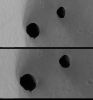
PSP_003317_1975_and_ESP_003317_1975-EB-LXTT-01.jpgThe "OO Pits" - Rimless Collapse Pits in Tharsis (High-Def-3D; credits for the additional process.: Elisabetta Bonora - Lunexit Team)83 visitenessun commentoMareKromium
|
|

OPP-SOL133-15-PCF-LXTT.jpgOn the Inner Slope of Endurance Crater - Sol 133 (Absolute Natural Colors; credits for the additional process. and color.: Dr Paolo C. Fienga - Lunexit Team)83 visitenessun commentoMareKromium
|
|

Tethys-PIA12802.jpgThe "Face" of Tethys (Absolute Natural Colors; credits for the additional process. and color.: Dr Paolo C. Fienga - Lunexit Team)83 visiteCaption NASA:"Geologic faults among craters on Saturn's moon Tethys are depicted in this image captured during a Fly-By of the moon by NASA's Cassini Spacecraft on Aug. 14, 2010.
The brightly illuminated, prominent Impact Crater near the bottom middle of this image has been dissected by numerous parallel Faults that run diagonally across the image. The presence of the Faults that cut through the Crater and the movement of Surface Materials have made the Crater outline somewhat non-circular.
Near the center of the image, running diagonally from the left to right, is an old Graben, such as a "Linear Depression of the Terrain between two Faults".
Below these Faults and near the middle top of the image is a large ancient Impact Crater that is so highly overprinted by more recent Craters that it can barely be recognized.
On the left of the image, there are some horizontal lines that can be seen very faintly cutting across Craters. These lines are artifacts of missing data in the raw image that could not be eliminated through processing the image.
This view looks toward the Leading Hemisphere of Tethys. The view is centered on terrain at 59° North Latitude and 79° West Longitude.
The image was taken in Visible Light with the Cassini Spacecraft narrow-angle camera. The view was acquired at a distance of approx. 40.000 Km (such as about 25.000 miles) from Tethys and at a Phase Angle of 103°. Image scale is roughly 234 meters (767 feet) per pixel".MareKromium
|
|

PSP_005514_1360_RED_abrowse.jpgDunes on Rabe Crater's Floor (Absolute Natural Colors; credits for the additional process. and color.: Dr Paolo C. Fienga - Lunexit Team)83 visitenessun commentoMareKromium
|
|

SOL304-2N153362576EFF89BCP0615L0M1.jpgHorizon - Sol 304 (Natural Colors; credits for the additional process. and color.: Dr Paolo C. Fienga - Lunexit Team)83 visitenessun commentoMareKromium
|
|
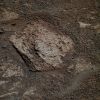
OPP-SOL2482-0-GB-LXTT.jpgBerries and Rocks - Sol 2482 (Natural Colors; credits for the additional process. and color.: Dr Gianluigi Barca - Lunexit Team)83 visitenessun commentoMareKromium
|
|
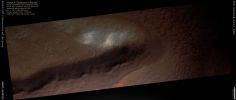
PSP_006648_2255_RED_abrowse-PCF-LXTT.jpgScarps in Deuteronilus Mensae (Absolute Natural Colors; credits for the additional process. and color.: Dr Paolo C. Fienga - Lunexit Team:)83 visiteThis image shows Scarps (such as "Steep Slopes") in Deuteronilus Mensae, a Region of distinctive Terrain in the Northern Hemisphere of Mars. Polygonal fractures, possibly formed by thermal cycles in ice-rich ground, are visible throughout the scene.
The high-standing topography at the top of the Scarps have several muted circles: these are Remnant Impact Craters that have degraded throughout time and their degradation process might have been enhanced by the presence of ground ice.
The two Scarps have different morphologies: the lower (East-facing) side has a Debris Apron with a wave-like texture at its base.
This is suggestive of material that has moved down the Scarp and gradually flowed away from it. Such a process would be expected if the material were ice-rich. There is no counterpart of this feature at the base of the upper (such as the West-facing) side.MareKromium
|
|
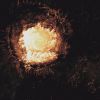
PSP_005370_1845_RED_abrowse-01.jpgExtremely unusually-looking Surface Feature in Sinus Meridiani (EDM - Absolute Natural Colors; credits for the additional process. and color.: Dr Paolo C. Fienga - Lunexit Team)83 visitenessun commentoMareKromium
|
|

PSP_005370_1845_RED_abrowse-00.jpgExtremely unusually-looking Surface Feature in Sinus Meridiani (CTX Frame - Absolute Natural Colors; credits for the additional process. and color.: Dr Paolo C. Fienga - Lunexit Team)83 visitenessun commentoMareKromium
|
|
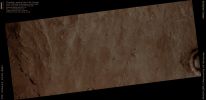
PSP_006633_2010_RED_abrowse~0.jpgPossible MSL Landing Site in Nili Fossae (Absolute Natural Colors; credits for the additional process. and color.: Dr Paolo C. Fienga - Lunexit Team) 83 visiteThe Nili Fossae are Valleys that have cut into the ancient crust of Mars, exposing Clay Minerals. These minerals formed in the presence of water and may be the result of chemical reactions between hot water and rocks. If so, this could have been a favorable location for Martian Life in ancient times.
This HiRISE image is part of a series in search for a safe place the Mars Science Laboratory Rover can land. In the central part of the image, the Terrain is a mix of Sand Dunes and relatively smooth rock exposures. There are some small Knobs but very few large rocks in the area. Instead, the multi-colored rock exposures seem to be mostly a mosaic of flat fractured rock.
On the Southern edge of the image (Dx), an Impact Crater is a potential hazard. In the Northern part of the image, the Scarp marking the boundary of the valley is visible.MareKromium
|
|
| 25353 immagini su 2113 pagina(e) |
 |
|
|
|
|
753 | |
|
|
|
|





