| Piú viste |
Gliese-581.jpgGliese 581 - Planetary System83 visite"...Non mi curo del Passato, poichè non esiste più, così come non mi curo del Futuro, poichè non esiste ancora.
E, ad essere sincero, non mi curo neppure del Presente poichè, in quanto Elemento di Transizione fra ambiti spazio-temporali che non esistono, come fa - mi chiedo - ad esistere?!?..."
Luciano De CrescenzoMareKromium
|
|
as17-148-22614.JPGAS 17-148-22614 - Out of the Night!83 visitenessun commentoMareKromium
|
|

Io-lor_0035102969_0x630_sci_1.jpgMoments of Tvashtar (1)83 visitenessun commentoMareKromium
|
|

Japetus-IMG002621-cr2000.jpgJapetus' "Bright Side" (natural colors - elab. Lunexit)83 visitenessun commentoMareKromium
|
|

Atlas-N00084624.jpgAtlas (1)83 visiteUna nuova (e secondo noi spettacolare, anche se segnata da innumerevoli artifacts) inquadratura della piccola luna-pastore saturniana "Atlas" la quale, nella maggior parte delle immagini Cassini, ci appare come un semplice ed insignificante puntino a ridosso dell'Anello "A" del Gigante Gassoso.
In questo frame, si distingue una regione di Atlas che appare caratterizzata da rilievi stratiformi i quali vengono a formare una sorta di montagna dall'apparenza conica e sulla cui sommità, che in questo frame è visibile proprio a ridosso del Terminatore, si intuisce l'esistenza di crepacci e, forse, di una vera e propria catena di strapiombi. Indefinibile in rilievo posto ad ore 11, sempre sulla linea del Terminatore (potrebbe essere un rilievo assimilabile ad una caldera).
Il resto di questo minuscolo mondo (dim. -> 37x34,4x27 Km), immerso nella luce del Sole, si presenta relativamente liscio - ma questo potrebbe essere un semplice effetto derivante dalla sovrasaturazione della porzione di frame che inquadra le regioni illuminate di Atlas - e molto luminoso. Da notare, tra ore 5 ed ore 6, la presenza di 2 o 3 rilievi che potrebbero essere dei crateri e, ad ore 2 e tra ore 4 ed ore 5, vediamo dei grandi bacini i quali conferiscono a questo corpo celeste l'apparente forma di un tubero.
La colorazione che abbiamo adottato (grigio/azzurra di base) è di fantasia ma, nello sceglierla, ci siamo riferiti ai colori naturali di Deimos (la Luna Marziana minore): un corpo celeste interno al quale Atlas a noi sembra assomigliare davvero parecchio.MareKromium
|
|

New_Moon-PIA08369_full_movie.gifA "New Moon" for Saturn83 visiteCaption NASA:"The 60th moon of Saturn reveals itself in a sequence of images. The discovery suggests that the new moon, along with its neighbors Methone and Pallene (discovered by the Cassini imaging team in 2004), may form part of a larger group of moons in this region. The movie spans 6 hours.
Initial calculations show the moon to have a width of approx. 2 Km (1,2 miles), with an orbit that lies between those of the moons Methone and Pallene. The moon's orbit is in resonance with another moon, Mimas, also seen in this sequence as a very bright, moving object. The new moon's location is indicated by a red box.
The (narrow) ring visible in the images is the G-Ring, and the G-Ring arc passes through the field of view during the course of the movie. Calypso, a Trojan moon of Tethys, is also visible in the sequence. Trojan moons are found near gravitationally stable points ahead or behind a larger moon.
This view looks toward the non-illuminated side of the Rings from about 3° above the Ring-Plane.
The series of images was taken in visible light with the Cassini spacecraft wide-angle camera on May 30, 2007, at a distance of approximately 1.76 million kilometers (1.09 million miles) from Saturn. Image scale is about 105 kilometers (65 miles) per pixel. The ghostly shape that stretches across the scene results from scattered light within the camera optics".MareKromium
|
|

APOLLO_10_AS_10-35-5223.jpgAS 10-35-5223 - Earthrise with "something flying away"... (3)83 visitenessun commentoMareKromium
|
|

Kaguya-008-20071113.jpgThe setting "Blue Marble", from Lunar Orbit (Kaguya is near the Lunar South Pole)83 visiteCaption JAXA:"This still image was cut out from a moving image (tele shot) taken by the HDTV onboard the KAGUYA at 12:07 p.m. on November 7, 2007 (Japan Standard Time, JST,) then sent to the JAXA Usuda Deep Space Center.
In the image, the Moon's surface is near the South Pole, and we can see the Australian Continent (center left) and the Asian Continent (lower right) on the Earth.
(In this image, the upper side of the Earth is the Southern Hemisphere, thus the Australian Continent looks upside-down)".MareKromium
|
|
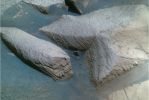
OPP-SOL1341-Sol1341B_P2594_1_False_L257.jpg"Wishing You Were Here" from Mars (false colors; elab. NASA) - Sol 134183 visiteCaption NASA:"If you were a scientist studying Mars and sharing your progress with family and friends, perhaps you would send back digital postcards showing them where you've been. Earthlings have now received a record 200.000 such postcards from NASA's 2 Mars Rovers!
The images enable us to study changes on the Red Planet, such as subtle variations in color and texture shown here in a ring of rocks inside Victoria Crater.
The light-colored rocks are interesting because scientists think they may be the original surface before a meteor formed the crater and splattered debris onto it".MareKromium
|
|

The_Moon-Aristarchus_Plateau.jpgAristarchus Plateau: the cradle of TLP's83 visiteCaption NASA:"Anchored in the vast lava flows of the Moon's Oceanus Procellarum lies the Aristarchus Plateau. The bright impact crater at the corner of the plateau is Aristarchus, a young crater 42 Km wide and 3 Km deep. Only slightly smaller, lava flooded Herodotus crater is above and to the left.
A valley (or rille) feature likely carved by rapidly flowing lava or a collapsed lava tunnel, Vallis Schroteri begins just to the right of Herodotus and winds across the plateau for about 160 Km, eventually turning toward the top of the picture.
Aristarchus Plateau itself is like a rectangular island about 200 km across, raised up to 2 kilometers or so above the smooth surface of the lunar Ocean of Storms.
Recorded from a backyard observatory in Buffalo, New York, the contrast of light-colored ejecta around Aristarchus with surrounding dark, smooth, lava flooded surfaces suggests more familiar snowy scenes of planet Earth".MareKromium
|
|

ISD_highres_AS13_AS13-60-8589-2.jpgAS 13-60-8589 - S-IV-B in the distance? (2 - extra-detail mgnf)83 visiteUna visione affascinante, misteriosa e - ahinoi!... - incommentabile.
Se vorrete darci i Vostri pareri al riguardo, noi li aspettiamo per discuterli con piacere!MareKromium
|
|

APOLLO_15_AS_15-86-11599-2.jpgAS 15-86-11599 (2) - Image Artifact or Bright Sphere in the distance?83 visitenessun commentoMareKromium
|
|
| 25353 immagini su 2113 pagina(e) |
 |
|
|
|
|
750 | |
|
|
|
|





