| Piú viste |

APOLLO_15_AS_15-86-11599-2.jpgAS 15-86-11599 (2) - Image Artifact or Bright Sphere in the distance?84 visitenessun commentoMareKromium
|
|
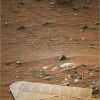
SOL1425-2.jpgSolar Panels and Small Dunes - Sol 1425 (possible natural colors + MULTISPECTRUM; credits: Dr G. Barca)84 visitenessun commentoMareKromium
|
|

SOL066-2N132225906EFF1700P1943L0M1.jpgApproaching "Bonneville Crater" (3 - MULTISPECTRUM; credits: Lunexit) - Sol 6684 visitenessun commentoMareKromium
|
|

Venus-South_Polar_Vortex-12_VIRTIS_vortex_movie_H.gifThe restless South Pole of Venus (GIF-Movie - credits: ESA)84 visiteCaption ESA:"This video is composed of a set of images acquired by the Visible and Infrared Thermal Imaging Spectrometer (VIRTIS) on board ESA’s Venus Express, during two observations slots in August 2007. The spacecraft was flying at a distance of about 65.000 Km from the Planet.
The video was obtained at 3.8-micrometre wavelength, allowing the instrument to see the cloud top thermal emission at an altitude of about 60-65 km.
The South Polar "Dipole", a complex atmospheric vortex-like feature situated over the South Pole of the Planet, can be clearly seen.
The change of the Polar Vortex shape in a time scale of a few hours is remarkably noticeable here"MareKromium
|
|

OPP-SOL886-1.jpgHappy Family! - Sol 886 (Superdefinition + MULTISPECTRUM; credits: Dr G. Barca & Lunexit)84 visitenessun commentoMareKromium
|
|
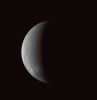
Enceladus-PIA10422.jpgCrescent Enceladus (MULTISPECTRUM-2; credits: Lunexit)84 visiteCaption NASA:"The Cassini Spacecraft observes the wrinkled surface of Enceladus.
The geologically active South Polar Region is visible at bottom.
This view looks toward the Saturn-facing side of Enceladus (about 504 Km, or 313 miles across). Lit terrain is on the moon's Leading Hemisphere. North is up and rotated 16° to the right.
The image was taken in visible green light with the Cassini Spacecraft narrow-angle camera on June 2, 2008. The view was obtained at a distance of approx. 285.000 Km (such as about 177.000 miles) from Enceladus and at a Sun-Enceladus-Spacecraft, or Phase, Angle of 108°.
Image scale is roughly 2 Km (a little more than 1 mile) per pixel".MareKromium
|
|

PHOE-SOL046-lg_12469.jpg"Up-Sunset" over Vastitas Borealis (by Dr Paolo C. Fienga)84 visitenessun commentoMareKromium
|
|
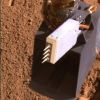
PHOE-SOL099-PIA11073.jpgPhoenix Conductivity Probe after Extraction - Sol 99 (natural colors; credits: NASA)84 visiteCaption NASA:"NASA's Phoenix Mars Lander inserted the 4 needles of its Thermal and Conductivity Probe into Martian soil during the 98th Sol of the mission and left it in place until Sol 99 (Sept. 4, 2008).
The Surface Stereo Imager on Phoenix took this image on the morning of Sol 99 after the probe was lifted away from the soil. This imaging served as a check of whether soil had stuck to the needles.
The Thermal and Conductivity Probe measures how fast heat and electricity move from one needle to an adjacent one through the soil or air between the needles. Conductivity readings can be indicators about water vapor, water ice and liquid water.
The probe is part of Phoenix's Microscopy, Electrochemistry and Conductivity suite of instruments".MareKromium
|
|

Haumea-1.jpgHaumea: an "Egg" in the Outer Solar System...84 visitenessun commentoMareKromium
|
|

APOLLO_13_AS_13-60-8622_ANOMALY-2.jpgAS 13-60-8622 - The Silver Sphere (NASA Original uncompressed frame, HR version, fully restored; credits: Lunar Explorer Italia)84 visiteCome potete vedere nella nostra Galleria dedicata ai "NASA Original Frames", la versione digitale L&PI del quadro in oggetto è praticamente inservibile: la pellicola, infatti, forse a causa di una non perfetta conservazione e certamente in ragione della sua "età" (!), si è irrimediabilmente sbiadita e deteriorata.
In effetti, anche sviluppando a nostra cura il frame (partendo da una copia del negativo originale gentilmente fornitaci dal L&PI), il risultato finale raggiungibile - post digitalizzazione - era un brutto quadro di colore blu, in cui sia la Luna, sia l'Anomalìa Argentea (un riflesso secondo alcuni, un corpo reale secondo altri) erano quasi completamente svanite.
Oggi, con l'aiuto di un Amico Fotografo Professionista, abbiamo riprocessato (si può dire che abbiamo "ricostruito", di fatto) la copia del negativo originale fornitaci dal L&PI e quindi abbiamo ridigitalizzato il prodotto finito.
Il risultato - disponibile sia nella versione LR del frame NASA, sia nella sua versione HR - è quello che vedete: un modesto scorcio della Luna e la "nostra" Anomalìa che, ad un'osservazione attenta e dettagliata, si mostra per quello che è realmente.
La nostra opinione? E' assolutamente un Oggetto Reale, caratterizzato da forma sferica, superficie argentea ed albedo elevata.
Per gli Osservatori più attenti (ed eventualmente muniti di adeguato software), la "Sfera" pare essere altresì caratterizzata da una netta scanalatura longitudinale che l'attraversa lungo tutta la sua porzione visibile (nota: la scanalatura in questione la potete vedere poco al di sotto dell'Equatore della Sfera ed essa sembra costituire altresì la linea di demarcazione fra un'area più brillante ed una meno brillante del manufatto).
ATTENZIONE: questo specifico dettaglio può essere rilevato solo nella versione HR del frame NASA Originale riprocessato.
Dedichiamo questo frame (che rappresenta un OVNI genuino al 100%) al nostro Carissimo Amico Massimo Staccioli ("Ufologo"), per la Passione e la Dedizione che ha sempre dimostrato nello svolgimento del suo Lavoro di Investigatore Spaziale.MareKromium
|
|
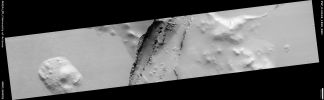
PSP_010638_1890_RED_abrowse-00.jpgAngular Unconformity in Cerberus Fossae (ctx RAW frame)84 visiteThis HiRISE image shows a part of the Cerberus Fossae, a long system of aligned fissures. The Cerberus Fossae were the source of the youngest major volcanic eruption on Mars that covered much of the surrounding area in lava. The region has also seen much other volcanic activity.
The walls of the fissures typically reveal lava layers. At this site, they have cut through an older hill that protrudes above the surrounding plains. The layers within the hill are tilted relative to the overlying rock, which appears to drape the region and runs continuously over the hill and plains.
This tilted contact is known as an Angular Unconformity. It is most likely that this formed when horizontal layers were tilted by faults before the most recent volcanic eruptions, forming the irregular hills.
The hills represent relatively old rock, while the smooth plains and the thin draping cover were formed more recently.MareKromium
|
|

Lenticular_Clouds.jpgLenticular Clouds' Cluster84 visiteCaption NASA:"Are those UFOs near that mountain?
No! They are Multilayered Lenticular Clouds.
Moist air forced to flow upward around mountain tops can create lenticular clouds. Water droplets condense from moist air cooled below the dew point, and clouds are opaque groups of water droplets. Waves in the air that would normally be seen horizontally can then be seen vertically, by the different levels where clouds form.
On some days the city of Seattle, Washington, USA, is treated to an usual sky show when lenticular clouds form near Mt. Rainier, a large mountain that looms just under 100 Km South-Eeast of the city.
This image of a spectacular cluster of lenticular clouds was taken last December (2008)".MareKromium
|
|
| 25353 immagini su 2113 pagina(e) |
 |
|
|
|
|
740 | |
|
|
|
|





