| |
| Piú viste |

OPP-SOL408-1N164419237EFF5100P1607L0M1-PCF-LXTT-IPF.jpgLike waves, in an Ocean of Sand... - Sol 408 (Absolute Natural Colors; credits for the additional process. and color.: Dr Paolo C. Fienga/Lunar Explorer Italia/Italian Planetary Foundation)85 visitenessun commentoMareKromium
|
|

SOL0054-PIA14762-NASA-JPL-Caltech-MSSS.jpg"Bathurst Inlet" Rock - Sol 54 (Natural Colors; credts: NASA/JPL-Caltech, Malin Space Science Systems)85 visiteNASA's Mars Rover Curiosity held its Mars Hand Lens Imager (MAHLI) camera about 10,5" (---> inches, such as about 27 centimeters) away from the top of a Rock called "Bathurst Inlet" for a set of 8 images combined into this merged-focus view of the Rock. This context image covers an area that is roughly 6,5 by 5" (such as 16 by 12 centimeters). Resolution is about 105 microns per pixel.
MAHLI took the component images for this merged-focus view, plus closer-up images of Bathurst Inlet, during Curiosity's 54th Martian Day, or Sol (such as September 30, 2012). The instrument's principal investigator had invited Curiosity's science team to "MAHLI it up!" in the selection of Sol 54 targets for inspection with MAHLI and with the other instrument at the end of Curiosity's Arm: the Alpha Particle X-Ray Spectrometer.
The "Bathurst Inlet" Rock is dark gray and appears to be so fine-grained that MAHLI cannot resolve Grains or Crystals in it. This means that the Grains or Crystals, if there are any at all, are smaller than about 80 microns in size. Some windblown sand-sized Grains or Dust Aggregates have accumulated on the Surface of the Rock, but this Surface is clean (if compared, for example, to the pebbly substrate below the rock - upper left and lower right in this context image).
MAHLI can do focus merging onboard the MER and, in fact, the full-frame versions of the 8 separate images that were combined into this view were not even returned to Earth -- just the thumbnail versions. In other words, merging the images onboard reduces the volume of data that is supposed to be downlinked to Earth.MareKromium
|
|

SOL0058-EB-MF-LXTT-IPF-2.jpgDeep Rover Tracks - Sol 58 (an Image-Mosaic in Natural Colors - EDM; credits for the additional process. and color.: Elisabetta Bonora and Marco Faccin/Lunar Explorer Italia/Italian Planetary Foundation)85 visitenessun commentoMareKromium
|
|
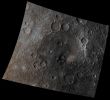
ZZ-Mercury-Craters-Raffaello_Crater-PIA16307-PCF-LXTT-IPF-1.jpgRaffaello Crater (Absolute Natural Colors; credits for the additional process. and color.: Dr Paolo C. Fienga/Lunar Explorer Italia/Italian Planetary Foundation)85 visiteThis beautiful Absolute Natural Color image-mosaic of the huge Impact Basin Raffaello (named after the Italian Renaissance painter and having a diameter of approx. 343 Km), taken in the past month of October 2012 by the NASA - MESSENGER Spacecraft, shows us a wide diversity of colors (which, as you know, represent a wide variety of Mineral Compositions) that exist and can be easily identified within the Volcanic Plains that, eons ago, flooded the Raffaello Basin's Floor. Furthermore, many white-colored Hollows appear to be in process of being formed along most of the Rim and the Northern portion of the Floor - and, in both cases, they are forming in the so-called Low Reflectance Material (or LRM for short) - of a smaller - roughly 40-Kilometer (such as approx. 25-miles) diameter -, Unnamed and Highly Complex Impact Crater that is located just South of the center of the giant Raffaello Basin.
Date acquired: October, 19th, 2012
Images Mission Elapsed Time (MET): 259122560, 259122580, 259122564
Images ID: 2793045, 2793050, 2793046
Instrument: Wide Angle Camera (WAC) of the Mercury Dual Imaging System (MDIS)
Center Latitude: 20,39° South
Center Longitude: 283,6° East
Resolution: 599 meters/pixel
Solar Incidence Angle: 53,4° (meaning that the Sun, at the time that the pictures were taken, was about 36,6° above the imaged Local Mercurian Horizon)
Emission Angle: 27,0°
Sun-Mercury-Messenger (or "Phase") Angle: 80,3°
This picture (which is an Original NASA - MESSENGER Spacecraft color frame published on the NASA - Planetary Photojournal with the ID n. PIA 16307) has been additionally processed and then re-colorized in Absolute Natural Colors (such as the colors that a human eye would actually perceive if someone were onboard the NASA - MESSENGER Spacecraft and then looked down, towards the Surface of Mercury), by using an original technique created - and, in time, dramatically improved - by the Lunar Explorer Italia Team. Different colors, as well as different shades of the same color, mean, among other things, the existence of different Elements (Minerals) present on the Surface of Mercury, each having a different Albedo (---> Reflectivity) and Chemical Composition.MareKromium
|
|

ESP_029516_1730-PCF-LXTT-IPF-2.jpgFeatures of Hydrae Chasma (Absolute Natural Colors; credits for the additional process. and color.: Dr Paolo C. Fienga/Lunar Explorer Italia/Italian Planetary Foundation)85 visiteHydrae Chasma is a deep, almost Circular Depression approximately 50 Km across, situated between Juventae Chasma (to the North) and the large Canyon System known as Valles Marineris (to the South). This Chasma (---> Abyss) has steep Walls, flanked by numerous Landslides and a massive Scarp along its Southern Boundary, just where the Surface has collapsed into the Depression.
The EDM shows us an isolated flat-topped and small Mountain (known as a "Mesa") rising out of a Sea of Dunes located in the center of Hydrae Chasma. Darker-toned Dunes, likely composed of Basaltic Sands, form an Apron along the base of the Mesa's Northern Margin. The Western Side of the Mesa is gently sloping and is composed of a highly fractured light-toned Rubbly Base. It is overlaid by alternating light and dark Layered Cliff-forming Units and is covered by a Sediment Cap containing still more Dunes.
The Layered Sequences are present only in the Interior Deposits and not in the Walls of the Chasma. Similar Deposits can also be found on the Floor of the Valles Marineris Canyon System, as well as in other Chasmata (like Juventae, for instance), and may represent the Sedimentary Remnants of ancient (relatively) deep and quiet (---> with probably minimal Internal Streams) Martian Lakes that formed, eons ago, within all these Canyon and Depression Systems and which, in (a, likely, extremely long) time, slowly disappeared (---> evaporated, sublimed or just froze).
Mars Local Time: 15:39 (Middle Afternoon)
Coord. (centered): 6,825° South Lat. and 297,987° East Long.
Spacecraft altitude: 268,4 Km (such as about 167,8 miles)
Original image scale range: 26,9 cm/pixel (with 1 x 1 binning) so objects ~ 81 cm across are resolved
Map projected scale: 25 cm/pixel
Map projection: EQUIRECTANGULAR
Emission Angle: 8,5°
Phase Angle: 45,9°
Solar Incidence Angle: 54° (meaning that the Sun was about 36° above the Local Horizon at the time the picture was taken)
Solar Longitude: 205,5° (Northern Autumn - Southern Spring)
Credits: NASA/JPL/University of Arizona
Additional process. and coloring: Lunar Explorer Italia
These two pictures (which are a NASA - Original Mars Reconnaissance Orbiter CTX b/w frame and an EDM color frame, both identified by the serial n. ESP_029516_1730) have been additionally processed and then colorized and re-colorized (as far as the EDM is concerned), respectively, in Absolute Natural Colors (such as the colors that a human eye would actually perceive if someone were onboard the NASA - Mars Reconnaissance Orbiter and then looked down, towards the Surface of Mars), by using an original technique created - and, in time, dramatically improved - by the Lunar Explorer Italia Team.MareKromium
|
|

SOL0130-PIA16562-PCF-LXTT-IPF-2.jpgOn the Edge of "Yellowknife Bay" - Sol 130 (an Image-Mosaic in Absolute Natural Colors; credits for the additional process. and color. Dr Paolo C. Fienga/Lunar Explorer Italia/Italian Planetary Foundation)85 visitenessun commentoMareKromium
|
|

SOL0270-EB-MF-PCF-LXTT-IPF.jpgSunset at Gale Crater - Sol 270 (a Martian Fantasy by Elisabetta Bonora, Marco Faccin and Paolo C. Fienga/Lunar Explorer Italia/Italian Planetary Foundation)85 visiteIl frame è originale, l'elaborazione cromatica principale è stata fatta da Elisabetta Bonora (2di7) e Marco Faccin (Titanio44); il processing "psichedelico", con aggiunta del Sole calante, sono opera mia. Secondo me, questo risultato, per improbabile che possa essere, è bellissimo. Una "Fantasia Marziana": nulla di più.MareKromium
|
|

Aeolian_Features-Windstreaks-SMP-PIA17683-PCF-LXTT-IPF.jpgWindstreaks in Syrtis Major Planum (EDM - Absolute Natural Colors; credits for the additional process. and color.: Dr Paolo C. Fienga/Lunar Explorer Italia/Italian Planetary Foundation)85 visiteIn this VIS image, taken by the NASA - Mars Odyssey Orbiter on September, 24th, 2013, and during its 52.254th orbit around the Red Planet, we can see (an count) a series of at least 8 (eight) Windstreaks (probably the most common Aeolian - meaning Wind-caused/related - Surface Feature found on Mars), which are located in the (VERY dark, as far as its Albedo - Reflectivity - is concerned) Region known as Syrtis Major Planum.
Syrtis Major Planum - when observed through a telescope - looks like a "Dark Spot" (---> Albedo Feature) located at the Boundary between the Northern Lowlands and Southern Highlands of Mars, just West of the large Impact Basin known as Isidis Planitia. In fact, Syrtis Major Planum was discovered, on the base of data collected by the NASA - Mars Global Surveyor Orbiter, to be a low-relief Shield Volcano, when it was formerly believed to be just a Plain (and it was then known as Syrtis Major Planitia). The very dark color of its Surface comes - most likely - from the Basaltic Volcanic Rocks that form (---> are found all over) the Region and a corresponding (and relative) relative lack of the Red/Orange Dust that covers most of the Red Planet.
Latitude (centered): 5,90248° North
Longitude (centered): 69,73730° East
Instrument: VIS
This image (which is an Original Mars Odyssey Orbiter b/w and Map-Projected frame published on the NASA - Planetary Photojournal with the ID n. PIA 17683) has been additionally processed, magnified, contrast enhanced, Gamma corrected and then colorized in Absolute Natural Colors (such as the colors that a human eye would actually perceive if someone were onboard the NASA - Mars Odyssey Orbiter and then looked down, towards the Surface of Mars), by using an original technique created - and, in time, dramatically improved - by the Lunar Explorer Italia Team.MareKromium
|
|

SOL0472-EB-MF-LXTT-IPF-00.jpgGold?!? - Sol 472 (an Image-Mosaic in Natural Colors; credits for the additional process. and color.: Elisabetta Bonora and Marco Faccin/Lunar Explorer Italia/Italian Planetary Foundation)85 visiteIl titolo del frame è una "provocazione", e non lo è. Mi è capitato, infatti, nella Vita, di vedere dell'Oro sia "libero" (le classiche "pepite" di fiume, ad esempio), sia ancora "incastonato" nella roccia (come è quello che viene estratto dalle miniere). L'elaborazione del frame, è in Colori Naturali, ed il Colore Naturale dell'Oro è proprio quello che caratterizza il dettaglio posto sul margine superiore dell'immagine. Sarà Oro davvero? Beh, su Marte, a quanto pare (ed in accordo a recentissime scoperte, ancora non pubblicizzate), esistono (o meglio: esisterebbero) Diamanti - anche di cospicue dimensioni - sparpagliati sulla Superficie. Se questo è vero, allora perché escludere la possibilità che vi sia anche dell'Oro (o altri Minerali, per noi Terrestri, preziosi) in bella vista, sulla Superficie di Marte?...MareKromium
|
|

ZZ-Mercury-Craters-To_Ngoc_Van_Crater-PIA15201-PCF-LXTT-IPF-00.jpgTo Ngoc Van (CTX Frame - Absolute Natural Colors; credits for the additional process. and color.: Dr Paolo C. Fienga/Lunar Explorer Italia/Italian Planetary Foundation)85 visiteIn this beautiful view obtained by the NASA - MESSENGER Spacecraft on November, 8, 2011, we can see, once again, prominent, near the center of the degraded Impact Crater To Ngoc Van, an interesting (and really irregularly shaped) Collapse Pit (approx. 20 Km - such as about 12,42 miles - across). As a matter of fact, many samples of Impact Craters with one (or more) Collapse Pit/s located on their Floors, have already been identified across the Mercurian Surface and - most likely - they all formed as a consequence of (extremely ancient) phenomena of Explosive Volcanism.
Date acquired: November, 8th, 2011
Image Mission Elapsed Time (MET): 229277972
Image ID: 988708
Instrument: Wide Angle Camera (WAC) of the Mercury Dual Imaging System (MDIS)
Center Latitude: 52,89° North
Center Longitude: 248,60° East
Solar Incidence Angle: 60,3° (meaning that the Sun, at the time that the picture was taken, was about 29,7° above the imaged Local Mercurian Horizon)
Emission Angle: 23,0°
Sun-Mercury-Messenger (or "Phase") Angle: 83,4°
This picture (which is an Original NASA - MESSENGER Spacecraft's b/w and Map-Projected image published on the NASA - Planetary Photojournal with the ID n. PIA 15201) has been additionally processed, contrast enhanced, Gamma corrected, magnified to aid the visibility of the details and then colorized in Absolute Natural Colors (such as the colors that a human eye would actually perceive if someone were onboard the NASA - MESSENGER Spacecraft and then looked outside, towards the Surface of Mercury), by using an original technique created - and, in time, dramatically improved - by the Lunar Explorer Italia Team. Different colors, as well as different shades of the same color, mean, among other things, the existence of different Elements (Minerals) present on the Surface of Mercury, each having a different Albedo (---> Reflectivity) and Chemical Composition.MareKromium
|
|

Iustitia.jpgIustitia (Imagination)85 visitenessun commentoMareKromium
|
|

w-Phobos_shadow-233-150206-2345-4-nd-01-PhobosShadow.JPGPhobos' shadow85 visitenessun commentoMareKromium
|
|
| 25353 immagini su 2113 pagina(e) |
 |
|
|
|
|
732 | |
|
|
|
|
|
|





