| Piú viste |

2-Milky_Way-PIA12335.jpgInfraRed Astronomical Satellite's View of the Sky (IRAS)85 visite"...Qui parcit virgae, filium suum odit..."
(Proverbi - 13, 24)
"...Chi realmente ama il proprio figlio, deve (se del caso) punirlo severamente..." (trad. libera)MareKromium
|
|

OPP-SOL288-1P153750471EFF37MIP2271R1M1_p2_copy1.jpgExtremely unusually-looking Surface Feature - Sol 288 (CTX Frame - credits: Ivana Tognoloni)85 visiteDall'occhio sempre attento e vivace di Ivana Tognoloni, un dettaglio come sempre suggestivo ed indecifrabile, dal Sol 288 di Opportunity.
Il Rover sta guardando il Bordo ("Rim") del Cratere che poi visiterà per molti mesi: c'è qualcosa che, confusa tra le rocce di Endurance, "guarda", a sua volta, il Rover?...
Questa è la domanda, queste le immagini...Una sola annotazione: "Teorie Esotiche" a parte, le rocce di Marte, ormai lo sapete bene, si caratterizzano per le loro fattezze così incredibilmente antropomorfe.
Pareidolìa? Probabilmente si. Ma non dovreste trascurare la circostanza per cui queste "rocce", in fondo, potrebbero anche essere raggruppate in "Classi" e "Tipologie", in ragione delle loro fattezze che - se non altro a nostro parere - sono (curiosamente!) ripetitive.
Un pò come "specie differenti" all'interno del medesimo "genere"...MareKromium
|
|
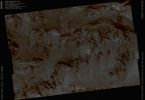
PSP_001415_1875_RED_abrowse.jpgAlluvial Fans in Mojave Crater (Natural Colors; credits: Lunexit)85 visiteAptly-named Mojave Crater in the Xanthe Terra Region has Alluvial Fans that look remarkably similar to landforms in the Mojave Desert of South-Eastern California and portions of Nevada and Arizona.
Alluvial Fans are "fan-shaped deposits of water-transported material" (---> Lat.: alluvium). They typically form at the base of hills or mountains where there is a marked break, or flattening of slope.
They typically deposit big rocks near their Mouths (close to the mountains) and smaller rocks at greater distances. Alluvial Fans form as a result of heavy desert Downpours, typically "Thundershowers" (Nota Lunexit: piogge torrenziali che occorrono durante violenti temporali, per lo più di tipo tropicale).
Because deserts are poorly vegetated, heavy and short-lived Downpours create a great deal of erosion and nearby deposition.
There are Fans inside and around the outsides of Mojave Crater on Mars that perfectly match the morphology of Alluvial Fans on Earth, with the exception of a few small impact craters dotting this Martian Landscape.
Channels begin at the apex of topographic Ridges, consistent with precipitation as the source of water, rather than groundwater. This remarkable landscape was first discovered from Mars Orbital Camera images. Mars researchers have suggested that impact-induced Atmospheric Precipitation may have created these unique landscapes.
This HiRISE image at up to 29 cm/pixel scale supports the Alluvial Fan interpretation, in particular by showing that the sizes of the largest rocks decrease away from the Mouths of the Fans.MareKromium
|
|

SOL568-2N176788619ESFADAEP1560L0M1.jpgRunning Pillars of Dust - Sol 568 (Enhanced Natural Colors; credits: Dr Paolo C. Fienga - Lunexit Team)85 visitenessun commentoMareKromium
|
|
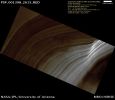
PSP_001398_2615_RED_abrowse.jpgExposure of NPLD with "Unconformities" (Natural - but enhanced - Colors; credits: Dr Paolo C. Fienga - Lunexit Team)85 visiteThis image shows a portion of the North Polar Layered Deposits (NPLD). The NPLD are layers that have been deposited over an extensive area at both Poles, possibly throughout Martian History. They likely contain ice-rich and dust-rich layers, with the darker layers being probably more dust-rich than the bright layers.
The NPLD holds clues to past climate regimes similar to ice cores on Earth. Several of the layers occur in fairly regular sequences, as seen in this image, suggesting that Mars underwent cyclic climate changes in the past.
Towards the top left side of the image, there is a series of layers that appears truncated at an angle, forming what geologists call "Angular Uncomformity". They typically form by first laying down a series of continuous beds. Then erosion cuts through the beds at an angle. Aferwards, a new set of beds are laid over this partially eroded sequence. A similar Unconformity exists at the bottom right of the image.MareKromium
|
|

Channels-Patapsco_Vallis-20100113a.jpgPatapsco Vallis and Elysium Fossae (Enhanced Natural Colors; credits: Dr Paolo C. Fienga - Lunexit Team)85 visiteThis VIS image shows two different types of "Linear Depressions".
The wide depression on the left of the frame is a wide trough known as "Elysium Fossae", which most likely formed due to tectonic activity.
The Fossae is probably bounded on both sides by faults.
The narrow depression on the right of the frame, instead, is a Lava Channel called Patapsco Vallis.
This Channel has Lava Flows on both sides which were probably formed by over spilling of lava as it flowed down the Channel.
Both these features are located East of Elysium Mons.MareKromium
|
|

APOLLO_17_-_AS_137-20985-6.jpgAS 17-137-20985 and 20986 - Orange Soil at Shorty Crater (Image-Mosaic and True Colors; credits: Dr Marco Faccin - Lunexit Team)85 visitenessun commentoMareKromium
|
|
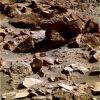
OPP-SOL2161-GB-LXTT-1.jpgIn the "Ruins"... - Sol 2161 (Natural Colors; credits: Dr G. Barca - Lunexit Team)85 visitenessun commentoMareKromium
|
|
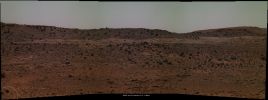
SOL1377-2-EB-LXTT.jpgRocky Skyline - Sol 1377 (an Image-Mosaic in possible True Colors by Elisabetta Bonora - Lunexit Team) 85 visitenessun commentoMareKromium
|
|

Deuteronilus_Mensae-PIA12996.jpgDeuteronilus Mensae (Natural Colors; credits for the add. process, and color.: Dr Paolo C. Fienga - Lunexit Team)85 visiteThe Terrain in this image lies in the Deuteronilus Mensae Region, along the highland-lowland Dichotomy Boundary in the Northern Hemisphere of Mars.
The High Resolution Imaging Science Experiment (HiRISE) camera on NASA's Mars Reconnaissance Orbiter recorded this image on March 9, 2010.
The target for this HiRISE observation was a suggestion submitted through the camera team's HiWish public-suggestion program. For more information about how to submit target suggestions, see http://uahirise.org/hiwish/.
This Region contains many Mesas surrounded by Lobate Debris Aprons that are thought to be ice-rich. These Aprons have been interpreted as a variety of possible features including rock glaciers, ice-rich mass movements, or debris-covered glacial flows. Recent radar data from the Shallow Radar instrument on the Mars Reconnaissance Orbiter has shown them to be composed of nearly pure ice. This image shows an area at the edge of one of these Mesas with a Lobate Debris Apron extending from its base.
Both the Mesa top and the Surface of the Debris Apron appear covered with ice-rich mantling materials characteristic of the Martian Mid-Latitudes and thought to have been deposited around 10 million years ago during a period of high obliquity.
This image covers a swath of ground about 1 Km (about two-thirds of a mile) wide. It is a portion of HiRISE observation ESP_016959_2240, which is centered at 43,62° North Latitude and 28,62° East Longitude. The season on Mars is Northern-Hemisphere Spring. MareKromium
|
|

IC-434.jpgIC 434 - The "Horse Head Nebula"85 visite"...Si è sempre responsabili di quello che non si è saputo evitare..."
Jean Paul SartreMareKromium
|
|

OPP-SOL2239-PCF-LXTT.jpgLate Sun over Endeavour (by Dr Paolo C. Fienga - Lunexit Team)85 visitenessun commentoMareKromium
|
|
| 25353 immagini su 2113 pagina(e) |
 |
|
|
|
|
730 | |
|
|
|
|





