| Piú viste |

34-Apollo 11 LS-1888_40L_Hi.jpgThe "Apollo 11 Landing Site"85 visiteCaption ESA originale:"This image, taken by the Advanced Moon Imaging Experiment (AMIE) on board ESA’s SMART-1 spacecraft, shows the Apollo 11 Landing Site in the Mare Tranquillitatis Region of the Moon.
AMIE obtained the image on 5 February 2006 from a distance of 1764 Km from the surface, with a ground resolution of 159 mt per pixel.
The imaged area is centred at a Long. of 23,9º East, close to the Moon Equator, at 1,7º North Latitude.
The area is close to crater Moltke (outside the field of view of this image) in the Mare Tranquilitatis Region. The arrow shows the Landing Site of Apollo 11, where the first men from Earth set foot on another object in our Solar System, on 20 July 1969. The two prominent craters nearby are named after two of the Apollo 11 Astronauts. The first man on the Moon, Armstrong, has a crater named after him outside the field of this image".
|
|
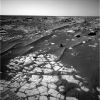
OPP-SOL891-1N207287490EFF74V1P1825R0M1.jpgBeagle Crater (1) - Sol 89185 visitenessun commento
|
|
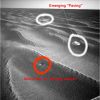
OPP-SOL914-1N209329424EFF75GTP0685R0M1.jpgFeatures of Meridiani - Sol 91485 visitenessun commento
|
|

ZE-I-Viking1-p133b.jpgColor snap-shots from Viking 1 (2)85 visite"...Even for pictures where we have both visible and IR information, two possible types of color can be created. The character of the Sunlight reaching the Martian Surface is significantly different than that reaching Earth's surface, primarily because of scattering and absorption by suspended dust particles. In addition, a certain amount of light reflected from the yellowish brown surface finds its way back as reflected sky light.
Figures (1), (2), and (3) illustrate the range of possible color reconstructions. All three pictures are based on the same camera data. The sampling area at the Viking 1 Site is shown. Two trenches in the Sandy Flats site, the first to be dug are shown at the far left.
Figure (1) is produced by using only visible color information, making no allowance for IR leaks..." (continua)
|
|

Earth-PIA08324-1.jpgEarth, from Saturn's Space (1)85 visiteCaption NASA originale:"Not since NASA's Voyager 1 spacecraft saw our home as a pale blue dot from beyond the orbit of Neptune has Earth been imaged in color from the Outer Solar System. Now, Cassini casts powerful eyes on our home Planet, and captures Earth, a pale blue orb - and a faint suggestion of our Moon - among the glories of the Saturn System.
Earth is captured here in a natural color portrait made possible by the passing of Saturn directly in front of the Sun from Cassini's point of view. At the distance of Saturn's orbit, Earth is too narrowly separated from the Sun for the spacecraft to safely point its cameras and other instruments toward its birthplace without protection from the Sun's glare.
The Earth-and-Moon System is visible as a bright blue point on the right side of the image above center. Here, Cassini is looking down on the Atlantic Ocean and the Western Coast of North Africa. The phase angle of Earth, seen from Cassini is about 30°".
|
|

080-OPP-SOL949-1N212429831EDN76ACP1585L0M1-1.jpgMartian "Blue Skies" (1) - Sol 94985 visitePer gli "amanti" dei Cieli Azzurri su Marte, la nostra interpretazione - peraltro già offerta nella Sezione "Walking on Mars" - di questa (affascinante ed improbabile) situazione.
I colori sono stati ottenuti usando il buon senso ed i dati NASA: atmosfera assai rarefatta e, quindi, cielo sempre più scuro a mano a mano che si alza lo sguardo. Questo è (sarebbe) il Cielo di Meridiani.
|
|

SOL694-2N187979400EFFAKE1P0735R0M1~0.jpgImaginary Sunset (not real) - Sol 69485 visiteUno dei nostri (ormai soliti...) "tramonti Marziani", realizzato con Jasc Paint Shop Pro in 3 minuti - e totalmente falso, dato che questo frame è stato ottenuto circa alle ore 13 MLT).
|
|

APOLLO 12 AS 12-50-7369.jpgAS 12-50-7369 - Icy Streaks on the "Hatch Window"85 visiteCaption NASA originale:"According to National Space Science Data Center document NSSDC-70-11 (July 1970), this photo shows the 'Fouled Hatch Window; streaks go (left) away from the CMS cone (right)'.
This photo was taken inside the Command Space Module (CSM) during the Translunar Coast".
Nota: un commento asciutto ed un dettaglio intrigante ma...che cosa si vede - realmente - fuori dall'oblo'?!?
|
|
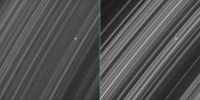
Aldebaran-PIA08300.jpgThrough the B-Ring85 visiteThese side-by-side views of a star (Aldebaran?) seen through Saturn's densely populated B-Ring show marked contrast between the region where spokes - the ghostly radial features periodically seen in it - are produced and regions where no spokes are seen.
In the view at left, the B-Ring displays an uneven grainy texture, with a great deal of variability in brightness along the direction of the particle motion. In the view at right, the B-Ring is far smoother and more uniform along the same longitudinal direction.
Ring scientists on the Cassini Imaging Team are studying images such as these to understand the processes by which spokes are created. This difference in appearance from one location to another on the Ring could provide the researchers with helpful insights into the features' formation.
These views were acquired about half an hour apart as the Cassini spacecraft looked toward the unlit side of the Rings from about 33° above the Ring-Plane.
|
|

APOLLO_11_AS_11-45-6712_HR.jpgAS 11-45-6712 - Hard rock surface and sparkling cristals (HR)85 visitenessun commentoMareKromium
|
|
OPP-SOL956-PIA09170-1.jpgMartian Twilights... - Sol 956 (elab. Lunexit)85 visitenessun commento
|
|

L-h0513_0009_nd2-00.jpgFrame Mars Express RAW n. h0513_0009_nd285 visiteMareKromium
|
|
| 25353 immagini su 2113 pagina(e) |
 |
|
|
|
|
727 | |
|
|
|
|





