| Piú viste |

Enceladus-PIA11108.jpgBaghdad Sulcus86 visiteCaption NASA:"This Cassini image was the 4th 'skeet shoot' narrow-angle image captured during the Oct. 31, 2008, flyby of Saturn's moon Enceladus.
The source region for jet VI (see PIA08385) has been identified. The image was taken with the Cassini Spacecraft narrow-angle camera on Oct. 31, 2008, at a distance of approximately 3417 Km (about 2135 miles) from Enceladus and at a Sun-Enceladus-Spacecraft, or Phase, Angle of 75°.
Image scale is roughly 38 meters (125 feet) per pixel".MareKromium
|
|

Martian_Winter.jpgWinter on Mars (by Roberto Tremolada & Lunexit)86 visitenessun commentoMareKromium
|
|

SOL1356-2.jpgBright Spots - Sol 1356 (false colors; credits: Dr G. Barca)86 visiteCuriose scintille di luce caratterizzano i punti della roccia posta ai piedi di Spirit laddove il Rover (probabilmente usando le sue ruote o il RA) ha intaccato lo strato superficiale - ed opaco - di sabbia e polveri che ne "nasconde" le reali fattezze.
Si tratterà di un "impolverato" e "semi-insabbiato" mega-cristallo di Quarzo? Difficile: il Quarzo non è un minerale comune su Marte...
Solo una certezza: l'effetto "Goccia di Luce" che si vede contraddistinguere alcune zone della roccia in questione - sulla base di quanto constatato in qualche annetto di osservazioni - si verifica SOLO in due casi (almeno per quanto ne sappiamo):
1) luce del Sole che colpisce una superficie Cristallina (o ricoperta di Ghiaccio d'Acqua)
2) luce del Sole che colpisce una superficie Metallica
Cosa stiamo osservando in questo caso?!?MareKromium
|
|
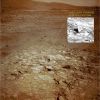
SOL1763-2N282881994EFFAZ25P1918R0M1-CRS.jpgUnbelievable "Pseudo-Balance" - Sol 1763 (edm - false colors; credits: Lunexit)86 visitePseudo-Equilibrio, o Equilibrio Illusorio: trattasi di un equilibrio che non è stabile, nè instabile, nè apparente. Un equilibrio, insomma, che, in Natura (ed almeno sulla Terra) non esiste (rectius: non dovrebbe esistere).
E' ovvio che questa riflessione (determinata dalla mera osservazione) è anche una provocazione: ci sarebbero, infatti, delle possibili (anche se, va detto, piuttosto stiracchiate...) spiegazioni a questo fenomeno.
Spiegazioni che potete trovare Voi stessi, magari usando l'edm del dettaglio.
Quello che a noi preme sottolineare è solo un fatto, semplicissimo: questa particolare Surface Feature, al di là di tutto, costituisce un caso eclatante di Singolarità (se vogliamo restare tranquilli) o di autentica e pura Anomalìa di Superficie (se vogliamo "lanciarci" un pò).
Sulle nozione di Singolarità ed Anomalìa, come saprete, abbiamo già detto molto, molte volte e quindi non vogliamo ripeterci ed annoiarVi; sul fatto che QUESTA Feature sia - se non altro potenzialmente - ESTREMAMENTE CURIOSA (ribadiamo: ai limiti dell'impossibile, fisicamente parlando) riteniamo che non possano sussistere dubbi.
Chissà che cosa ne pensa la NASA... MareKromium
|
|

SOL572-2P177142336ESFADAEP2541R7M1.jpgInteresting rock (3) - Sol 572 (natural colors; credits: Lunar Explorer Italia)86 visitenessun commentoMareKromium
|
|

Titan-Regions-Senkyo_and_Aaru_Region-PIA10565.jpgSenkyo and Aaru Region86 visiteCaption NASA:"Named for other-worldly Paradises, the dark regions of Senkyo and Aaru comprise the center of this image of Saturn's moon Titan. The Egyptian fields of Aaru were Paradise for the god Osiris. This side of Titan, which always faces Saturn, is on the opposite side of the moon from Shangri-La and Adiri, the home to the Huygens probe.
The craft touched down on the border between the lowland dunes of Shangri-La and the higher terrains of Adiri. Like Senkyo and Aaru, these Regions' namesakes reflect heavenly aspirations. North is up in this image.
Senkyo is the Equatorial Region to the right of the center of the image. Aaru is above Senkyo.
The image was taken with the Cassini Spacecraft narrow-angle camera on Dec. 12, 2008 using a spectral filter sensitive to wavelengths of infrared light centered at 938 nanometers.The view was acquired at a distance of approx. 2,4 MKM (such as about 1,5 MMs) from Titan and at a Phase Angle of 35°.
Image scale is roughly 14 Km (about 9 miles) per pixel".MareKromium
|
|
Craters-Adivar_Crater-1.jpgAdivar Crater (Natural Colors; credits: Lunar Explorer Italia)86 visitenessun commentoMareKromium
|
|
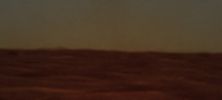
OPP-SOL1821-PIA11836.jpgWestern Rim of Endeavour Crater and farther Iazu Crater's Rim on sight! - Sol 1821 (Natural Colors; credits: Lunar Explorer Italia)86 visiteIn the left half of this view from the Panoramic Camera (PanCam) of NASA's Mars Exploration Rover Opportunity, a western portion of the rim of Endeavour Crater is visible on the horizon. In the right half, the rim of a smaller crater, farther away, appears faintly on the horizon.
Opportunity's Pancam took this image on March 8, 2009, during the 1821st Martian Day, or Sol, of the Rover's Mission on Mars. The width of the image covers approx. 1° of the horizon.
The part of Endeavour's rim visible here is about 16 kilometers (10 miles) from where Opportunity was when the image was taken. The Rover was at the same location as when its Pancam took images after a drive on Sol 1820. Opportunity remained at that location until a drive on Sol 1823.
The more-distant rim to the right, part of Iazu Crater, is about 38 Km (approx. 24 miles) away. Iazu is South of Endeavour and about 7 Km (approx. 4 miles) in diameter.MareKromium
|
|
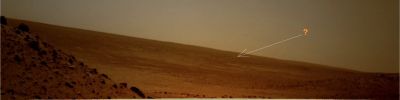
SOL1926-2N297349760ESFB1DQP1561L0M1.jpgIs Spirit observing a distant Alien Probe? - Sol 1926 (Natural Colors - Blue filter OFF; credits: Lunar Explorer Italia)86 visiteE' un fatto: Spirit, ormai da parecchi Soles, sta osservando stabilmente - usando tutti i filtri a disposizione - un probabile manufatto argenteo che splende sotto il Sole.
Il dettaglio, già individuato dai nostri Lettori in tre frames passati, non sembra essersi mosso e la sua esistenza è rivelata solo dalla sua albedo, elevatissima.
La distanza del dettaglio da Spirit è imprecisata, ma la riteniamo prossima ai 1800/2000 metri. Ora la domanda è semplice: se non si tratta di un oggetto metallico, che cosa altro può brillare così intensamente sotto il velato Sole di Marte?
Ricordate la Silver Sphere? L'effetto ottico è analogo, ma noi non crediamo che si tratti dello stesso oggetto. La Silver Sphere, seppur brillante, era un oggetto piuttosto piccolo (meno di un metro di diametro, in accordo alla nostra stima) e sparì dalla visuale di Spirit relativamente presto.
E comunque, ad oltre quattro anni di distanza, la polvere rossastra che aleggia costantemente negli strati più bassi dell'Atmosfera Marziana, dovrebbe averlo ormai completamente ricoperto (salvo l'occorrere, anche per la Silver Sphere, dei "Cleansing Events", come li chiama la NASA...).
Comunque sia, secondo noi questo oggetto è sensibilmente più grande della Silver Sphere e si trova nella posizione in cui lo vediamo da poco tempo (abbiamo altre immagini di questo scorcio che risalgono ad alcuni mesi fa ed il dettaglio controverso NON APPARE).
Che cosa potrà mai essere?
Le Vostre idee, saranno - come sempre - apprezzate.MareKromium
|
|
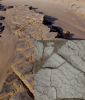
OPP-SOL1825_and_Limestone-EarthPaving.jpgThe Beautiful Martian Paving and the Limestone (or Earth Paving) of São Pedro de Moel (Portugal)86 visiteUna comparazione fra il meraviglioso (e sempre enigmatico) "Martian Paving" - che ormai ci sembra essere davvero uniformemente presente, assieme ai Martian Berries ed appena al di sotto di una leggera coltre di sabbie e polveri, nella Regione Equatoriale Marziana di Meridiani Planum - ed una spettacolare "Formazione Calcarea Pavimentata" (Limestone) emersa sulle rive dell'Atlantico, in una cittadina Portoghese dal nome di São Pedro de Moel.
Una comparazione che deve aiutarci a ricordare che Marte, in fondo, è molto più vicino a noi di quanto si possa immaginare...MareKromium
|
|
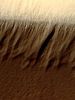
PSP_009356_1835_RED_abrowse-01.jpgRidged Margin of Elevated Plateau North-West of Pavonis Mons (edm - Natural Colors; credits: Lunar Explorer Italia)86 visitenessun commentoMareKromium
|
|

ZZ-ZZ-ZZ-ZZ-APOLLO_11-LANDING_SITE-008.gifThe Eagle has Landed: Apollo 11 Landing Site86 visitenessun commentoMareKromium
|
|
| 25353 immagini su 2113 pagina(e) |
 |
|
|
|
|
717 | |
|
|
|
|





