| Piú viste |

OPP-SOL285-2-B_site37_navcam_360_BurnsCliff_cyp_L-B296R1_br2.jpgBurns Cliff - 360° panorama (2)86 visitenessun commento
|
|

OPP-SOL285-4-B_site37_navcam_360_BurnsCliff_cyp_L-B296R1_br2.jpgBurns Cliff - 360° panorama (4)86 visitenessun commento
|
|

Kemble_s Cascade Asterism.jpgThe "asterism" known as "Kemble's cascade"86 visite"...Coelum, non animo mutant, qui trans mare currunt..."
(Orazio)
"...I viaggiatori cambiano il cielo (sotto cui si muovono), non (la loro) natura..."
|
|

Huygens-IMG001253-br500.jpgThe "Huygens Probe", "camera artifacts" and 4 "known" stars86 visiteShown in white boxes are known stars; the probe is the brightest item on the lower right. The other dots are artifacts of the camera. Although only a few pixels across, this image is helping navigators reconstruct the probe's trajectory and pinpoint its position relative to Cassini. This information so far shows that the probe and Cassini are right on the mark and well within the predicted trajectory accuracy. This information is important to help establish the required geometry between the probe and the orbiter for radio communications during the probe descent on January 14. The Huygens probe, built and managed by ESA, will remain dormant until the onboard timer wakes it up just before the probe reaches Titan's upper atmosphere. Then it will begin a dramatic plunge through Titan's murky atmosphere, tasting its chemical makeup and composition as it descends to touch down on its surface. The data gathered during this 2,5 hours descent will be transmitted from the probe to the Cassini orbiter. Afterward, Cassini will point its antenna to Earth and relay the data through NASA's Deep Space Network to JPL and on to the European Space Agency's Space Operations Center in Darmstadt, Germany, which serves as the operations center for the Huygens probe mission.
|
|

North_Polar_Regions-The_Erg-PIA07282.jpgOutcrops in the North polar Erg (Original NASA/MGS/MSSS b/w Frame)86 visiteCaption NASA originale:"This Mars Global Surveyor (MGS) Mars Orbiter Camera (MOC) image, acquired during Northern Summer in December 2004, shows dark, windblown Sand Dunes in the North Polar Erg: a vast Sea of Sand Dunes that surrounds the North Polar Cap. These landforms are located near 80,3° North Lat. and 144,1° West Long. Light-toned features in the image are exposures of the substrate that underlies the immense Erg. The image covers an area of about 3 Km (1,9 mi) wide and is illuminated by sunlight from the lower left".
Nota Lunexit: le "light-toned features", a nostro avviso, sono soltanto degli affioramenti rocciosi (Rocky Outcrops).
|
|

18-Rima Hadley.jpgHadley Rille86 visiteCaption NASA originale:"Lunar Orbiter 5 view of Hadley Rille and the surrounding region on the Moon. Hadley Rille is the sinuous depression running from the top to the bottom of the image. To the right are the 1 to 2 Km high Apennine mountains. Apollo 15 landed near the very rightmost extension of the rille, near the top of the image. The large crater in the center of the image is the 30 Km diameter Hadley C.
A HR image of the rille is available as L05-H105. North is up (Lunar Orbiter 5, frame M-105)".
Location & Time Information
Date/Time (UT): 1967-08-14 T 12:41
Distance/Range (km): 132
Central Latitude/Longitude (deg): +25.09/002.95
|
|
SOL318-325-Husband_Hill-PIA07334_br2-03.jpgColumbia Hills: "Husband Hill's Region" - full 360° panorama (4 - Approximate True Colors; credits: NASA/JPL-Caltech)86 visiteVogliamo parlare adesso del Cielo di Marte? Certo suggestivo, ma se ci/Vi interessa la Verità, "questo cielo Marziano" è davvero ridicolo ed improponibile.
Vi è sufficiente andare a guardare il frame - anch'esso in "almost true colors" (come questo!!!) - ripreso da Opportunity mentre si aggirava intorno allo Scudo Termico (tanto per restare in tempi recenti) per vedere delle ENORMI - ed INGIUSTIFICABILI! - DIFFERENZE.
La nostra opinione - dato che i misteri ci affascinano, ma non è mai una buona idea vederne/trovarne troppi... - è che i Cieli di Marte, tranne rarissimi frames, sono TUTTI FALSI e vengono "incollati" sui panorami una volta che la foto è "pronta per la pubblicazione".
E come vengono fatti?
In laboratorio, naturalmente, probabilmente usando qualche semplice software che tutti potremmo avere già installato sul nostro pc.
Insomma: fra il vero cielo di Marte e quello di questo frame (come di tantissimi altri) - a nostro parere - non c'è nessuna parentela!...
|
|

Japetus-A-U-The Wall.jpgThe "Wall" of Japetus (detail mgnf)86 visiteOsserviamo bene questo "muro" e cerchiamo di svolgere delle considerazioni: si tratta, se usiamo la logica convenzionale, di un semplice rilievo montuoso, alto circa 19 Km e largo altrettanti, che circonda il pianeta quasi completamente. E' "inusuale", certo, ma che cosa c'è di "usuale" nello Spazio? Questa spettacolare increspatura potrebbe aver avuto origine durante la fase di raffreddamento di Giapeto, agli albori della sua storia, così come potrebbe essere, invece, il residuo visibile di un crack di dimensioni planetarie (causato da eventi sismici di portata - per noi - inimmaginabile, o magari da un impatto particolarmente violento e/o da entrambi questi fattori) il quale, con il tempo, si è "cicatrizzato", generando quello che vediamo oggi. Il rilievo, inoltre, è fortemente craterizzato: lo è al pari di tutta la superficie di questa luna. Ebbene, un simile dato può farci pensare che l'ipotesi della sua formazione (contemporanea o quasi) con la "nascita" di Giapeto, sia - tutto sommato - accettabile.
|
|

OPP-SOL074-1N134755338EFF10CGP1972R0M1.jpgDeep tracks, tiny Side-Winders86 visiteAlcuni Studiosi sostengono che le increspature delle sabbie Marziane possano dipendere da "eventi mareali" tutt'ora in corso.
Cosa sono? Probabilmente un Mare (ma non sapremmo dire se questa parola può essere intesa nel senso 'terrestre' del termine) che fluttua ed ondeggia in profondità. Forse a grande profondità.
Un Oceano sotto il Deserto.
Fantascienza? Forse.
La Storia ci ha comunque insegnato che, alle volte, quella che oggi viene chiamata "fantascienza" diventa la base della Scienza di domani.
Pensate, per esempio, a Monsieur Jules Verne ed al suo "Viaggio sulla Luna"...
|
|

SOL446-2P165957385EFFA9B0P2514R1M1.jpgShifting angles or moving rocks? (2)86 visitevedi il commento al frame che precede
|
|

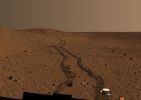
OPP-SOL006-1N128724318EFF0211P1527L0M1.jpgAirbags' Tracks - Sol 686 visitenessun commento
|
|

00-SMART1.jpgSMART-1 and the Moon86 visiteSMART-1's science payload, with a total mass of some 15 Kg, features many innovative instruments and advanced technologies. These are:
- AMIE, a miniaturised HR camera for Lunar Surface imaging;
- SIR, a Near-Infrared Point-Spectrometer for Lunar mineralogy investigation;
- D-CIXS, a very compact X-ray Spectrometer with a new type of detector and micro-collimator which will provide fluorescence spectroscopy and imagery of the Moon's surface elemental composition;
- XSM, an X-ray monitor to support D-CIXS by providing measurements of solar X-ray emission for calibration:
- KaTE, an experiment aimed at demonstrating deep-space telemetry and telecommand communications in the X and Ka-bands;
- RSIS, a Radio-Science Experiment relying on KaTE. It monitors the electric propulsion by means of tracking techniques. In lunar orbit it will, with AMIE, also study the Moon's libration.
|
|
| 25353 immagini su 2113 pagina(e) |
 |
|
|
|
|
711 | |
|
|
|
|





