| Piú viste |

18-Rima Hadley.jpgHadley Rille87 visiteCaption NASA originale:"Lunar Orbiter 5 view of Hadley Rille and the surrounding region on the Moon. Hadley Rille is the sinuous depression running from the top to the bottom of the image. To the right are the 1 to 2 Km high Apennine mountains. Apollo 15 landed near the very rightmost extension of the rille, near the top of the image. The large crater in the center of the image is the 30 Km diameter Hadley C.
A HR image of the rille is available as L05-H105. North is up (Lunar Orbiter 5, frame M-105)".
Location & Time Information
Date/Time (UT): 1967-08-14 T 12:41
Distance/Range (km): 132
Central Latitude/Longitude (deg): +25.09/002.95
|
|
![22-Dawes Crater-lo5_m70[1].jpg](albums/userpics/10008/small_22-Dawes%20Crater-lo5_m70%5B1%5D.jpg "Nome del file=22-Dawes Crater-lo5_m70[1].jpg
Dimensione del file=224KiB
Dimensioni=938x1121
Aggiunta il=Gen 23, 2005")
22-Dawes Crater-lo5_m70[1].jpgDawes Crater87 visiteCaption NASA originale:"Lunar Orbiter 5 image of Dawes Crater. Dawes Crater is 18 Km in diameter and appears to be a relatively young Lunar Lrater. The Crater is about 600 m deep. North is up (Lunar Orbiter 5, frame M-70)".
Nota: questo frame, sebbene molto suggestivo, è pesantemente intaccato dalla presenza di artefatti fotografici.
Attenzione, quindi, allorchè operate analisi ed interpretazioni.
Location & Time Information
Date/Time (UT): 1967-08-12 T 16:03:49
Distance/Range (km): 116
Central Latitude/Longitude (deg): +17.30/026.33
|
|

Radio Sky.jpgEverlasting broadcast from "Radio-Sky"!87 visiteDa "NASA - Picture of the Day" del 6 febbraio 2005:"Tune your radio telescope to 408MHz (i.e.: 408 million cycles per second) and check out the Radio Sky! In the 1970s, large dish antennas at 3 radio observatories (Jodrell Bank, MPIfR and Parkes Obs.ry), were used to do just that - the data were combined to map the entire sky. Near this frequency, cosmic radio waves are generated by high energy electrons spiraling along magnetic fields. In the resulting false color image, the galactic plane runs horizontally through the center, but NO stars are visible. Instead, many of the bright sources near the plane are distant Pulsars, Star Forming Regions and Supernova Remnants, while the grand looping structures are pieces of bubbles blown by local stellar activity. External galaxies, like Centaurus A, located above the plane to the right of center, and the Large Magellanic Cloud (below and right) also shine in the Radio Sky".
|
|
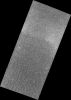
North_Polar_Regions-Olympia_Undae-PIA06848-00.jpgNorth Polar Erg: Olympia Undae (Original NASA/JPL/ASU b/w Frame)87 visiteImage information: VIS instrument;
Latitude: 81,4° North;
Longitude: 180,6° East (such as 179,4° West);
Resolution: 19 meter/pixel.
|
|

SOL390-u-site_AA3_navcam_180_cyl-A391R1.jpg"Cumberland Ridge Panorama" and the "Pyramid" (high res. - detail mgnf)87 visiteEd ecco la "Singolarità", posta all'estrema Sn dell'immagine (Dx dell'Osservatore), che "emerge" in tutta la sua straordinaria bellezza. Certo, un "picco squadrato" in Natura può esistere, non ci sono dubbi e quindi non celebriamo ancora nulla: ma questo specifico "picco squadrato", unito alle tantissime altre Singolarità individuate nella zona di Cumberland Ridge - Husband Hill, forse, dovrebbe dirci qualcosa...
|
|
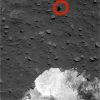
SOL401-2P161964365EFFA600P2556L6M1.jpgThe Hills' terrain (2)87 visiteUna differenza incredibile, non è vero?!? Questo è un esempio concreto di quello che intendiamo dire allorchè Vi avvertiamo della enorme differenza - in termini di "risultato finale" - che esiste tra i diversi filtri/colore impiegati per le riprese. Marte, ai nostri occhi, cambia radicalmente NON SOLO (e non tanto) a seconda dell'ora del giorno in cui la ripresa è effettuata, MA ANCHE (e soprattutto) a seconda del particolare FILTRO/COLORE impiegato.
Il risultato? Due immagini identiche diventano profondamente diverse...
E comunque, per non limitare le nostre riflessioni e congetture a dei meri dettagli tecnici, guardate bene la roccia affiorante che abbiamo cerchiato in rosso.
Strana, non credete?!?...
|
|
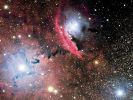
NGC-6559-0.jpgNGC 6559 - The "Story" of a Star Forming Region87 visiteIn questa immagine vediamo delle nebulose ad emissione - ossìa che brillano di luce propria - di color rosso (Idrogeno); nebulose a riflessione - ossìa che riflettono la luce delle stelle circostanti - di color blu (costituite da polveri) - e nebulose ad assorbimento - o 'nebulose oscure' - le quali, anch'esse formate da polveri interstellari, 'assorbono e, in un certo senso, soffocano' la luce degli oggetti circostanti.
Ed ecco la 'storia' che NGC 6559 ci racconta: le prime stelle ultra-massicce che si sono formate per addensamento dei gas presenti nella Regione emetteranno luce, onde mareali e possenti venti solari i quali eroderanno e ridefiniranno questa zona del Cosmo. Tuttavia, queste ciclopiche stelle non avranno una lunga vita: esse, in tempi relativamente brevi, esploderanno.
Un 'caos cosmico' regnerà per qualche decina di milioni di anni, ma poi tutte le polveri verranno consumate, i gas residui saranno dispersi e ciò che "vedremo" sarà solo uno splendido ammasso aperto di giovani stelle...
|
|
SOL106-4-2P135773783EFF3100P2292L2M1.jpgThe dunes of Missoula Crater - Sol 10687 visitenessun commento
|
|

Chasmas-Melas_Chasma-07.jpgSample scarp edge in layered unit in Melas Chasma or... Frozen Waterfalls on Mars? (7)87 visitevedi i commenti svolti nei quadri precedenti
|
|

NGC-1316-00.jpgNGC 1316 and the giant "radio lobes" of Fornax A87 visiteCaption NASA originale:"Together, the 'radio lobes' span over 1 MLY, but what caused them? In the center is a large but peculiar elliptical galaxy dubbed NGC 1316. Detailed inspection of the NGC 1316 system indicates that it began absorbing a small neighboring galaxy about 100 MY ago. Gas from the galactic collision has fallen inward toward the massive central black hole, with friction heating the gas up to 10 million degrees. For reasons not yet understood, two oppositely pointed fast moving jets of particles then developed, eventually smashing into the ambient material on either side of the giant elliptical galaxy. The result is a huge reservoir of hot gas that emits radio waves, observed as the orange (false-color) radio lobes in the above image. The radio image is superposed on an optical survey image of the same part of the sky. Strange patterns in the radio lobes likely indicate slight changes in the directions of the jets".
|
|
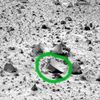
SOL534-2P173773703ESFACAQP2536L2M1.jpgExtra-flat Rock (1) - Sol 53487 visiteE' semplicemente incredibile la (quantomeno apparente) piattezza della roccia che abbiamo cerchiato in verde. La sensazione, a prima vista, è che si tratti di una pietra la quale difficilmente può avere origini naturali, ma le sensazioni, spesso, ingannano.
In realtà, elaborando l'immagine (pulizia dei difetti + aumento del contrasto + ingrandimento) qualche leggera asperità, unita a dei modesti cracks superficiali, si riesce anche a vedere.
Non siamo davanti a quanto residua di un antico colonnato, dunque, ma la sensazione che le Rocce di Marte stìano cercando di raccontarci una storia - forse troppo incredibile per essere accettata razionalmente - si fa più forte di Sol in Sol...
(Left Panoramic Camera Non-linearized Sub-frame EDR acquired on Sol 534 of Spirit's mission to Gusev Crater at approximately 13:44:28 Mars local solar time, camera commanded to use Filter 2)
|
|

ThreeSuns-PIA03521.jpgA planet with 3 Suns...87 visite"...Accettare a priori, è un atto di Fede; rifiutare a priori è un atto di stupidità..."
Alessio Feltri
|
|
| 25353 immagini su 2113 pagina(e) |
 |
|
|
|
|
700 | |
|
|
|
|





