| Piú viste |

APOLLO 13 AS 13-60-8623.jpgAS 13-60-8623 - Moon from orbit318 visiteIl tempo di un singolo fotogramma e l'oggetto - perchè di oggetto (secondo noi) si trattava - è sparito. Parlando di UFO, dobbiamo dire che l'apparizione di "sfere argentee" di modeste - se non addirittura "piccole" - dimensioni (da mezzo metro ad un metro e mezzo di diametro apparente), non è un fatto nuovo, anzi. Svariati avvistamenti "da Terra" parlano o addirittura mostrano, sia attraverso fotografie, sia tramite filmati, delle "sfere" color alluminio o bianco scintillante che si muovono nel cielo, ora da sole, ora in gruppi e che, talvolta, si affiancano e/o seguono per un certo tempo degli aerei in volo.
|
|

Image012.jpgThe "Hills of Disgrace" : the "Area from above"318 visiteUn "falso" eseguito con mano tremante ed in maniera, a quanto ci sarà dato vedere e capire, così approssimativa e dozzinale (almeno per degli "occhi esperti") da lasciarci tutti quanti attoniti.
Buona lettura!
LE COLLINE DEL DISONORE
In questa occasione prenderò in esame una foto ufficiale fornita dalla NASA sulla missione di Spirit - PIA06770 (frame precedente) - relativa al sito denominato “WEST SPUR” allo scopo di valutarne l’attendibilità attraverso una serie di controlli incrociati (per Vostra informazione siamo nel Sol 210).
Al fine di inquadrare meglio la posizione del West Spur all’interno del Cratere Gusaev, bisogna ricordare che questo particolare sito si trova lungo le pendici delle Columbia Hills, ossìa le colline che potete osservare nella presente planimetria 3D. Un primo elemento da rimarcare in questa "pianta" è che, in generale, il terreno Marziano sembra MOLTO più accidentato di quanto non appaia, invece, dal frame oggetto di analisi e valutazione.
|
|

Image051-Ukert-4.jpgUkert: the "pseudo-triangular" Lunar Crater318 visitenessun commento
|
|

ESP_020793_1935_RED_abrowse-PCF-LXTT.jpgElliptical Impact Crater or Crater Chain? (Natural Colors; credits for the additional process. and color.: Dr Paolo C. Fienga - Lunexit Team)318 visiteCaption NASA:"This image shows what appears to be a highly Elliptical Crater, which would be unusual. Closer examination reveals that it is probably two overlapping Craters that formed concurrently, plus several smaller Craters aligned with the Long Axis of the elliptical depression.
This type of "Crater Chain" can form from a highly oblique impact, in which the Impactor (Bolide) trajectory is almost parallel to the Surface".MareKromium
|
|

Craters-Lowell_Crater-PIA08026-PCF-LXTT-2.jpgFeatures of Lowell Crater (Absolute Natural Colors; credits: Dr Paolo C. Fienga - Lunexit Team)318 visiteLatitude: approx. 51,8° North
Longitude: approx: 277,1° EastMareKromium
|
|

OPP-SOL2568-1P356179936EDNB400P2694L7M1.jpgHorizon - Sol 2568 (Absolute Natural Colors; credits for the additional process. and color.: Dr Paolo C. Fienga - Lunexit Team)318 visitenessun commentoMareKromium
|
|
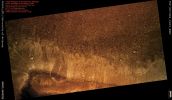
PSP_007492_2265_RED_abrowse-PCF-LXTT.jpgPolygons in Deuteronilus Mensae (Enhanced Absolute Natural Colors; credits for the additional process. and color.: Dr Paolo C. Fienga - Lunexit Team)318 visiteThis image reveals hexagonal and polygonal patterns formed by networks of soil troughs on the floor of a valley in the Deuteronilus Mensae Region, located on the Northern edge of Arabia Terra and borders the Martian Southern Highlands and Northern Lowlands.
The polygonal patterns indicate that the surface has undergone stress, potentially caused by subsidence (sinking), desiccation (drying out), or thermal contraction. These polygon features are similar to permafrost thermal-contraction polygons that form in Polar and High Alpine Regions on Earth by seasonal-to-annual contraction of the subsoil. On Earth, such polygon features are indicative of the presence of ground ice and are commonly referred to as “patterned ground”. The patterns are the result of thermal contraction in ice-cemented soil or permafrost that forms a honeycomb network of small fractures below the surface.
The network of fractures is eventually manifested as shallow troughs at the surface, forming the hexagonal and polygonal patterns visible in this image.
The polygons in this scene average approx. 100 meters (110 yards) in size and appear to be higher in elevation in the center than in the surrounding troughs. Boulders are accumulated in the center of the polygons and dunes are visible in several of the troughs.
The landforms we observe here most likely indicate that ice-rich permafrost is present or has been present in the past.MareKromium
|
|

Daedalia_Planum-PIA14154-PCF-LXTT.jpgFeatures of Daedalia Planum (Natural Colors; credits: Dr Paolo C. Fienga - Lunexit Team)318 visitenessun commentoMareKromium
|
|

Max-002.jpgDreams never die...318 visitenessun commentoMareKromium
|
|

APOLLO 11 AS 11-37-5453.jpgAS 11-37-5453 - Sea of Tranquillity (3)317 visiteprosieguo della panoramica iniziata con i frames AS 11-37-5449, 5450 e 5451. Vedi il commento al frame precedente.
|
|

APOLLO 15 AS 15-85-11491.jpgAS 15-85-11491 - The Lunar Rover317 visiteUn'immagine carina, senza pretese scientifiche, del Lunar Rover dopo che è stato "parcheggiato" in prossimità del Monte Hadley. Molto bello il paesaggio collinare-montuoso che fa da sfondo al LR.
|
|

ESP_020875_0980_RED_abrowse-PCF-LXTT.jpgSouth Polar "Pseudo-Trees" (Absolute Natural Colors; credits for the additional process. and color.: Dr Paolo C. Fienga - Lunexit Team)317 visitenessun commentoMareKromium
|
|
| 25353 immagini su 2113 pagina(e) |
 |
|
|
|
|
52 | |
|
|
|
|





