| Piú viste |

Saturn_and_Companions-EB-LXTT.jpgDeep Space... (Natural Colors; credits: Elisabetta Bonora - Lunexit Team)54 visitenessun commentoMareKromium
|
|
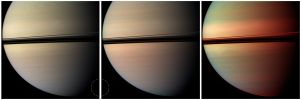
Saturn-Triplet-EB-LXTT.jpgSaturnian Views: RGB, IR and Methane (an Image-Mosaic by Elisabetta Bonora - Lunexit Team)54 visitenessun commentoMareKromium
|
|

The_Sun_in_Extreme_UV.jpgThe Sun in Extreme UV54 visiteThis wild-looking portrait of the Sun was made on March 30th, 2010, by the recently launched Solar Dynamics Observatory (SDO).
Shown in false-color, the composite view covers Extreme UltraViolet wavelengths and traces hot plasma at temperatures approaching 1 million Kelvins. At full resolution, SDO image data is intended to explore solar activity in unprecedented detail. In fact, SDO will send 1.5 terabytes of data back each day, equivalent to a daily download of about half a million MP3 songs.MareKromium
|
|

M-066-0-HST.jpgM 66 - Spiral Galaxy54 visite"...My way of joking is to tell the Truth. Because the Truth is, very often, the funniest joke in the World..."
George Bernard Shaw (1856 - 1950)MareKromium
|
|

The_Sun-Texture.jpgThe "Texture" of the Sun54 visiteUp close, the Solar Surface is a striking patch work of "granules" in this very High Resolution picture of the quiet Sun. Caused by convection, the granules are hot, rising columns of plasma edged by dark lanes of cooler, descending plasma. But the HR view reveals that the dark lanes are dotted with many small, contrasting bright points. Constantly present on the Solar Surface, the bright points do not seem to be related to Sunspots that come and go with the Magnetic Solar Cycle.
Nonetheless, the bright points are regions of concentrated Magnetic Fields and are bright because the magnetic pressure opens a window to hotter deeper layers below the Photosphere. For scale, the white bar at the lower left corresponds to approx. 5000 Km across the Sun's Surface.
The sharp, narrow-band image was recorded in September, 2007 using the Swedish Solar Telescope on the astronomical island of La Palma.MareKromium
|
|
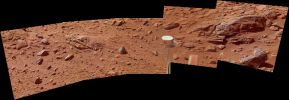
SOL278-MF-LXTT.jpgOrange Sands with Outcrop - Sol 278 (an Image-Mosaic in Natural Colors by Dr Marco Faccin - Lunexit Team)54 visitenessun commentoMareKromium
|
|

Noachis_Terra-PIA13074.jpgNoachis Terra (Natural Colors; credits for the additional process. and color.: Dr Paolo C. Fienga - Lunexit Team)54 visiteThis observation shows Gullies in a semi-circular Trough in Noachis Terra. The Gullies are observed to face all directions.
It is interesting to note that the Gully Morphology seen here depends on the orientation of the Gullies. The morphology differences are most pronounced on the sunlit slope, with the Gullies facing South (down) being more deeply incised than those facing the West. It is unknown what caused the different Gully Morphologies, but there are several possibilities.
Gullies are proposed to form at locations determined by the availability of a forming liquid (thought to be water) and/or the amount of insolation the Slope receives, among other factors. It is possible that the deeper Gullies experienced more erosional events or that their erosional events were more effective for undetermined reasons. It is also possible that the Gullies formed at different times such that they did not have the same amount of water -- either for an individual flow or total -- available to them. Also, the underlying topography could make the Gullies appear relatively more incised without this actually being the case.
The majority of the Gullies on both sides of the Trough appear to originate at a boulder-rich layer visible in the subimage. The layer appears dark on the sunlit slope because the boulders sticking out from the slopes cast shadows. If these Gullies formed by water from the Subsurface, then it is possible that this layer is a permeable layer that conducted water to the Surface.
The layer is deteriorating and traveling down slope in the form of Boulders. These Boulders can clearly be seen in the alcoves of the Gullies on both sides of the Trough.MareKromium
|
|

SOL2190-GB-PCF-LXTT1.jpgRover Tracks and heavily disturbed Terrain - Sol 2190 (Absolute Natural Colors; credits for the additional process. and color.: Drr Gianluigi Barca & Paolo C. Fienga - Lunexit Team)54 visitenessun commentoMareKromium
|
|

SOL2181-GB-PCF-LXTT.jpgHeavily Disturbed Terrain - Sol 2181 (Natural Colors; credits for the additional process. and color.: Drr Gianluigi Barca & Paolo C. Fienga - Lunexit Team)54 visitenessun commentoMareKromium
|
|

OPP-SOL2173-GB-PCF-LXTT.jpgRover Tracks - SOl 2173 (Absolute Natural Colors; credits for the additional process. and color.: Drr Gianluigi Barca & Paolo C. Fienga - Lunexit Team)54 visitenessun commentoMareKromium
|
|

Titan-N00155212-13-14-rgb-EB-LXTT.jpgCrescent Titan (Natural Colors; Special Processing by Elisabetta Bonora - Lunexit Team)54 visitenessun commentoMareKromium
|
|
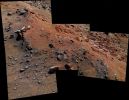
SOL485-MF-LXTT.jpgMineral Diversity in Gusev Crater - Sol 485 (an Image-Mosaivc in possible True Colors by Dr Marco Faccin - Lunexit Team)54 visitenessun commentoMareKromium
|
|
| 25353 immagini su 2113 pagina(e) |
 |
|
|
|
|
2092 | |
|
|
|
|





