| Piú viste |
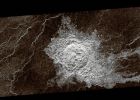
Craters-Unnamed_Crater-PIA00468.jpgUnnamed (and heavily degraded) Crater (possible Natural Colors; credits: Dr Paolo C. Fienga - Lunexit Team)54 visiteDuring orbits 423 through 424 on 22 September 1990, Magellan imaged this Impact Crater that is located at Latitude 10,7° North and Longitude 340,7° East.
This Crater is shown as a representative of Venusian Craters that are of the proper diameter (about 15 Km) to be 'transitional' in their morphology between 'complex' and irregular'.
Complex Craters account for about 96% of all craters on Venus with diameters larger than about 15 Km; they are thought to have been formed by the impact of a large, more or less intact, mass of asteroidal material that has not been excessively effected during its passage through the dense Venusian Atmosphere.
Complex Craters are characterized by circular Rims, terraced Inner Wall Slopes, well developed Ejecta Deposits, and flat Floors with a Central Peak or Peak Ring.
Irregular Craters make up about 60% of the Craters with diameters less than about 15 Km. Irregular Craters are thought to form as the result of the impact of asteroidal projectiles that have been aerodynamically crushed and fragmented during their passage through the Atmosphere.
Irregular craters are characterized by irregular and/or discontinuous Rims and hummocky or multiple Floors.
The 'Transitional' Crater shown here has a somewhat circular Rim like larger Complex Craters, but has the hummocky Floor and asymmetric Ejecta characteristic of smaller Irregular Craters. MareKromium
|
|
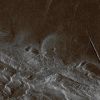
Lakshmi_Planum-PIA00249.jpgDanu Montes and Lakshmi Planum (possible Natural Colors; credits: Dr Paolo C. Fienga - Lunexit Team)54 visiteSouthwest Lakshmi Planum is bounded on the South by the Danu Montes.
Lakshmi Planum is an elevated plateau plain that is bounded on all sides by mountain chains. Here, the Danu Mountains have an angular fractured appearance. Chasms slice diagonally across the mountains in the lower left (South-West) corner of the image. Because of the steep slopes and the local relief of the mountains of several kilometers (2-3 miles, these fault-bounded troughs appear to zig-zag through the mountains when, in fact, they are probably straight if viewed from above.
The radar view provides a perspective that would place the viewer's eye to the right, 27° above the Horizon. Thus, slopes facing to the right can be seen completely, though dark, and slopes facing away to the left appear shortened, often seen only as thin bright lines. In the center of the image is a low volcanic dome (approx. 20 Km - about 12 miles - in diameter).
This type of volcanic feature frequently occurs on the low plains. This dome on the edge of Lakshmi is deformed and faulted where it has been affected by the forces that created the Danu mountains.
The image is approx. 75 Km (about 46 miles) on a side. The center is at 60° North Latitude and 324,5° East Longitude.MareKromium
|
|

Craters-Barton_Crater-PIA00463.jpgBarton Crater (possible Natural Colors; credits: Dr Paolo C. Fienga - Lunexit Team)54 visiteDuring orbits 404 through 414 on 19-20 September 1990, the Magellan Probe imaged a Peak-Ring Crater that is about 50 Km in diameter located at Latitude 27,4° North and Longitude 337,5° East. The name "Barton" has been proposed by the Magellan Science Team for this Crater, after Clara Barton, founder of the Red Cross; however, the name is tentative pending approval by the International Astronomical Union.
Barton is just at the diameter size that Venus Impact Craters appear to begin to possess Peak-Rings instead of a single Central Peak or Central Peak complex like does about 75% of the craters with diameters between about 50 and 15 Km.
The floor of the Crater is flat and radar-dark, indicating possible infilling by volcanic deposits sometime following the impact event. Barton's Central Peak Ring is discontinuous and appears to have been disrupted or separated during or following the cratering process. The extremely blocky crater deposits (ejecta) surrounding Barton appear to be most extensive on the South-West to South-East (lower left to right) side of it.MareKromium
|
|

PSP_001916_2220_RED_abrowse.jpgKnobs and Mounds on the Northern Plains (Natural Colors; credits: Dr Paolo C. Fienga - Lunexit Team)54 visiteLight-toned Mounds occur across the image.
The northern part of the image is dominated by small Knobs or Patches, while there are features hundreds of meters across to the South. The larger features frequently have one or more craters and an irregular shape; it has been proposed that these features are Mud Volcanoes, which erupt mud instead of lava.
On Earth, Mud Volcanoes usually form in conditions of tectonic pressurization or rapid burial of sediments.
At high resolution, the Knobs show some fine lineations which may be wind-blown material, but are otherwise very smooth. In between the Mounds, the Surface is rough and rich in Boulders. The few Boulders on the Mounds were likely ejected from nearby Impact Craters.
Information like this from HiRISE images provides useful constraints on the formation and material of these Knobs and Cones.MareKromium
|
|

FIGURA_08.jpgThe "San Marco - Broglio Space Center"54 visiteVeduta del segmento terrestre del San Marco - Broglio Space Center.MareKromium
|
|

FIGURA_06A.jpgPreparing for Launch54 visitePreparazione al lancio di un missile Scout.MareKromium
|
|

FIGURA_05.jpgThe Launch of "Ariel-5", from the San Marco Platform54 visiteLancio del satellite britannico "Ariel 5" dalla Piattaforma San Marco.
MareKromium
|
|

Pandora-091227-W00062229-31.jpgPandora perhaps? (an Image-Mosaic in False Colors, by Elisabetta Bonora - Lunexit Team)54 visitenessun commentoMareKromium
|
|

Sungrazer-2010-SOHO.jpgSungrazer54 visiteCaption NASA:"Intense and overwhelming, the direct glare of the Sun is blocked by the smooth occulting disk in this image from the Sun-staring SOHO Spacecraft. Taken on January 3rd, 2010, an extreme UltraViolet image of the Sun to scale, is superimposed at the center of the disk. Beyond the disk's outer boundary, is a Sungrazer Comet, one of the brightest yet seen by SOHO.
The comet was discovered by an Australian Amateur Astronomer, Alan Watson, while examining earlier images from another Sun-watching Spacecraft, STEREO-A. Based on their orbits, Sungrazers are believed to belong to the Kreutz family of comets, created by successive break ups from a single large Parent Comet that passed very near the Sun in the twelfth century.
Subjected to strong Tidal Forces and intense Solar Heat, this Sungrazer did not survive its close encounter".MareKromium
|
|

FIGURA_13.jpgThe "San Marco Platform", in 199554 visiteDa non dimenticare che il 1995 è stato l'anno del rinnovo dell'accordo Italia - Kenya, relativo al mantenimento ed al'impiego del "Broglio Space Center" e delle altre strutture (incluse quelle terrestri) ad esso collegate.MareKromium
|
|

FIGURA_10.JPGChecking the Scout...54 visitePersonale AMI supervisiona il 2° stadio di un missile Scout.MareKromium
|
|

FIGURA_09.JPGBoarding on the Santa Rita Platform54 visiteTrasbordo di personale AMI sulla piattaforma Santa Rita, nel 1971.
MareKromium
|
|
| 25353 immagini su 2113 pagina(e) |
 |
|
|
|
|
2089 | |
|
|
|
|





