| Piú viste |
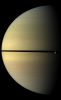
Saturn-PIA12513.jpgCrescent Saturn (Natural Colors; credits: NASA/JPL/Space Science Institute)54 visiteCaption NASA:"Saturn, stately and resplendent in this Natural Color view, dwarfs the icy moon Rhea.
Rhea orbits beyond the Rings on the right of the image. The moon Tethys is not shown here, but its shadow is visible on the Planet on the left of the image. This view looks toward the Northern, sunlit side of the Rings from just above the Ring-Plane.
Images taken using red, green and blue spectral filters were combined to create this Natural Color view. The images were obtained with the Cassini Spacecraft wide-angle camera on Nov. 4, 2009 at a distance of approx. 1,3 MKM (about 808.000 miles) from Saturn.
Image scale is roughly 72 Km (about 45 miles) per pixel".MareKromium
|
|

The_Rings-PIA12512.jpgThe "E-Ring"54 visiteCaption NASA:"The Cassini Spacecraft takes a look at Saturn's diffuse E-Ring which is formed from icy material spewing out of the South Pole of the moon Enceladus (see PIA08921 to learn more about how Enceladus creates the E-Ring). The E-Ring is seen nearly edge-on from slightly above the Northern Side of Saturn's Ring-Plane.
The image was taken in Visible Light with the Cassini Spacecraft wide-angle camera on Oct. 23, 2009. The view was acquired at a distance of approx. 2,5 MKM (such as about 1,6 MMs) from Saturn.
Image scale is roughly 149 Km (approx. 92 miles) per pixel".MareKromium
|
|

Prometheus-N00148968-N00148985-GB.gifPrometheus adrift... (GIF-Movie; credits: Dr G. Barca)54 visitenessun commentoMareKromium
|
|

The_Rings-091227-W00062195-96-98-EB-LXTT.jpgRings on Parade! (possible Natural Colors; credits: Elisabetta Bonora - Lunexit Team)54 visiteMareKromium
|
|

Volcanoes-PIA00261.jpgVolcanoes in Guinevere Planitia (possible Natural Colors; credits: Dr Paolo C. Fienga - Lunexit Team)54 visiteThis image, with radar illumination from West to East, shows three unusual Volcanoes located in the Guinevere Planitia Lowland. At the center of the image is a large feature (approx. 50 Km or about31 miles in diameter) with an unusual shape; very round when viewed from above with steep slides and a flat top.
These Volcanoes are believed to be the result of relatively thick and sticky (viscous) Lava Flows that originated from a point source. Although a faint remnant of its original circular shape is preserved, the Northern Rim of this center Volcano has a steep Scarp.
The Scarp is probably the result of material that has slid away from the Volcano and subsequently has been covered by Lava Flows. This Volcano overlaps another feature to the South-West that is about 45 Km (approx. 28 miles) in diameter and disrupted by many fractures.
The South-Eastern Volcano (about 25 Km or approx. 15,5 miles in diameter) appears to be the highest of the three as its illuminated Western Edge has the brightest radar return. The scalloped Edges give this feature a bottlecap-like appearance. The highly scalloped Edges are probably the result of multiple material slides along the Volcano Margin.MareKromium
|
|

Ovda_Regio-PIA00218.jpgOvda Regio (possible Natural Colors; credits: Dr Paolo C. Fienga - Lunexit Team)54 visiteThis Magellan image shows part of the interior of Ovda Regio, one of the large Highlands ringing the Equator of Venus.
Several tectonic events formed this complex block fractured terrain. An underlying fabric of Ridges and Valleys strikes N/E - S/W. These Ridges are spaced approx. 10 to 20 Km (such as about 6 to 12 miles) apart and may have been caused by shortening of the crust at right angles to this trend.
These structures are cut by thoroughgoing extension fractures trending N/W - S/E, suggesting a later episode of N/E - S/W extension. Lastly, the largest Valleys, particularly the about 20 Km (approx. 12 mile) wide one extending across the image, were filled with dark material, probably Lava.
The complex internal fabric of Ovda Regio attests to a long history of tectonic deformation.
This image, centered approx. at 1° South Lat. and 81° East Long., measures approx. 225 Km (about 140 miles) by approx. 150 (about 90 miles) and was acquired by Magellan in November 1990.MareKromium
|
|

The_Rings-EB.jpgUp-Sun in the Space of Saturn (Natural Colors; credits: Elisabetta Bonora - Lunexit Team)54 visitenessun commentoMareKromium
|
|

Prometheus-4220346220_c47de906a1_o.jpgPrometheus adrift... (possible True Colors; credits: Dr M. Faccin - Lunexit Team)54 visitenessun commentoMareKromium
|
|
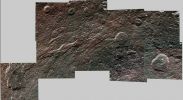
Rhea-Cracks-MF.jpgExtremely Long Tectonic Fracture on Rhea (possible True Colors; credits: Dr M. Faccin - Lunexit Team)54 visitenessun commentoMareKromium
|
|

Rhea-4229274308_c987cf73d9_o.jpgLarge Crater on Rhea (possible True Colors; credits: Dr M. Faccin - Lunexit Team)54 visitenessun commentoMareKromium
|
|

FIGURA_04.jpgLuigi Broglio54 visiteL'ingegner Luigi Broglio in Florida, in visita al John F. Kennedy Space Center di Cape Canaveral.MareKromium
|
|

FIGURA_02.jpgThe San Marco Platform54 visiteLa Piattaforma San Marco con uno "Scout" sulla torre di lancio.
MareKromium
|
|
| 25353 immagini su 2113 pagina(e) |
 |
|
|
|
|
2088 | |
|
|
|
|





