| Piú viste |
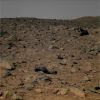
SOL074-GB-LXT.jpgRockland! - Sol 74 (Natural Colors; credits: Dr G. Barca & Lunar Explorer Italia)54 visitenessun commentoMareKromium
|
|
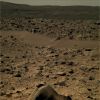
SOL071-GB-LXT.jpgRockland! - Sol 71 (Natural Colors; credits: Dr G. Barca & Lunar Explorer Italia)54 visitenessun commentoMareKromium
|
|

ZZ-Mercury-Terminator-PIA12045.jpgMercurian Terminator (Natural Colors; credits: Lunar Explorer Italia)54 visiteThis high-resolution NAC image shows a view of Mercury's Dawn Terminator, the division between the sunlit dayside and dark nightside of the planet, as seen as the MESSENGER Spacecraft departed the Planet during the mission's second Mercury flyby.
This frame is just one of 195 images that make up the second NAC mosaic obtained following closest approach (see PIA11767). A mosaic is a series of images that form a larger picture, in this case a high-resolution view of a portion of Mercury's Northern Hemisphere. This image is also just one of the 1287 total images acquired during Mercury flyby 2.
Last week, all of the images (as well as data from MESSENGER's other instruments) collected during Mercury flyby 2 were made publicly available on NASA's Planetary Data System (PDS) website, giving scientists around the world access to this exciting new dataset.
Date Acquired: January 14, 2008
Image Mission Elapsed Time (MET): 108829034
Instrument: Narrow Angle Camera (NAC) of the Mercury Dual Imaging System (MDIS)
Resolution: 590 meters/pixel (0,37 miles)
Scale: Moody is approx. 80 Km (about 50 miles) in diameter
Spacecraft Altitude: about 23.100 Km (approx. 14.300 miles)MareKromium
|
|

ZZ-Mercury-Limb-PIA12046.jpgMercurian Limb and Navoi Crater (Natural Colors; credits: Lunar Explorer Italia)54 visiteAt the center of this NAC image is the crater Navoi, named in November 2008 for the Uzbek poet Alisher Navoi (1441/1501 - see also PIA11762).
Located in the far north of Mercury’s Northern Hemisphere, Navoi can be seen clearly as a bright orange feature near the top of a previously released enhanced-color Wide Angle Camera (WAC) image of the Caloris Basin (part of which is shown in this release) (see PIA10359). As seen in that color WAC image, Navoi contains uncommon reddish material that indicates a different rock composition from its surroundings. In the high-resolution NAC image shown here, Navoi also appears to have an irregularly shaped depression in its center. Such depressions have been seen elsewhere on Mercury, including within Praxiteles Crater (see PIA12040), and may indicate past volcanic activity.
Date Acquired: January 14, 2008
Image Mission Elapsed Time (MET): 108828804
Instrument: Narrow Angle Camera (NAC) of the Mercury Dual Imaging System (MDIS)
Resolution: 550 meters/pixel (0,34 miles)
Scale: Navoi is about 66 Km (approx. 41 miles) in diameter
Spacecraft Altitude: approx. 21.700 Km (about 13.500 miles)MareKromium
|
|

ZZ-Mercury-Scarp-PIA12054.jpgLong and High Scarp (Natural Colors; credits: Lunar Explorer Italia)54 visiteThe Scarp cutting through this Unnamed Crater was imaged as MESSENGER approached the Planet during the mission's second Mercury flyby. The full NAC image acquired by MDIS is shown in a previous release (see PIA11772) while the image shown here is a reprojected view. Compare the two images to see the differences.
By using very precise knowledge about the time that the image was taken and the location of the Spacecraft at that time, the original image can be mapped onto a globe of Mercury. Once mapped onto a Mercury globe, that globe can be viewed in many different ways, including reprojections that create flat maps of Mercury's Surface, as seen in the Global Map of Mercury (see PIA11403). The reprojected image shown here is from a simple cylindrical map projection. Map projections are needed to measure accurately the extent of features on the surface. For example, from this reprojection it was determined that this Scarp is about 1 Km (0,6 miles) high and over 160 Km (about 100 miles) in length. MESSENGER Science Team members recently published an image similar to this reprojection in Science magazine.
Date Acquired: October 6, 2008
Image Mission Elapsed Time (MET): 131766501
Instrument: Narrow Angle Camera (NAC) of the Mercury Dual Imaging System (MDIS)
Resolution: 420 meters/pixel (0,26 miles)
Scale: This crater is about 200 Km (about 124 miles) in diameter
Spacecraft Altitude: 16.300 Km (about 10.100 miles)MareKromium
|
|

OPP-SOL1915-GB2.jpgThe "NASA Logo" and the Surface of Meridiani - Sol 1915 (Natural Colors credits: Dr G. Barca)54 visitenessun commentoMareKromium
|
|

ZZ-Mercury-Craters-Vyasa_and_Stravinsky_Crater-PIA12035_fig1.jpgLow-Sun over Mercury...54 visiteThis NAC image shows a close-up view of the craters Vyasa and Stravinsky (see PIA11360). Stravinsky is the smooth-floored crater partially seen on the right side of the image that overlies the rim of the larger, rougher crater Vyasa in the center and left. The low-Sun lighting angle casts distinctive shadows that show Mercury's rough surface, pockmarked by craters of all sizes. Small craters are visible on the smooth-floor of Stravinsky because of the high resolution of this image.
Date Acquired: October 6, 2008
Image Mission Elapsed Time (MET): 131771118
Instrument: Narrow Angle Camera (NAC) of the Mercury Dual Imaging System (MDIS)
Resolution: 140 meters/pixel (0,09 miles/pixel) near the bottom of the image
Scale: Stravinsky crater is about 190 Km in diameter (120 miles)MareKromium
|
|

ZZ-Mercury-Craters-Cratered_Plains-PIA12050.jpgRudaki Plains and Crater54 visiteLast week (April 2009), MESSENGER team members presented the results from 4 papers published in the 1st of May issue of the "Science" magazine at a NASA media teleconference. The color views shown here of the Plains near Rudaki Crater was just one of the graphics presented at that teleconference (nota: NO. La versione che vedete su queste pagine è quella ottenuta da Lunar Explorer Italia, applicando la metodologia Multispettrale).
The left image was created by combining WAC images from three narrow-band color filters to approximate Mercury's color as it would be seen by the human eye. The right image used a statistical analysis of all 11 WAC filters to highlight subtle color differences on the surface, as has been used for many previous releases, such as ones focused on Thakur Crater and Caloris Basin.
Date Acquired: October 6, 2008
Image Mission Elapsed Time (MET): 131770571-131770621
Instrument: Wide Angle Camera (WAC) of the Mercury Dual Imaging System (MDIS).
WAC Filters: Left image: 3, 4, 5 (480, 560, 630 nanometers). Right Image: statistical analysis involving all 11 WAC filters
Scale: The crater in the center of the image is approx. 68 Km (about 42 miles) in diameter
Spacecraft Altitude: about 2800 Km (approx. 1700 miles)MareKromium
|
|

OPP-SOL1921-MF-LXT-ALLFILTERS.jpgThe Paving under the Berries - Sol 1921 (ALL Filters ON; credits: Dr M. Faccin & Lunar Explorer Italia)54 visitenessun commentoMareKromium
|
|

OPP-SOL1915-MF-ALLFILTERS.jpg"Dusty" NASA-logo - Sol 1915 (ALL Filters ON; credits: Dr M. Faccin & Lunar Explorer Italia)54 visiteUna elaborazione, anche questa, bellissima e tecnicamente perfetta, assolutamente degna di competere (e probabilmente vincere!) con le elaborazioni NASA-Original.MareKromium
|
|

SOL463-dd_enhanced_463e-A476R1.jpgDust Devils near Spirit - Sol 463 (Tri-chromatic Version; credits for the additional process. and color.: Dr Paolo C. Fienga - Lunar Explorer Italia)54 visitenessun commentoMareKromium
|
|
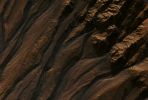
PSP_003583_1425_RED_browse-02.jpgGullies near Gorgonum Chaos (edm - Natural Colors; credits: Dr M. Faccin)54 visitePSP_003583_1425 shows incredible details of an Unnamed Crater with Gullies that provides strong evidence for gully formation involving fluid flow.
Of note is the variety of gully morphologies along the crater walls. The North and West Walls have Gullies, while the South Wall has only Landslides.
"Mass Wasting" is the more general term geologists use to describe Landslides, slumps, and other movements of the ground in response to gravity. It usually occurs on steep slopes when the force of gravity causes weak or loose material to travel downslope. Mass Wasting produces structures that are sometimes similar to gully channels, but which can usually be distinguished by their occurrence on steep slopes.
The Gullies on the North Wall have eroded all the way to the Crater Rim. They appear older than other nearby Gullies because they have existed long enough to be modified by permafrost processes as evidenced by the polgyonal fractures found on some of the channel and inter-gully walls.
Another noticeable difference among the gullies is channel lengths. The Gullies on the North Wall and the group just to the left of these have much shorter channels than the Gullies on the North-Western Wall. It is possible that the Gullies with shorter channels had less fluid flow through their systems. The Gullies appear to originate around a sequence of rocky layers near the Crater Rim.
Many of the gully channels appear to have boulders littered throughout. This is suggestive of a fluid flowing in these channels; a fluid would preferentially transport smaller particles and leave behind the larger ones, such as the boulders seen here.
There are many overprinted small channels in each gully, as can be seen in this edm. These are indicative of multiple flow events such that some channels experience flow, then are abandoned.
The edm also shows several channels merging.
Particularly interesting is the channel flowing from the top of the scene. There are several intertwining channels that merge into one just to the right of the center of the subimage. However, the way some channels truncate others suggests that there were at least three episodes of flow through this area. (written by Kerry Kolb)MareKromium
|
|
| 25353 immagini su 2113 pagina(e) |
 |
|
|
|
|
2084 | |
|
|
|
|





