| Piú viste |
Eclipse-N00136236.gifEclipse... (GIF-Movie; credits: Dr G. Barca)54 visiteUno spettacolare GIF-Movie realizzato dal nostro (sempre più bravo) Dr Barca il quale ci mostra una stupenda eclissi mentre si materializza davanti agli "occhi elettronici" dell'Orbiter CASSINI.
Un "commento"? Ecco lo Spazio: l'Ultima Frontiera. La VERA e l'UNICA Ultima Frontiera.MareKromium
|
|

Pandora-PIA11499.jpgPandora54 visiteCaption NASA:"The thin shadow of the moon Pandora cuts across Saturn's narrow F-Ring.
As Saturn approaches its August 2009 Equinox, the planet's moons cast shadows onto the Rings. Pandora (about 81 Km, or approx. 50 miles across) is on the left of the image. Other bright points of light in the image are background stars.
This view looks toward the unilluminated side of the Rings from about 55° above the Ring-Plane. The image was taken in Visible Light with the Cassini Spacecraft narrow-angle camera on April 16, 2009. The view was obtained at a distance of approx. 1,3 MKM (such as about 808.000 miles) from Saturn and at a Sun-Saturn-Spacecraft, or Phase, Angle of 98°.
Image scale is roughly 8 Km (about 5 miles) per pixel".MareKromium
|
|

ESP_011898_1535_RED_abrowse.jpgPossible MSL Landing Site in Holden Crater (Natural Colors; credits: Lunar Explorer Italia)54 visitenessun commentoMareKromium
|
|

OPP-SOL1894-GB-LXT.jpgOrange Pebble in a Sea of Berries - Sol 1894 (Natural Colors; credits: Dr G. Barca & Lunar Explorer Italia)54 visitenessun commentoMareKromium
|
|

Titan-PIA11508.jpgTitan in Eclipse54 visiteCaption NASA:"The Cassini spacecraft captured this image of a dimly lit Titan as Saturn's largest moon was eclipsed by the Planet.
This view looks up toward the South Pole of Titan which lies on the Terminator about a quarter of the way inward from the right of the visible disk. Lit terrain seen here is on the Saturn-facing side of Titan. In Saturn's shadow, the Southern Hemisphere of Titan is lit by two sources: sunlight scattered through the Planet's Rings and refracted sunlight passing through the edge of Saturn's Atmosphere.
Stars in this image are smeared by the long camera exposure time of 560" needed to capture the faint light on Titan. The image was taken in Visible Light with the Cassini Spacecraft wide-angle camera on May 7, 2009. The view was acquired at a distance of approx. 667.000 Km (about 414.000 miles) from Titan and at a Phase Angle of 58°.
Image scale is roughly 40 Km (about 25 miles) per pixel".MareKromium
|
|

Titan-Clouds-02.jpgTitan's South Polar Cloud Burst54 visiteThis InfraRed image of Saturn's moon Titan shows a large burst of clouds in the moon's South Polar Region. These clouds form and move much like those on Earth, but in a much slower, more lingering fashion, new results from NASA's Cassini Spacecraft show.
This image is a color composite, with red shown at a 5-micron wavelength, green at 2.7 microns and blue at 2 microns. An InfraRed color mosaic is also used as a background image (red at 5 microns, green at 2 microns, blue at 1.3 microns).
The images were taken by Cassini's visual and InfraRed Mapping Spectrometer during a flyby of Titan on March 26, 2007, known as T27.
Titan's Southern Hemisphere still shows a very active meteorology (the cloud appears in white-reddish tones) even in 2007. According to climate models, these clouds should have faded out since 2005.
Scientists have monitored Titan's Atmosphere for 3-and-a-half years, between July 2004 and December 2007, and observed more than 200 clouds.
The way these clouds are distributed around Titan matches scientists' global circulation models. The only exception is timing — clouds are still noticeable in the Southern Hemisphere while Fall is approaching.
Scientists will continue to observe the long-term changes during Cassini's extended mission, which runs until the fall of 2010.MareKromium
|
|

Titan-Clouds-01.jpgTitan's Lingering Clouds54 visiteLots of clouds are visible in this InfraRed image of Saturn's moon Titan. These clouds form and move much like those on Earth, but in a much slower, more lingering fashion, new results from NASA's Cassini Spacecraft show.
Scientists have monitored Titan's Atmosphere for 3-and-a-half years, between July 2004 and December 2007, and observed more than 200 clouds.
The way these clouds are distributed around Titan matches scientists' global circulation models. The only exception is timing — clouds are still noticeable in the Southern Hemisphere while Fall is approaching.
Three false-color images make up this mosaic and show the clouds at 40 to 50° mid-Latitude. The images were taken by Cassini's Visual and InfraRed Mapping Spectrometer during a close flyby of Titan on Sept. 7, 2006, known as T17.
Each image is a color composite, with red shown at the 2-micron wavelength, green at 1.6 microns and blue at 2.8 microns. An infrared color mosaic is also used as a background (red at 5 microns, green at 2 microns and blue at 1.3 microns).
The characteristic elongated mid-Latitude clouds, which are easily visible in bright bluish tones (see close-up in the inset) are still active even late into 2006-2007. According to climate models, these clouds should have faded out since 2005.
Scientists will continue to observe the long-term changes during Cassini's extended mission, which runs until the fall of 2010.MareKromium
|
|
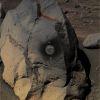
SOL060-GB.jpgStrong Abrasion on Humphrey - Sol 60 (possible True Colors; credits: Dr G. Barca)54 visitenessun commentoMareKromium
|
|
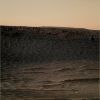
SOL070-GB-LXT.jpgSpectacular Dunefield inside Bonneville Crater - Sol 70 (possible True Colors; credits: Dr G. Barca & Lunar Explorer Italia)54 visitenessun commentoMareKromium
|
|

SOL074-GB-LXT2.jpgThe "Columbia Hills" in the distance - Sol 74 (Natural Colors; credits: Dr G. Barca & Lunar Explorer Italia)54 visitenessun commentoMareKromium
|
|

SOL074-GB-LXT3.jpgThe "Columbia Hills" in the distance - Sol 74 (Natural Colors; credits: Dr G. Barca & Lunar Explorer Italia)54 visitenessun commentoMareKromium
|
|

Craters-Unnamed_South_Polar_Crater-IR-MO-20090617a.jpgSouthern Crater Dunes (IR - Natural Colors; credits for the additional process. and color.: Dr Paolo C. Fienga - Lunar Explorer Italia)54 visiteCaption NASA:"Many craters around the South Polar Cap contain Dunefields on their Floors. This is one example of such a crater. This image was taken with the THEMIS InfraRed Camera and shows the warm daytime temperature of the dunes compared to the surrounding materials".MareKromium
|
|
| 25353 immagini su 2113 pagina(e) |
 |
|
|
|
|
2083 | |
|
|
|
|





