| Piú viste |
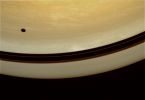
Saturn-PIA10512.jpgLonely Shadow... (possible True Colors; credits: Lunexit)54 visiteCaption NASA:"The shadow of Tethys drifts across the face of Saturn. Nearby, shadows of the Planet's Rings form a darkened band above the Equator. This view looks toward Saturn from a vantage point 63° North of the Equator.
The image was taken in visible green light with the Cassini Spacecraft wide-angle camera on Oct. 1, 2008. The view was acquired at a distance of approx 615.000 Km (about 382000 miles) from Saturn.
Image scale is roughly 37 Km (approx. 23 miles) per pixel".MareKromium
|
|
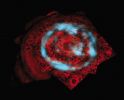
Saturn-PIA11396.jpgSouth Polar Aurora on Saturn54 visiteCaption NASA:"This image of the North Polar Regions of Saturn shows both the Aurora and underlying Atmosphere, seen at 2 different wavelengths of IR light as captured by NASA's Cassini spacecraft.
Energetic particles, crashing into the Upper Atmosphere cause the Aurora, shown in blue, to glow brightly at 4 microns (six times the wavelength visible to the human eye). The image shows both a bright ring, as seen from Earth, as well as an example of bright Auroral Emission within the Polar Cap that had been undetected until the advent of Cassini.
This Aurora, which defies past predictions of what was expected, has been observed to grow even brighter than is shown here. Silhouetted by the glow (cast here to the color red) of the hot interior of Saturn (clearly seen at a wavelength of 5 microns, or seven times the wavelength visible to the human eye) are the clouds and haze that underlie this Auroral Region. For a similar view of the Region beneath the Aurora see PIA09185.
This image is a composite captured with Cassini's Visual and Infrared Mapping Spectrometer. The aurora image was taken in the near-infrared on Nov. 10, 2006, from a distance of about 1 MKM (such as about 659.000 miles), with a phase angle of 157° and a sub-Spacecraft Planetocentric Latitude of 52° North.
The image of the clouds was obtained by Cassini on June 15, 2008, from a distance of approx. 602.000 Km (such as about 374.000 miles) and a sub-Spacecraft Planetocentric Latitude of 73° North".MareKromium
|
|
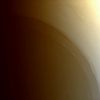
Saturn-PIA10513.jpgThe South Pole of Saturn (natural colors; credits: Lunexit)54 visiteCaption NASA:"Long streamers of cloud encircle the South Polar Region of Saturn. Farther poleward, or toward lower left, faint, deeper atmospheric structures lurk beneath the haze.
This image was acquired from a vantage point 74° South of the Planet's equator.
The view was taken with the Cassini spacecraft wide-angle camera on Oct. 2, 2008 using a spectral filter sensitive to wavelengths of IR light centered at 728 nanometers. The view was obtained at a distance of approx. 369.000 Km (such as about 229.000 miles) from Saturn.
Image scale is roughly 19 Km (about 12 miles) per pixel".MareKromium
|
|

OPP-SOL570-3.jpgSolar Panels and Paving - Sol 570 (possible True Colors; credits: Dr G. Barca & Lunexit)54 visitenessun commentoMareKromium
|
|

OPP-SOL559-2.jpgThe Beautiful "Martian Paving" - Sol 559 (possible True Colors; credits: Dr G. Barca & Lunexit)54 visitenessun commentoMareKromium
|
|

Pallene-N00119642.jpgPallene54 visitePallene è un satellite naturale minore del pianeta Saturno, la cui orbita è situata fra quelle di Mimas ed Encelado. Pallene è stata scoperta nel 2004 da Sébastien Charnoz del Cassini Imaging Team, il gruppo scientifico responsabile dell'analisi delle immagini scattate dalla Sonda Cassini, guidato da Carolyn Porco.
Dopo aver ricevuto la designazione provvisoria S/2004 S 2, il satellite fu successivamente battezzato dall'Unione Astronomica Internazionale con il nome di Pallene, una Ninfa della mitologia greca. Si rilevò inoltre che il satellite coincideva con un oggetto avvistato il 23 agosto 1981 in una singola fotografia scattata dalla sonda spaziale Voyager 2, con una distanza stimata da Saturno di circa 200.000 km; al satellite, di cui non fu possibile stabilire l'orbita esatta, venne allora attribuita la designazione S/1981 J 14.
L'orbita di Pallene è visibilmente influenzata da una Risonanza Orbitale con Encelado, molto più grande, anche se l'effetto è meno intenso rispetto alle perturbazioni esercitate da Mimas sulla vicina Metone. Il fenomeno è all'origine delle oscillazioni periodiche nel semiasse maggiore di circa 4 Km, e della longitudine del Nodo Ascendente di 0,02° (pari a circa 75 Km). Anche l'Eccentricità Orbitale di Pallene varia (fra 0,002 a 0,006), mentre la sua Inclinazione oscilla fra 0,178° e 0,184°.MareKromium
|
|

OPP-SOL570-6.jpgSolar Panels and Paving - Sol 570 (possible True Colors; credits: Dr G. Barca & Lunexit)54 visitenessun commentoMareKromium
|
|

OPP-SOL570-5.jpgThe "JPL TradeMark" - Sol 570 (possible True Colors; credits: Dr G. Barca & Lunexit)54 visitenessun commentoMareKromium
|
|
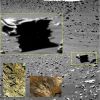
SOL765-2P194275970EFFAOG2P2277L7M1-1~0.jpgMars and Earth: a comparison - Sol 765 (insets by Dr Gualtiero La Fratta)54 visiteRocce "bizzarre" su Marte? Si, quasi una regola! Ma anche la Terra non scherza (come il bravissimo Dr La Fratta ci mostra e ci ricorda)...MareKromium
|
|

SOL753-1_copia-2.jpgMosaic-like Rock - Sol 753 (natural colors; credits: Dr G. Barca)54 visitenessun commentoMareKromium
|
|

SOL750-1_copia2.jpgMosaic-like Rock - Sol 750 (natural colors; credits: Dr G. Barca)54 visitenessun commentoMareKromium
|
|

SOL777-1_copia2.jpgGusev's Volcanic Paving - Sol 777 (possible True Colors; credits: Dr G. Barca)54 visitenessun commentoMareKromium
|
|
| 25353 immagini su 2113 pagina(e) |
 |
|
|
|
|
2081 | |
|
|
|
|





