| Piú viste |
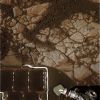
OPP-SOL570-4.jpgSolar Panel and Paving - Sol 570 (possible True Colors; credits: Dr G. Barca & Lunexit)54 visitenessun commentoMareKromium
|
|
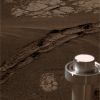
OPP-SOL570-3~0.jpgRover Tracks and Antenna MAST - Sol 570 (possible True Colors; credits: Dr G. Barca & Lunexit)54 visitenessun commentoMareKromium
|
|

PSP-20081120_spirit.jpgSpirit from orbit54 visiteThe solar system's most celebrated team of off-planet drivers cheered when they heard the news. Spirit had phoned home from Mars, ending four days of silence. The team had kept the rover safe, with help from a friend named "Marci."
Spirit had survived a fierce and sudden dust storm that had driven solar power to all-time lows. Without being able to notify Earth, Spirit had followed instructions the team sent to protect the rover.
The team had received warning from scientists who keep tabs on Martian weather with MARCI -- short for Mars Color Imager. From orbit, the instrument showed thick, swirling dust clouds advancing from the west. Engineers responded with instructions to conserve energy. They told Spirit to turn off a heater and do only two things each day -- check battery power and dust in the atmosphere.
As directed, Spirit contacted Earth on Nov. 13, 2008. MareKromium
|
|

Saturn-W00051225-MF.jpgThe colourful Upper Atmosphere of Saturn (True - but enhanced - Colors; credits: Dr M. Faccin)54 visiteUn frame bellissimo, ed incommentabile...MareKromium
|
|

SOL287-5~0.jpgOn the move... - Sol 287 (possible True Colors; credits: Dr G. Barca)54 visitenessun commentoMareKromium
|
|
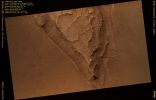
PSP_006005_2050_RED-00-PCF-LXTT.jpgStreamlined Island in Kasei Valles (Saturated Natural Colors; credits for the additional process. and color.: Dr Paolo C. Fienga - Lunexit Team)54 visiteIn this picture there is a Streamlined Island: one of many observed in the large outflow channels on Mars. This outflow channel is called Kasei Valles, and is one of the largest catastrophic outflow channels on Mars.
The Streamlined Island forms as water flows through the channel, but is blocked by some sort of obstacle, such as a crater or other topographic landform. In this HiRISE image, we only see the very tail end of the Streamlined Island, which is over 118 Km in length.
The platy surface within the channels has been attributed to either later lava or mud flows along the surface. The island itself is quite dusty and covered in small craters, so the island may be quite old. Along the edge of the island, however, you can see individual layers of rock.
These layers represent individual rock units that may be volcanic or sedimentary in origin.MareKromium
|
|

SOL033-7-prospect.jpgSpirit's "Nest" - Sol 33 (possible True Colors; credits: Dr G. Barca)54 visitenessun commentoMareKromium
|
|

Mimas___Prometheus-PIA10523.jpgThe "Ring-Masters" of Saturn54 visiteCaption NASA:"Two moons that have profound impacts on the Rings of Saturn, Mimas and Prometheus, are seen here with the F-Ring.
Mimas (approx, 396 Km, or about 246 miles across), the larger and much more distant of the moons, creates the Cassini Division: between the A and B-Rings.
Prometheus (approx. 86 Km, or about 53 miles across), although much smaller than Mimas, is half of a duo responsible for maintaining the narrow FRing".MareKromium
|
|

20010119.jpgBright Crater Wall (natural colors; credits: Lunexit)54 visiteNEAR Shoemaker captured this image on January 11, 2001, while orbiting about 38 Km (approx. 24 miles) above Eros.
Material on the inner wall of the crater in the center of the image is brighter than the surrounding regolith and is thought to be subsurface material exposed when overlying, darker regolith slides off.
The whole scene is about 1,2 Km (such approx. 0,7 miles) across.MareKromium
|
|

SOL281-2N151318360EFF8987P0635L0M1.jpgMartian landscape on Sol 281 (natural colors; credits: Lunar Explorer Italia)54 visitenessun commentoMareKromium
|
|

TITAN-1.jpgCrescent Titan (possible True Colors; credits: Calvin J. Hamilton)54 visiteVi invitiamo a leggere, sul nostro blog TruePlanets, la prima parte della Monografia su Titano "Oltre la Nebbia", scritta dal Dr Paolo C. Fienga.
Un tentativo - si spera riuscito - di riassumere in un quantitativo ragionevole di pagine le ultime scoperte relative alla Luna Nebbiosa.
Nella prima parte, un pò di Storia, di Geografia e di Meteorologia, ed una serie di riflessioni dedicate ai "Colori di Titano" (perchè non esistono solo i "Colori di Marte"...).
In seguito (parte seconda), la Geografia di dettaglio di Titano, con cenni alla sua Storia Geologica ed alla possibile evoluzione; nella parte terza, infine - pubblicazione prevista nel Marzo 2009 - qualche ipotesi sugli scopi e le modalità di colonizzazione dello Spazio Profondo...
Buona Lettura!MareKromium
|
|

TITAN-2.jpgCrescent Titan (possible True Colors; credits: Calvin J. Hamilton)54 visiteVi invitiamo a leggere, sul nostro blog TruePlanets, la prima parte della Monografia su Titano "Oltre la Nebbia", scritta dal Dr Paolo C. Fienga.
Un tentativo - si spera riuscito - di riassumere in un quantitativo ragionevole di pagine le ultime scoperte relative alla Luna Nebbiosa.
Nella prima parte, un pò di Storia, di Geografia e di Meteorologia, ed una serie di riflessioni dedicate ai "Colori di Titano" (perchè non esistono solo i "Colori di Marte"...).
In seguito (parte seconda), la Geografia di dettaglio di Titano, con cenni alla sua Storia Geologica ed alla possibile evoluzione; nella parte terza, infine - pubblicazione prevista nel Marzo 2009 - qualche ipotesi sugli scopi e le modalità di colonizzazione dello Spazio Profondo...
Buona Lettura!MareKromium
|
|
| 25353 immagini su 2113 pagina(e) |
 |
|
|
|
|
2080 | |
|
|
|
|





