| Piú viste |

OPP-SOL849-1F203557168EFF72H4P1151L0M1.jpgIgnis Fatuus on Mars... - Sol 84954 visiteDi "Fuochi Fatui" sulla Luna, grazie ai frames Apollo, ne abbiamo visti davvero tanti ma, a quanto pare, anche su Marte non si scherza a questo riguardo.
Per cui cosa dire?
Photoartifacts? No.
Riflessi? Può essere, ma riflessi di cosa?
Improvvisi "Scintillii" causati da outgassing di un qualche tipo? Diremmo di no: le "fiamme" da outgassing sono diverse.
E allora?
Giudicate Voi!...
|
|
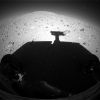
SOL151-2F139776571EFF62FOP1201L0M1.jpgMoving "Rocks" (1) - Sol 15154 visiteStimolati dal nostro caro Amico e Socio, Lorenzo Leone, abbiamo deciso di pubblicare i 4 frames (tutti Front HazCam, due relativi all'occhio Dx e due relativi all'occhio Sx) dai quali è stata estrapolato il collage che ci mostra il movimento (apparente o reale?) di due sassetti (vedi la Sez. Mars Spirit Anomalies).
In realtà, come lo stesso Sig. Leone sottolinea, "il movimento dei due sassi - laddove reale ed effettivo - deve essere movimento di entrambi, poichè i punti di riferimento attorno ad essi, cambiano radicalmente".
E' vero: giudicate Voi stessi e, per Vostra informazione, sappiate che i 4 frames cono stati ottenuti fra le 14:21:45 e le 14:23:18 MLT.
Inutile dire che sono i frames come questi a suscitare, in tutti noi, un grande sconcerto: che cosa stiamo guardando, realmente?!?
|
|

SOL151-2F139776666EFF6300P1210R0M1.jpgMoving "Rocks" (4) - Sol 15154 visitenessun commento
|
|
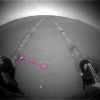
OPP-SOL848-1F203469129EFF72DKP1205R0M1.jpgMartian Snake sticks-up?!? - Sol 84854 visiteCerchiatura Viola: sembra (effettivamente!) la testolina di un serpentello che sbuca dal terreno e guarda, con aria per nulla intimorita (anzi, si direbbe piuttosto "seccata"...), quella "cosa" - il MER Opportunity - che gli è appena passata accanto.
Questa, come ovvio, è fantasia...O no?!?
|
|
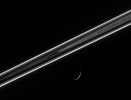
The Rings&Dione-PIA08201.jpgLike Neon-Lights...54 visiteCaption originale:"The dark side of the Ring-Plane glows with scattered light, including the luminous F-Ring, which shines like a rope of brilliant neon.
Below, Dione (1.126 Km, or 700 miles across) presents an exquisitely thin crescent.
The image was taken using a spectral filter sensitive to wavelengths of infrared light centered at 930 nanometers and it was acquired with the Cassini spacecraft narrow-angle camera on May 3, 2006 at a distance of approx. 1,8 MKM (about 1,1 MMs) from Dione and at a phase angle of 160°. Image scale is roughly 11 Km (about 7 miles) per pixel".
|
|
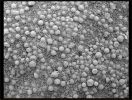
OPP-SOL825-Alamogordo_Creek-B849R1-3.jpgAlamogordo Creek - detail mgnf (3) - Sol 82554 visiteThe Microscopic-Imager frame covers the area outlined by the white boxes in both the PanCam views, a rectangle 3 cm (1,2") across.
As Opportunity traverses to the South, it is analyzing soil and rocks along the way for differences from those seen earlier. At this site, the soil contains abundant small spherical fragments, thought to be Hematite-rich concretions, plus finer-grained basaltic sand. Most of the spherical fragments seen in the Microscopic Image are smaller than those first seen at the Rover's Landing Site (Eagle Crater), some 5 Km (about 3,1 miles) to the North. However, a few larger spherical fragments and other rock fragments can also be seen in the PanCam images".
|
|

Pan-PIA08320.jpgPan through the Rings54 visiteCaption originale:"Saturn's small, walnut-shaped moon, Pan, embedded in the Planet's Rings.
This image was taken in visible light with the Cassini spacecraft narrow-angle camera on April 29, 2006, at a distance of approximately 209.000 Km (about 130,000 miles) from Pan.
The image scale is approx. 1 Km per pixel".
|
|

OPP-SOL855-PIA08565-1.jpgBeagle Crater (normal) - Sol 85554 visiteCaption NASA originale:"This imagery from the PanCam on NASA's MER Opportunity shows the outcrop-rimmed "Beagle Crater" appearing on the horizon as Opportunity approaches it. The stretched version (see the following frame) is vertically stretched to make horizon details easier to see. The un-stretched version (such as this one) has normal proportions. The image is a mosaic of frames taken during Opportunity's 855th Martian day, or Sol (such as June 20, 2006).
Beagle Crater is 35 meters (about 115 feet) in diameter. The Opportunity science and engineering teams hope to have the Rover visit it on the way to Victoria Crater. Beagle Crater was 310 meters (about 1.107 feet) away from Opportunity when this picture was taken. Even at this distance, blocks of ejecta can be seen around the prominent, raised rim of Beagle crater, suggesting that it may be among the youngest craters visited by Opportunity".
|
|

OPP-SOL862-1R204713013EFF73IEP1311L0M1-1.jpgBright rock (context image) - Sol 86254 visitenessun commento
|
|

OPP-SOL864-1R204886727EFF73L6P1375R0M1.jpgThe way behind (2) - Sol 86454 visite"Right Rear HazCam Non-linearized Full frame EDR acquired on Sol 864 of Opportunity's mission to Meridiani Planum at approx. 12:49:35 MLT"
|
|

OPP-SOL864-1R204888439EFF73O9P1311L0M1.jpgThe way behind (5) - Sol 86454 visite"Left Rear HazCam Non-linearized Full frame EDR acquired on Sol 864 of Opportunity's mission to Meridiani Planum at approx. 13:17:21 MLT"
|
|
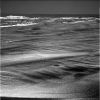
OPP-SOL869-1P205336830EFF73U6P2438R2M1.jpgIf this is not a fake... (1) - Sol 86954 visiteDue frames PanCam, uno più falso dell'altro: osservate le immagini, la grana, i dettagli e poi domandateVi se quello che vedete è il vero Marte, oppure la sua versione digitalizzata (per giunta di pessima qualità).
Caption NASA:"Right PanCam Non-linearized Full frame EDR acquired on Sol 869 of Opportunity's mission to Meridiani Planum at approximately 14:31:37 MLT; camera commanded to use Filter 2 (754 nm)".
|
|
| 25353 immagini su 2113 pagina(e) |
 |
|
|
|
|
2076 | |
|
|
|
|





