| Piú viste |

OPP-SOL335-1P157922265EFF40B8P2364R1M1.jpgMulticolored Reflections or just "something else"? (1) - elab. in MULTISPECTRUM, by Lunexit54 visiteForse si tratta solo di un curioso riflesso multicolore, determinato da un particolare gioco di luci e di angoli di ripresa; o forse, come noi cercheremo di dimostrare attraverso una serie di elaborazioni ulteriori dei frames che mostrano queste bizzarre "bolle di luce" - come le ha correttamente definite il Dr Faccin -, si potrebbe trattare di un fenomeno elettrico superficiale.
Sin d'ora ringraziamo, per il grande aiuto, la pazienza e l'attenzione messa nell'effettuazione delle elaborazioni sulle immagini originali NASA e per il bellissimo GIF-Movie che segue, due fra i nostri più cari e preziosi Amici e Collaboratori: il Dr Gianluigi Barca (per il GIF-Movie) ed il Dr Marco Faccin (per le elaborazioni, gli ingrandimenti ed il fotomosaico che seguono).
E grazie a Voi, Cari Amici Lettori e Soci, che continuate a leggere le nostre pagine ed a fare sempre più domande, "costringendoci" - in un certo senso - a migliorare quotidianamente l'approccio verso questa Materia, tanto Meravigliosa e Complessa quanto, alle volte, terribilmente elusiva...MareKromium
|
|

OPP-SOL323.jpgRecent crack on the Paving - Sol 323 (natural colors; elab. Dr Marco Faccin)54 visitenessun commentoMareKromium
|
|

Epimetheus-N00098342.jpgEpimetheus (2)54 visiteCaption NASA:"N00098342.jpg was taken on December 03, 2007 and received on Earth December 04, 2007. The camera was pointing toward EPIMETHEUS that, at the time, was approximately 40.388 Km away, and the image was taken using the RED and CL2 filters.
This image has not been validated or calibrated".MareKromium
|
|

as16-107-17423.JPGAS 16-107-17423 - Beautiful Desolation (4)54 visitenessun commentoMareKromium
|
|
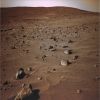
SOL365-2N158774840EFFA2DHP0645R0M1.jpgOne year on Mars: panorama from the Columbia Hills (2 - natural colors; elab. Lunexit))54 visitenessun commentoMareKromium
|
|
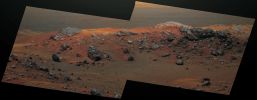
SOL608-A_P2582_3_L257-A625R1.jpg"Hillary" and "Tenzing" outcrops - Sol 608 (MULTISPECTRUM; elab. Lunexit)54 visitenessun commentoMareKromium
|
|

OPP-SOL122.jpgBerries near the Martian Sandglass - Sol 122 (natural colors and MULTISPECTRUM; credits: Dr Gianluigi Barca & Lunexit)54 visitenessun commentoMareKromium
|
|

OPP-SOL344-2.jpgWater Droplets INSIDE the Heat-Shield? - Sol 344 (context frame + extra-detail mgnf; credits: Dr M. Faccin)54 visitenessun commentoMareKromium
|
|

The_Rings-PIA10082.jpgMittens54 visiteCaption NASA:"This is an artist concept of the view from Cassini during the star occultation that detected "Mittens," the small object to the right of the star. As Cassini watched the star pass behind Saturn's F-Ring (foreground), the star blinked out when Mittens blocked it, indicating it may be a solid moonlet".MareKromium
|
|
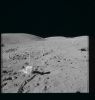
as16-113-18367.JPGAS 16-113-18367 - The "Heat Flow Electronics Package"54 visiteRightward of 18366, showing the Heat Flow Electronics (HFE) package with the drill stem rack and drill beyond the HFE to the right. Farther back on the right we can see the raised handle of the jack with which Charlie Duke removed the deep core.
Stone Mountain and the white ejecta blanket of South Ray Crater are in the distance.MareKromium
|
|

Neptune-PIA09927.jpgThe "Hot" South Pole of Neptune54 visiteCaption NASA:"These thermal images show a "hot" South Pole on the Planet Neptune. These warmer temperatures provide an avenue for Methane to escape out of the deep atmosphere.
The images were obtained with the Very Large Telescope in Chile, using an imager/spectrometer for mid-infrared wavelengths on Sept. 1 and 2, 2006.
The telescope is operated by the European Organization for Astronomical Research in the Southern Hemisphere (known as ESO).
Scientists say Neptune's South Pole is "hotter" than anywhere else on the Planet by about 10° Celsius (50 degrees Fahrenheit). The average temperature on Neptune is about -200° Celsius (-392 degrees Fahrenheit).
The upper left image samples temperatures near the top of Neptune's troposphere (near 100 millibar pressure, which is 1/10th the Earth atmospheric pressure at sea level). The hottest temperatures are indicated at the lower part of the image, at Neptune's south pole (see the graphic at the upper right).
The lower two images, taken 6.3 hours apart, sample temperatures at higher altitudes in Neptune's stratosphere. They do show generally warmer temperatures near, but not at, the south pole. They also show a distinct warm area which can be seen in the lower left image and rotated completely around the back of the planet and returned to the earth-facing hemisphere in the lower right image".MareKromium
|
|

SOL335-2N156104056EFF9946P0757R0M1.jpgSand dunes near Spirit, on Sol 335 (2 - MULTISPECTRUM; credits: Lunexit)54 visitenessun commentoMareKromium
|
|
| 25353 immagini su 2113 pagina(e) |
 |
|
|
|
|
2072 | |
|
|
|
|





