| Piú viste |

as09-19-2983.jpgAS 09-19-2983 - E.V.A.54 visitenessun commentoMareKromium
|
|

SOL633-HillaryOutcrop-AW.jpgHillary Outcrop (natural colors - elab. Aviation Week)54 visiteDa "NASA - Picture of the Day" del 13 Marzo 2007:"The Spirit rover attacked Mars again in 2005 September. What might look, above, like a military attack, though, was once again just a scientific one - Spirit was instructed to closely inspect some interesting rocks near the summit of Husband Hill. Spirit's Panoramic Camera captured the Rover's Instrument Deployment Device above as moved to get a closer look at an outcrop of rocks named Hillary. The Spirit rover, and its twin rover Opportunity, have now been exploring the red planet for over three years. Both Spirit and Opportunity have found evidence that parts of Mars were once wet".MareKromium
|
|

The_Rings-PIA08903.jpgF-Ring or just "Saturnian Neon-Lights"?...54 visiteCaption NASA:"Bright strands in Saturn's ever changing F-Ring emerge from the Planet's shadow. The F-Ring usually has a single bright core, about 50 Km (31 miles) across, but the section of the ring seen here appears to have a second bright strand.
Several background stars are visible by the trails they created while the image was being exposed.
This view looks toward the unlit side of the Rings from about 59° above the Ring-Plane.
The image was taken in visible light with the Cassini spacecraft narrow-angle camera on Feb. 9, 2007 at a distance of approx. 1,7 MKM (about 1,1 MMs) from Saturn.
Image scale is roughly 10 Km (about 6 miles) per pixel".
|
|

as16-119-19128.jpgAS 16-119-19128 - Herigonius Twins (2)54 visiteImage Collection: 70mm Hasselblad
Mission: 16
Magazine: 119
Magazine Letter: RR
Latitude: 16,6° South
Longitude: 31,5° West
Camera Altitude: 123 Km
Film Type: SO-368
Film Width: 70 mm
Film Color: color
Feature(s): HERIGONIUS ETA and HERIGONIUS PI
|
|
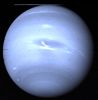
vg2_1124347.jpgNeptune (natural colors - elab. Lunexit)54 visitenessun commento
|
|

Enceladus.jpgEnceladus, the "E-Ring Creator"...54 visiteCaption NASA:"The active moon Enceladus appears to be making Saturn's E-Ring. An amazing picture showing the moon at work was taken late last year (AD 2006) by the Saturn-orbiting Cassini spacecraft and is shown above. Enceladus is the bright point near the center, right near the center of Saturn's E-Ring. Streams of ice and water vapor can be seen pouring off Enceladus into the E-Ring.
The above bright image of the normally faint E-Ring was made possible by aligning Cassini so that Saturn blocked the Sun. From that perspective, small ring particles reflect incoming sunlight more efficiently. Cassini has now been orbiting Saturn for almost three years, and is scheduled to swoop by the unexpectedly cryovolcanic Enceladus at least several more times".MareKromium
|
|

The_Rings-PIA08905.jpgClumps in the F-Ring54 visiteCaption NASA:"The brilliant core of the F-Ring displays a breakaway clump of material, possibly related to the other objects the Cassini spacecraft has witnessed in this dynamic Ring in the past few years of observations.
This view looks toward the unlit side of the Rings from about 58° above the Ring-Plane.
The image was taken in visible light with the Cassini spacecraft narrow-angle camera on Feb. 10, 2007 at a distance of approx. 1,7 MKM (1,1 MMs) from Saturn.
Image scale is roughly 10 Km (about 6 miles) per pixel".MareKromium
|
|

Saturn-PIA08366.jpgSaturn and Rhea54 visiteCaption NASA:"A serene orb of ice is set against the gentle pastel clouds of giant Saturn. Rhea transits the face of the gas giant, whose darkened Rings and their planet-hugging shadows appear near upper right.
Rhea is the second largest of Saturn's moons.
This view looks toward the unilluminated side of the Rings from about 3° above the Ring-Plane.
Images taken using red, green and blue spectral filters were combined to create this natural color view. The view was acquired with the wide-angle camera on Feb. 4, 2007. Cassini acquired the view at a distance of approx. 1,2 MKM (about 700.000 miles) from Saturn and approx. 679.000 Km (about 422.000 miles) from Rhea.
Image scale is roughly 68 Km (about 42 miles) per pixel on Saturn and about 40 Km (about 25 miles) per pixel on Rhea".
|
|

vg2_1129248.jpgOn the way to Neptune... (natural colors, according to Lunexit)54 visitenessun commentoMareKromium
|
|

Atlas-PIA08906.jpgAtlas and the F-Ring54 visiteCaption NASA:"The Cassini spacecraft gazes toward the multiple strands of the ever-changing F-Ring, also sighting Atlas at its station just beyond the A-Ring edge.
A few faint background stars are visible in the image. Atlas, which appears left of center, is 32 kilometers (20 miles across).
This view looks toward the unlit side of the Rings from about 58 degrees above the ringplane.
The image was taken in visible light with the Cassini spacecraft narrow-angle camera on Feb. 10, 2007 at a distance of approx. 1,7 MKM (such as about 1,1 MMs) from Atlas and at a Sun-Atlas-spacecraft, or phase, angle of 128°. Image scale is roughly 10 Km (such as about 6 miles) per pixel".MareKromium
|
|

The_Rings-PIA08908.jpgA huge clump in the F-Ring54 visiteCaption NASA:"The F-Ring dissolves into a fuzzy stream of particles -- rather different from its usual appearance of a narrow, bright core flanked by dimmer ringlets.
Also notable here is the bright clump of material that flanks the Ring's core.
This view looks toward the unlit side of the rings from about 58° above the Ring-Plane.
The image was taken in visible light with the Cassini spacecraft narrow-angle camera on Feb. 10, 2007 at a distance of approx. 1,7 MKM (such about 1,1 MMs) from Saturn. Image scale is roughly 10 Km (about 6 miles) per pixel".
|
|

as09-19-3010.jpgAS 09-19-3010 - Green-and-Blue Planet!54 visitenessun commentoMareKromium
|
|
| 25353 immagini su 2113 pagina(e) |
 |
|
|
|
|
2067 | |
|
|
|
|





