| Piú viste |

18-vg1_1636738.jpgThe "Great White Spot" of Jupiter (one of the many...)54 visitenessun commento
|
|
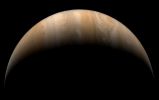
19-vg1_ipl260668.jpgCrescent Jupiter (HR)54 visitenessun commento
|
|
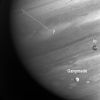
14-vg1_1610104.jpgJupiter, Io, Ganymede and...54 visiteL'oggetto indicato dalla freccia e contraddistinto da un "?" non è un photoartifact (nella maniera più categorica) e non è neppure una delle altre Lune Maggiori (o Galileiane) di Giove - e quindi non si tratta nè di Europa, nè di Callisto.
Abbiamo pensato potesse trattarsi di Amalthea, ma l'oggetto è troppo piccolo e non riusciamo a risolverlo per osservarne i dettagli superficiali e, soprattutto, le fattezze esteriori.
Se qualcuno di Voi avesse delle idee, ci scriva!
|
|

53-st123954_smart-1_moon_H.jpgThe Lunar Limb, from 600 Km54 visitenessun commento
|
|
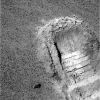
OPP-SOL929-1P210654840EFF759FP2376L4M1.jpgA small step for a Rover... - Sol 92954 visiteUna bellissima istantanea (diremmo quasi una 'Postcard from Mars') che, mutatis mutandis, ricalca in maniera impressionante il frame Apollo 11 con il quale veniva immortalata l'impronta di Armstrong sulla superficie della Luna (nostra immagine n. 10000). Nel 1969, era l'impronta di un Uomo; oggi, nel 2006, è l'impronta di una macchina.
Ma, sia come sia, in entrambi i casi si tratta di un "Giant Leap for Mankind".
|
|

44-vg1_1637750.jpgThe "Strange Companion" of Io (extreme detail mgnf)54 visiteL'oggetto a noi pare lo stesso (a tutti gli effetti) del frame VG1-1636836: il super-stretching ne evidenzia alcune, minime, caratteristiche superficiali e la sua dimensione apparente, a parità di stretching, suggerisce che esso si stia allontanando dalla Sonda Voyager.
Incredibile, vero?!?
Un vero peccato che, anche in questo caso, la NASA non abbia MAI speso una parola (se non altro per dire, ad esempio, "è solo un image artifact"...).
Mai.
|
|
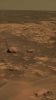
OPP-SOL901-PIA08753-002.jpgBeagle Crater and 360° Panorama from Sol 901 through 904 (2)54 visiteCaption NASA originale:"Though it looks relatively fresh in orbital images, from a closer vantage point Beagle Crater appears moderately eroded.
The crater walls are slumped and the middle of the crater bowl is filled with rippled sand. However, a slightly raised crater rim remains, and in a few places (for instance, on the inside left wall), cliffs of outcrop appear to be preserved in the crater. Ejected rocks from Beagle Crater surround the Rover, many with the distinctive, fine-grained layering commonly seen in the rocks of Meridiani Planum. Many of these rocks have surfaces smoothed by wind erosion. Wind erosion also formed the sand drifts nestled among the rocks".
|
|
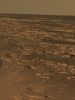
OPP-SOL901-PIA08753-003.jpgBeagle Crater and 360° Panorama from Sol 901 through 904 (3)54 visiteCaption NASA originale:"Because impact craters have well-understood shapes when they form, the altered appearance of eroded craters gives scientists clues to the processes that modified them. By observing how filled an impact crater has become and how worn its edges are, scientists can estimate how long its surface has been exposed to erosion. The many-sided outline of a crater such as Beagle and the blocky appearance of its ejecta may also tell scientists about the strength of the underlying bedrock. Based on observations such as these, scientists know that Beagle Crater is fresher than Eagle and Fram craters near Opportunity's Landing Site and more similar in form to Viking and Voyager craters in the plains to the North of Beagle".
|
|
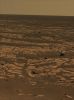
OPP-SOL901-PIA08753-004.jpgBeagle Crater and 360° Panorama from Sol 901 through 904 (4)54 visiteCaption NASA originale:"Opportunity made other observations at Beagle Crater, such as spectroscopic measurements taken with the PanCam and the Miniature Thermal Emission Spectrometer, to help scientists assess the composition of the rocks and determine whether Beagle Crater was excavated into the surface rocks of Meridiani Planum or into the ejecta blanket of Victoria Crater".
|
|
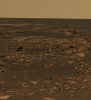
OPP-SOL901-PIA08753-006.jpgBeagle Crater and 360° Panorama from Sol 901 through 904 (6)54 visiteCaption NASA originale:"Opportunity took the mosaic of images that make up this 360-degree view of the Rover's surroundings with the Panoramic Camera (PanCam) on the Rover's 901st through 904th Soles, or Martian days (such as from Aug. 6 through Aug. 9, 2006), of exploration. This is an approximate true-color image combining exposures taken through the PanCam's 753-, 535- and 432-nanometer filters".
|
|

OPP-SOL901-PIA08753-009.jpgBeagle Crater and 360° Panorama from Sol 901 through 904 (8)54 visitenessun commento
|
|

OPP-SOL901-PIA08753-010.jpgBeagle Crater and 360° Panorama from Sol 901 through 904 (9)54 visitenessun commento
|
|
| 25353 immagini su 2113 pagina(e) |
 |
|
|
|
|
2061 | |
|
|
|
|





