| Piú viste |

OPP-SOL896-1N207728524EFF74YKP0666L0M1~0.jpgBeagle's Surroundings (3)55 visitenessun commento
|
|

OPP-SOL896-1P207729106EFF74YKP2355R2M1~0.jpgBeagle's Surroundings (5)55 visitenessun commento
|
|
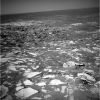
OPP-SOL898-1N207904322EFF74ZTP0650L0M1.jpgA look inside Beagle Crater (4) - Sol 89855 visitenessun commento
|
|

Nereid-vg2_1138148.jpgNereid (HR)55 visitenessun commento
|
|

Triton-vg2_p34665.jpgTriton (in natural colors and HR)55 visitenessun commento
|
|

The Rings-PIA08243.jpgThe Huygens "Gap"55 visiteCaption NASA:"The sharp outer boundary of Saturn's B-Ring, which is the bright ring region seen to the right in this image, is maintained by a strong resonance with the moon Mimas. For every two orbits made by particles at this distance from Saturn, Mimas makes one orbit.
The moon's repeated gravitational tugs force ring particles away from this region.
The dark region is called the "Huygens Gap" and it includes the bright, eccentric Huygens Ringlet, also visible here near center".
|
|
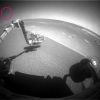
OPP-SOL910-1F208970165EFF748BP1110R0M1-A.jpgUFO? - Sol 910 (context image)55 visitenessun commento
|
|
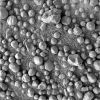
OPP-SOL910-1M208971935EFF748BP2936M2M1.jpgThe "Berries" of Beagle Crater (3) - Sol 91055 visitenessun commento
|
|

Dione-N00064763.jpgThe "Night" of Dione (3)55 visiteCaption NASA:"N00064763.jpg was taken on August 16, 2006 and received on Earth August 18, 2006.
The camera was pointing toward Dione that, at the time, was approximately 155.433 Km away.
This image was taken using the CL1 and CL2 filters".
|
|
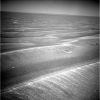
OPP-SOL912-1N209150120EFF7500P0695R0M1.jpgPanorama (2) - Sol 91255 visitenessun commento
|
|
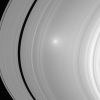
The Rings-PIA08247.jpgOpposition "Surge" on the A-Ring55 visiteThe Opposition Effect exists because of two contributing factors: one is due to the fact that the shadows of Ring particles directly opposite the Sun from Cassini - the Region of Opposition - fall completely behind the particles as seen from the spacecraft. These shadows are thus not visible to the spacecraft: all ring particle surfaces visible to the spacecraft in this image are in Sunlight and therefore bright. Much farther away from the Region of Opposition, the Ring particle shadows become more visible and the scene becomes less bright. The brightness falls off in a circular fashion around the Opposition Point. The main factor to the Opposition Surge in this image is an optical phenomenon called "coherent backscatter": here, the electromagnetic signal from the rays of scattered Sunlight making its way back to the spacecraft is enhanced near the Region of Opposition because, instead of canceling, the electric and magnetic fields comprising the scattered radiation fluctuate in unison.
|
|
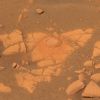
OPP-SOL896-B_P2558_1_True_RAD-B918R1.jpgBaltra - Sol 89655 visiteNASA's MER Opportunity recently stopped to analyze an exposure of rock near Beagle Crater, on a target nicknamed Baltra. Nearly 100 Soles have passed since Opportunity had last analyzed one of the now-familiar rock exposures seen on the Plains of Meridiani. The Rover ground a mm-deep (0,12"-deep) hole in the rock using the RAT on Sol 893 (July 29, 2006) while stationed about 25 mt (82 feet) from the South-West rim of Beagle Crater.
Scientists wanted to analyze the outcrop one more time before driving the Rover onto the ring of smooth material surrounding Victoria Crater. Opportunity's analysis showed the rock to be very similar in its elemental composition to other exposures encountered during the Rover's Southward trek across Meridiani Planum.
Opportunity acquired the image data shown here shortly after noon on Mars on Sol 896 (Aug. 1, 2006) with the PanCam after backing up 1 mt (3,3 feet) from Baltra to make sure that the target was in full Sunlight.
This is an approximately true-color Pancam image, generated from mathematical combinations of calibrated left-eye images using filters ranging from 432-nanometer to 753-nanometer wavelengths.
|
|
| 25353 immagini su 2113 pagina(e) |
 |
|
|
|
|
2045 | |
|
|
|
|





