| Piú viste |

SOL801-2N197469233EFFAQHAP1705R0M1.jpgDeep, salty Tracks... - Sol 80155 visitenessun commento
|
|

OPP-SOL781-1N197521286EFF6800P0705R0M1.jpgA Beautiful Landscape - Sol 78155 visitenessun commento
|
|

OPP-SOL779-1N197338622EFF67J9P1950R0M1.jpgDeep and bright tracks, on the way to Victoria (2) - Sol 77955 visiteCaption originale:"Right NavCam Non-linearized Full frame EDR acquired on Sol 779 of Opportunity's mission to Meridiani Planum at approximately 11:48:53 MLT".
|
|

SOL802-2P197563049EFFAQI8P2403L7M1-B~0.jpgBright light on Mars: photoartifact or Fast Moving Object? (2) - Sol 80255 visiteTutto ciò premesso, dobbiamo innanzitutto lodare l'occhio che il Dr Barca ha avuto nell'individuazione del dettaglio, e quindi - ahinoi... - dobbiamo anche dire che però, con ogni probabilità, si tratta di un photoartifact (un dead-pixel, versimilmente).
Come siamo arrivati a questa conclusione (interlocutoria, ovviamente, ma sostanziabile)? Mettendo in sequenza tutti i frames (divisi per Left e Right PanCam frames) e quindi abbiamo individuato le coordinate del punto luminoso.
Risultato: abbiamo visto che la presunta Anomalìa, anche se - a vista - sembra effettivamente un corpo reale (una "luce"), in realtà, nonostante il cambio di angolo di ripresa, si mantiene sempre sulle medesime coordinate.
Essa, in altre parole, rimane FERMA e FISSA, bloccata sempre allo stesso punto.
|
|

SOL802-2P197563205EFFAQI8P2403L7M1-2.jpgBright light on Mars: photoartifact or Fast Moving Object? (4) - Sol 80255 visite...E, come ovvio, non dovete crederci sulla parola...Provate a verificare Voi stessi!
|
|
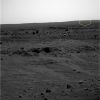
SOL802-2P197563205EFFAQI8P2403R1M1-2.jpgBright light on Mars: photoartifact or Fast Moving Object? (5) - Sol 80255 visitenessun commento
|
|

Japetus-N00056325.jpgDarker than the Night!55 visiteCaption originale:"N00056325.jpg was taken on April 07, 2006 and received on Earth April 08, 2006. The camera was pointing toward Japetus that, at the time, was approximately 923.304 Km away.
The image was taken using the CL1 and CL2 filters. This image has not been validated or calibrated".
|
|

Q-T-TerraCimmeria-PIA08052_modest.jpgTerra Cimmeria55 visiteThis scene in a Region of Mars named Terra Cimmeria shows a variety of ancient and recent geologic processes. In the upper portion of the image, a twisting ridge of raised ground may outline the location of a subsurface thrust fault. This type of fault results in the compression and crumpling of a Planet's surface. This crumpling of the Planet's surface has squeezed two originally circular craters on the ridge into oval-shaped craters. Valleys are also present throughout the image, suggesting that water flowed across this area a long time ago. Many valleys and craters in the image are now filled by deposits of dust or debris. This debris mantle is common over the middle latitudes of Mars and is a geologically recent deposit.
This image was taken by the High Resolution Imaging Science Experiment (HiRISE) camera onboard NASA's Mars Reconnaissance Orbiter spacecraft on March 25, 2006. The image is centered at 40,64° South latitude, 144,39° East Longitude. It is oriented such that North is 7° to the left of up. The range to the target was 2.038 Km (1.266 miles). At this distance the image scale is 2,04 meters (6,69 feet) per pixel, so objects as small as 6,1 mt (20 feet) are resolved. In total this image is 12,34 Km (such as about 7,67 miles) or 6.045 pixels wide and 34,68 Km (such as about 21,55 miles) or 17.003 pixels long. The image was taken at a Local Mars Time of 07:28 and the scene is illuminated from the upper right with a solar incidence angle of 82,0° (this meaning that the Sun was about 8,0° above the horizon).
|
|

OPP-SOL784-1P197781736EFF68DBP2385L2M1.jpgPaving and Rover Tracks - Sol 78455 visitenessun commento
|
|
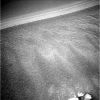
OPP-SOL786-1N197961630EFF68M8P1950R0M1.jpgMartian "sands" (close-up) - Sol 78655 visitenessun commento
|
|
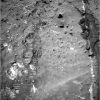
SOL806-2N197913106EFFAQKMP1919L0M1.jpgMartian "sands" (close-up) - Sol 80655 visitenessun commento
|
|

OPP-SOL749-B_P2545_1_True_RAD-B787R1.jpgLayers at Payson outcrop - Sol 74955 visiteCaption originale:"The stack of fine layers exposed at a ledge called Payson, on the western edge of Erebus Crater in Mars' Meridiani Planum Region, shows a diverse range of primary and secondary sedimentary textures formed billions of years ago. These structures likely result from an interplay between windblown and water-involved processes.
The PanCam on NASA's MER Opportunity acquired the exposures for this image on Spirit's 749th Sol (Feb. 10, 2006). This view is an approximately true-color rendering mathematically generated from separate images taken through all of the left PanCam's 432- to 753-nnmt filters".
|
|
| 25353 immagini su 2113 pagina(e) |
 |
|
|
|
|
2037 | |
|
|
|
|





