| Piú viste |

The Rings-PIA08295.jpgWhat's inside the Rings?55 visiteThe 2 prominent dark gaps in Saturn's A-Ring contain small embedded moons and a host of other intriguing features. Here, 3 unique ringlets are visible in the Encke Gap (about 325 Km wide). The innermost ringlet (topmost here) is faint but continuous. The center ringlet brightens substantially toward upper left and displays a few slight kinks. This ringlet is coincident with the orbit of Pan (about 26 Km across). The outermost ringlet is discontinuous, with two bright regions visible.
The narrower Keeler Gap (about 42 Km wide) hosts the moon Daphnis (7 Km across - not visible in this image), which raises waves in the Gap edges as it orbits Saturn. At lower left, faint ringlets flanking the bright F-Ring core are visible. These features were found by the Cassini spacecraft to be arranged into a spiral arm structure that winds around the Planet like a spring. The spiral may be caused by tiny moonlets or clumps of material that have smashed through the F-Ring core and liberated material.
This view looks toward the unlit side of the rings from about 23 degrees above the ringplane.
The image was taken in visible red light with the Cassini spacecraft narrow-angle camera on Sept. 11, 2006 at a distance of approximately 1.1 million kilometers (700,000 miles) from Saturn and at a Sun-Saturn-spacecraft, or phase, angle of 151 degrees. Image scale is about 6 kilometers (4 miles) per pixel.
|
|
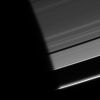
Saturn-PIA08297.jpgOut of the Dark...55 visiteCaption NASA:"As Ring particles emerge from the darkness of Saturn's shadow, they pass through a region of twilight. The Sun's light, refracted by the Planet's atmosphere, peeks around the limb, followed shortly by the Sun itself.
The "penumbra" is the narrow fringe Region of the Planet's shadow where part (but not all) of the Sun is visible around the side of the Planet, creating only a partial shadow there and making the shadow edge look fuzzy.
The A and F-Rings are captured here. This view looks toward the unlit side of the Rings from about 20° above the Ring-Plane. Two faint ringlets can be seen within the Encke Gap, which stretches out of the blackness at center and toward right.
The image was taken in visible light with the Cassini spacecraft narrow-angle camera on Sept. 12, 2006 at a distance of approx. 1,5 MKM (about 900.000 miles) from Saturn and at a phase angle of 163°. Image scale is roughly 9 Km (about 5 miles)".
|
|

Moon-Clem.JPG015 - The Moon (visible and near-infrared)55 visiteOne of the major scientific goals of the Clementine mission is to map the Moon in 11 different wavelengths in the visible and near-infrared parts of the spectrum. The filter colors of the Clementine cameras were carefully chosen to differentiate types of lunar surface material. In our first look at the global color, each Clementine image made by the UV/VIS camera has been reduced to its average value, producing a picture of the Moon at low resolution (about 50 kilometers per pixel). These pictures show the albedo (brightness) and color of the Moon from three aspects: the Earth-centered view (near side) with a 0 degree central longitude, and two far side views with 120 degrees East and 120 degrees West central longitudes. These images have been made by assigning colors to the relative reflectance values obtained through various filters, resulting in a map showing the compositional variation of the Moon.
Major compositional provinces in the highlands are evident. The large dark red-gray region on the far side is the South Pole-Aitken basin, an ancient impact feature that apparently contains rocks of distinct composition. A newly discovered compositional anomaly on the east limb of the Moon (pink area near center of 120 degrees East image) may be related to ancient flows of lava. The color picture shows that very high titanium lavas (deep blue and cyan colors) appear to be largely confined to the Oceanus Procellarum, Mare Imbrium, and Mare Tranquillitatis areas (near side). These views of the Moon in three colors only hint at the scientific richness contained within the Clementine global data, which will be investigated for years to come.
|
|

Original lunar orbiter frames-lo2-61h2-003.jpgOriginal Lunar Orbiter - Frame LO2-61h2-00355 visitenessun commento
|
|

as17-134-20446.JPGAS 17-134-20446 - The Mountains of the Moon55 visiteCaption originale:"123:06:24 MT - SEP site. This final frame from Gene Cernan's SEP partial pan shows the north arm of the SEP transmitter antenna".
|
|

as17-148-22607.JPGAS 17-148-22607 - Mother Earth55 visite
|
|

as17-148-22669.JPGAS 17-148-22669 - Mother Earth55 visite
|
|

as17-148-22671.JPGAS 17-148-22671 - Mother Earth55 visite
|
|

as17-148-22718~0.JPGAS 17-148-22718 - Southern Europe, East Africa and Arabic Peninsula55 visite
|
|

as17-148-22719.JPGAS 17-148-22719 - Africa55 visite
|
|

as17-148-22726.JPGAS 17-148-22726 - Africa, Madagascar, Arabic Peninsula and Antarctica55 visite
|
|

as17-145-22273.JPGAS 17-145-22273 - Docking Time!55 visiteCaption NASA originale:"CSM - orbit 52. The Command Module docking probe photographed from the Lunar Module during docking. The LM is the active vehicle during this maneuver. Craters visible on the Lunar Surface are Bessel and Deseilligny.
|
|
| 25353 immagini su 2113 pagina(e) |
 |
|
|
|
|
2032 | |
|
|
|
|





