| Piú viste |
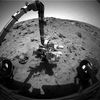
SOL571-2F177053260EFFADAEP1110R0M1.jpgOperating with the Robotic-Arm - Sol 57155 visiteOriginal caption:"Spirit has been busy performing investigations with the tools on its Robotic Arm: it studied two separate targets on the rock dubbed Bourgeoisie and did a small bump to Hausmann to take some Microscopic Images. The plan was to drive away the next day, but the uplink did not happen correctly. The drive was replanned for Aug. 5 (Sol 565). As of Sol 564, Spirit is approximately 100 mt (about 328 feet) from the summit and the Rover will continue driving towards it".
|
|
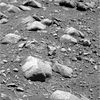
SOL571-2P177055116EFFADAEP2540L7M1.jpgRocks: Sol 57155 visitenessun commento
|
|
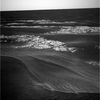
OPP-SOL550-1N177011874EFF58D4P1786L0M1.jpgOutcrops or Paving? (1) - Sol 55055 visiteProsieguo della panoramica a 360° operata da Opportunity durante il Sol 550 e ovvia reiterazione della domanda che, almeno a noi, non pare sia del tutto oziosa: che cosa stiamo guardando? Certo, quando si parla di "outcrops" si parla, tecnicamente, di "affioramenti" e queste chiazze di "pavimento Marziano", effettivamente, "affiorano" dalle sabbie della Pianura di Meridiani...
Il punto è, però, che gli outcrops, di regola, si manifestano in forme che sono diverse dalle semplici distese di roccia: gli outcrops "classici" che abbiamo sino ad ora incontrato si mostrano, per esempio, come piccoli o medi "cumuli" di roccia (ricordate Apollo 12 ed i primi Martian Outcrops visti da Spirit), oppure come strutture di forma conica le quali possono anche ricordare la sommità di "piramidi" o di strutture di matrice vulcanica ("coni" veri e propri) la cui porzione maggiore giace sepolta. Abbiamo anche incontrato degli Outcrops formati da "cataste di rocce", alcune molto grandi (macigni veri e propri) ed altre più...
|
|

Mimas Map-PIA06255.jpgMimas' Map55 visiteOriginal caption:"This map of the surface of Saturn's moon Mimas illustrates the Regions that were imaged by Cassini during the spacecraft's flyby of the moon on Aug. 2, 2005. At closest approach, the spacecraft passed within approx. 62.900 Km above the Moon's surface. The colored lines delineate the Regions that were imaged at differing resolutions. The closest images were obtained near closest approach. Mimas has never been imaged this closely before. The flyby provided the best views yet of the South Pole of Mimas and some of its northern latitudes, as well as distant views of the giant crater Herschel, near the terminator.
The highest resolution images show the trailing hemisphere of Mimas, opposite Herschel. Several fracture systems have been seen in the region in NASA Voyager images, like Pelion Chasma and Tintagil Chasma. Images obtained from this Cassini encounter may help test whether these canyons and others on Mimas' surface, are related to the formation of Herschel (...)".
|
|
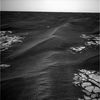
OPP-SOL562-1N178076978EFF5900P1875R0M1.jpg360° Panorama (4) - Sol 56255 visitenessun commento
|
|
OPP-SOL562-1N178077333EFF5900P1876L0M1.jpg360° Panorama (6) - Sol 56255 visitenessun commento
|
|

SOL583-2P178119764EFFAE03P2260L5M1.jpgLost horizons... (2) - Sol 58355 visitenessun commento
|
|
SOL585-2P178293409EFFAE03P2268L6M1.jpgLost horizons...again (2) - Sol 58555 visiteNoi sappiamo - anche perchè ce lo avete scritto in diversi - che molti di Voi appartengono alla Famiglia dei Dubbiosi (ci riferiamo, in particolare, ai dubbi relativi al "Moon Hoax") ed uno dei nostri compiti fondamentali, in qualità di Ricercatori, è quello di raccontare gli eventi occorsi in maniera obbiettiva e convincente, esponendo - se e quando necessario - i nostri propri - e personalissimi - punti di vista e lasciando sempre e comunque a Voi la decisione finale sul "chi" o il "che cosa" credere. Una decisione che prenderete sulla base di quello che le Vostre coscienze Vi suggeriranno.
Ebbene, l'ascesa di "toni polemici" che ha caratterizzato le nostre ultime note di commento ai frames NASA ed ESA relativi a Marte è stata da noi stessi ritenuta e valutata come eccessiva, e di questo ce ne scusiamo. Non è infatti con il sarcasmo o l'acredine portata ai limiti che si acquisisce una maggiore credibilità, anzi...
|
|
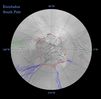
Enceladus-SP-PIA07722_modest.jpgEnceladus: Global Patterns of Fracture (Southern Polar Projection)55 visiteFractures on the surface of Enceladus record a long and complex history of tectonic activity. Many of the geologically youngest fractures define remarkably systematic patterns relative to Enceladus' axis of rotation, as well as to its tidal orientation (that is, the longitudes that point toward and away from Saturn). These fracture patterns offer clues to global changes of shape that the satellite has undergone over time, possibly in response to tidal forces exerted by Saturn or as a result of changes in the internal structure of the icy moon. Some of the most prominent global patterns of fracture are delineated in color in the Southern Hemisphere map shown here.
This map is a polar stereographic projection that was mosaicked from the best-available Cassini and Voyager clear-filter images.
The map is centered on the South Pole and coverage extends to the Equator. Gridlines show latitude and longitude in 30° increments.
|
|

SOL497-Gusev_Crater5-PIA04179.jpgGusev Crater's Horizon - Soles 497/500 (Approximate True Colors; credits: NASA/JPL-Caltech)55 visitenessun commento
|
|

SOL585-2-PIA04184.jpgPanorama from the Summit (2) - Sol 58555 visiteOriginal NASA caption:"The mosaic is made up of images taken by the Rover's PanCam over a period of three days (sols 583 to 585, or August 24 to 26, 2005). It spans about 240° in azimuth and was acquired using 51 different camera pointings and three camera filters (750, 530 and 480 nnmts).
Image-to-image seams have been eliminated from the sky portion of the mosaic to better simulate what a person standing on Mars would see".
|
|
OPP-SOL569-1P178706479EFF5927P2357L2M1.jpgThe "waves" of Meridiani (5) - Sol 56955 visitenessun commento
|
|
| 25353 immagini su 2113 pagina(e) |
 |
|
|
|
|
2019 | |
|
|
|
|





