| Piú viste |

Tethys-PIA08254-1.jpgMelanthius Crater (detail mgnf)55 visiteCaption NASA:"Cassini looks into the 245-Km (150-mile) wide crater Melanthius in this view of the Southern Terrain on Tethys. The crater possesses a prominent cluster of peaks in its center which are relics of its formation.
Notable here is a distinct boundary in crater abundance -- the cratering density is much higher in the farthest Western Terrain (left side of the image) than elsewhere.
North on Tethys is up and rotated 45° to the left.
The image was taken in visible light with the Cassini spacecraft narrow-angle camera on July 23, 2006 at a distance of approx. 120.000 Km (such as about 75.000 miles) from Tethys and at a Sun-Tethys-spacecraft, or phase, angle of 29°.
Image scale is roughly 715 mt (such as about 2,345 feet) per pixel".
|
|
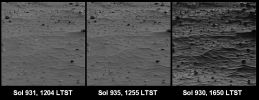
SOL930-935-P2763_L4_montage-A945R1.jpgMeaningful Shadows... (2) - Soles 930/93555 visiteSpirit acquired the single-frame images of sand ripples with the PanCam turned to an azimuth of 290° (West-NorthWest).
|
|

The Rings-PIA08257.jpgThe Music of Pan...The Waves in the Rings...55 visiteCaption NASA:"The Encke Gap displays gentle waves in its inner and outer edges that are caused by gravitational tugs from the small moon Pan. These scalloped edges were captured in a dramatic image taken by Cassini during its insertion into Saturn orbit in 2004.
The Encke Gap is a 325-Km (about 200-mile) wide division in Saturn's outer A-Ring.
Pan (26 Km, or approx. 16 miles across) orbits squarely in the center of this gap.
The original image was stretched in the horizontal direction by a factor of four to exaggerate the amplitude of the waves, then reduced to half size and cropped to focus on the gap.
The image was taken in visible light with the Cassini spacecraft narrow-angle camera on July 23, 2006 at a distance of approx. 290.000 Km(such as about 180.000 miles) from Saturn.
Scale in the original image was roughly 1 Km (about 0,6 mile) per pixel".
|
|

The Rings-PIA08259.jpgGravitational Disturbances55 visiteCaption NASA originale:"The clumpy disturbed appearance of the brilliant F-Ring constantly changes. The irregular structure of the Ring is due, in large part, to the gravitational perturbations on the ring material by one of Saturn's moons, Prometheus (about 102 Km, or 63 miles across).
Interior to the F-Ring, the A-Ring bears a striking resemblance to a classic grooved, vinyl record. Visible here are the Keeler Gap (about 42 Km, or 26 miles wide) and the Encke Gap (about 325 Km, or 200 miles wide).
The image was taken using a spectral filter sensitive to wavelengths of infrared light centered at 862 nnmts. The view was acquired with the Cassini spacecraft narrow-angle camera on July 26, 2006 at a distance of approx. 1,5 MKM (about 900.000 miles) from Saturn and at a Sun-Saturn-spacecraft, or phase, angle of 141°. Image scale is roughly 8 Km (such as about 5 miles) per pixel".
|
|

00-vg1_p20938.jpgJupiter, in true colors55 visiteUn nuovo viaggio in quelle che sono (ormai) le "Memorie dell'Astronautica".
Si tratta di Giove e del suo stupendo Sistema di lune, attraverso gli occhi di due grandissimi "Esploratori": le Sonde NASA, Voyager 1 e 2.
Voyager 1, il 15 Agosto 2006, ha raggiunto la (davvero "astronomica") distanza di 100 U.A. dal nostro Sole (o, se preferite, la distanza di circa 15 miliardi di Km dal Sole), confermandosi come l'oggetto fabbricato dall'Uomo "più distante" dal suo Mondo di origine.
Ecco un commento al riguardo da parte del Dr Edward Stone (ex Direttore del NASA JPL di Pasadena):"...what you can't predict is that the spacecraft isn’t going to wear out or break: Voyager 1 and 2 run 24 hours a day, 7 days a week, but they were built to last - Stone said.
The spacecrafts have really been put to the test during their nearly 30 years of space travel, flying by the outer planets, and enduring such challenges as the harsh radiation environment around Jupiter". - continua
|
|

02-vg1_p21151.jpgJupiter, in true colors55 visite"Interstellar space is filled with material ejected by explosions of nearby stars" Stone added. "and Voyager 1 will be the first human-made object to cross into it".
Voyager Project Manager Ed Massey of JPL says the survival of the two spacecrafts is a credit to the robust design of the spacecraft, and to the flight team, which is now down to only 10 people.
"But it’s these 10 people who are keeping these spacecrafts alive. They’re very dedicated. This is sort of a testament to them, that we could get all this done".
Between them, the two Voyagers have explored Jupiter, Uranus, Saturn and Neptune, along with dozens of their moons. In addition, they have been studying the Solar Wind, the stream of charged particles spewing from the sun at nearly a million miles per hour.
|
|

04-vg1_p21182.jpgJupiter, in true colors55 visitenessun commento
|
|

05-vg1_p21194.jpgThe elongated "Dark Spot" of Jupiter55 visiteSi tratta di un fenomeno anomalo il quale è stato osservato ed immortalato dalla Sonda Voyager 1, ma la cui spiegazione - in fondo - non è mai arrivata.
Le ipotesi più accreditatate sull'argomento parlano:
1) di una possibile "apertura" (rectius: uno "squarcio") nel tessuto compatto dell'Atmosfera Gioviana - determinato da cause ignote - tale per cui quello che vediamo NON è un sistema nuvoloso compatto e composto da nuvole più scure rispetto a quelle circostanti, bensì è un dettaglio di ciò che esiste al di sotto degli strati più esterni dell'Atmosfera Gioviana stessa;
2) di una turbolenza simile a quella (famosissima ed ultracentenaria) conosciuta come la "Macchia Rossa" di Giove ma, in questo caso, composta da nuvole "più dense" e - presumibilmente - formate da (o contenenti) elementi diversi (e più pesanti) rispetto a quelli che caratterizzano le Regioni circostanti;
3) una turbolenza Gioviana assolutamente analoga a tutte le altre, con l'unica differenza che, in questo caso, la colorazione più scura è semplicemente dovuta alle particolari condizioni di illuminazione di Giove al momento dello scatto.
|
|

06-vg1_p21224.jpgJovian turbulence (false colors)55 visitenessun commento
|
|

07-vg1_p21225.jpgJovian turbulence (natural colors)55 visitenessun commento
|
|

09-vg1_p21229c.jpgThe "Great Red Spot" of Jupiter (false colors)55 visitenessun commento
|
|
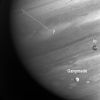
14-vg1_1610104.jpgJupiter, Io, Ganymede and...55 visiteL'oggetto indicato dalla freccia e contraddistinto da un "?" non è un photoartifact (nella maniera più categorica) e non è neppure una delle altre Lune Maggiori (o Galileiane) di Giove - e quindi non si tratta nè di Europa, nè di Callisto.
Abbiamo pensato potesse trattarsi di Amalthea, ma l'oggetto è troppo piccolo e non riusciamo a risolverlo per osservarne i dettagli superficiali e, soprattutto, le fattezze esteriori.
Se qualcuno di Voi avesse delle idee, ci scriva!
|
|
| 25353 immagini su 2113 pagina(e) |
 |
|
|
|
|
1996 | |
|
|
|
|





