| Piú viste |

SOL639-2R183091705EFFAH60P1301L0M1.jpgVarious views (2) - Sol 63955 visiteLa prima immagine era piuttosto anonima; decisamente meglio è questo secondo frame il quale ci propone - cerchiata in rosso - una roccia di forma piuttosto curiosa e che sembra avere qualcosa (poggiato?) nella (sulla) sua sezione centrale.
Tutte le elaborazioni che abbiamo effettuato, però, non sono decisive a causa della non buona risoluzione del frame.
|
|

SOL635-1-3D-PIA03062.jpgWhere should I go? - Sol 63555 visiteOriginal caption:"The first explorer ever to scale a summit on another planet, NASA's MER Spirit has begun a long trek downward from the top of Husband Hill to new destinations. As shown in this 180° panorama from East of the Summit, Spirit's earlier tracks are no longer visible. They are off to the West (to the left in this view). Spirit's next destination is Haskin Ridge, straight ahead along the edge of the steep cliff on the right side of this panorama".
|
|

SOL642-2R183359774EFFAI38P1312L0M1.jpgRear-View (2) - Sol 64255 visitenessun commento
|
|

Proteus2.jpgProteus (HR)55 visitenessun commento
|
|
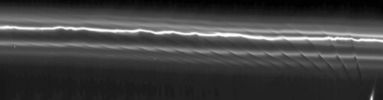
The Rings-PIA07750.jpgSurfing the waves of the F-Ring (from 1,1 MKM)55 visiteOriginal caption:"This mosaic of 15 Cassini images of Saturn's F-Ring shows how the moon Prometheus creates a gore in the Ring once every 14 h and 42', as it approaches and recedes from the F-Ring on its eccentric orbit. The individual images have been processed to make the Ring appear as if it has been straightened, making it easier to see the Ring's structure. The mosaic shows a Region 147.000 Km (about 91.000 miles) along the Ring (horizontal direction in the image); this represents about 60° of Longitude around the Ring. The Region seen here is about 1500 Km (900 miles) across (vertical direction). The first and last images in the mosaic were taken approximately 2,5 hours apart.
Each dark channel, or "gore," is clearly visible across more than 1,000 kilometers (600 miles) of the ring and is due to the gravitational effect of Prometheus (102 kilometers, or 63 miles across), even though the moon does not enter the F ring. The channels have different tilts because the ring particles closer to Prometheus (overexposed, stretched, and just visible at the bottom right of the image) move slower with respect to the moon than those farther away. This causes the channels to shear with time, their slopes becoming greater, and gives the overall visual impression of drapes of ring material. The channels at the right are the youngest and have near-vertical slopes, while those at the left are the oldest and have near-horizontal slopes. This phenomenon has not previously been detected in any other planetary ring system, but computer simulations of the system prove that the disturbance is caused by a simple gravitational interaction. The eccentric orbit of Prometheus is gradually moving so that the moon will eventually come even closer in its closest approach to the eccentric F ring. Scientists calculate that its perturbations of the F ring will reach a maximum in December 2009".
|
|
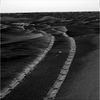
OPP-SOL622-1P183402214EDN63IRP2277R2M1.jpgPostcards from Erebus Crater (2) - Sol 62255 visiteGuardate bene le tracce lasciate dalle ruote di Opportunity: sia che i frames sìano genuini, sia che si tratti di frames "riveduti e corretti", come si può continuare a sostenere la natura "sabbiosa/polverosa" (nel senso terrestre del termine) di questa superficie? Dove sono i "poderosi venti" di Marte? Che cosa "tiene assieme e compatta" la sabbia di Meridiani? e poi, last but not least, qual'è la temperatura media reale di questa zona?
|
|

SOL646-2P183717888ESFAI38P2557L7M1.jpgThe "paving" of Husband Hill - Sol 64655 visiteOriginal caption:"Left Pan-Cam Non-linearized Sub-frame EDR acquired on Sol 646 of Spirit's mission to Gusev Crater at approx. 13:02:40 MLT, camera commanded to use Filter 7 (432 nm)".
|
|

SOL648-2P183889247EFFAI38P2575L6M1.jpgRocky landscape and a strange stone... - Sol 64855 visiteIl macigno che ci aveva incuriosito e che avevamo portato alla Vostra attenzione qualche giorno fa sembra ora aver "intrigato" anche la NASA: eccolo qui, infatti, in questo bel frame PanCam relativo al Sol 648! Forse non c'è nulla che "poggia" sul grande macigno bianco e, forse, c'è una notevole crepa proprio nel suo mezzo: difficile a dirsi... La qualità del frame non è eccelsa, ma la Singolarità costituita da questo masso è del tutto evidente.
Original caption:"Left PanCam Non-linearized Full frame EDR acquired on Sol 648 of Spirit's mission to Gusev Crater at approx. 11:21:50 MLT. Camera commanded to use Filter 6 (482 nm)".
|
|
SOL649-2R183985687EFFAIA6P1312L0M1.jpgWhat lies behind... (2) - Sol 64955 visitenessun commento
|
|
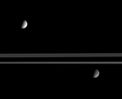
Tethys-PIA07623.jpgTethys and Dione55 visiteOriginal caption:"Saturn's expansive Rings separate the moon's Tethys (at the top) from Dione (at the bottom). Even in this distant view, it is easy to see that the moons' surfaces, and likely their evolutionary paths, are very different.
Both moons are on the far side of the Rings in this scene, which shows their Saturn-facing Hemispheres (terrain centered on 0° Long.). The dark shadow across the rings is cast by Saturn's Southern Hemisphere.
Note that the diameter of Tethys is about 1.071 Km while the diameter of Dione is approx. 1.126 Km.
This image was taken in visible light with the Cassini spacecraft narrow-angle camera on Sept. 12, 2005, at a distance of approx. 2,4 MKM (such as about 1,5 MMs) from Saturn. The image scale is about 17 Km (about 11 miles) per pixel on the two moons".
|
|
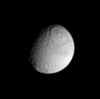
Tethys-PIA07622.jpgOdysseus and Melanthius55 visiteOriginal caption:"Cassini offers up this nice view of the craters Odysseus (at the top) and Melanthius (at the bottom) on Saturn's moon Tethys. Melanthius appears to have an elongated mountain range, rather than a single central peak, at its center.
This is the trailing hemisphere of Tethys, being centered on terrain at roughly 270° Longitude. North on Tethys is up.
This image was taken with the Cassini spacecraft narrow-angle camera on Sept. 20, 2005, through a filter sensitive to wavelengths of ultraviolet light centered at 338 nanometers. This view was obtained at a distance of approx. 1,4 MKM (about 900.000 miles) from Tethys and at a phase angle of 50°. Resolution in the original image was 8 Km (about 5 miles) per pixel. The image has been magnified by a factor of 2 to aid visibility".
|
|

SOL653-2P184333435EFFAIBMP2297R2M1.jpgLandscape (2) - Sol 65355 visitenessun commento
|
|
| 25353 immagini su 2113 pagina(e) |
 |
|
|
|
|
1993 | |
|
|
|
|





