| Piú viste |
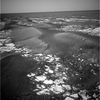
OPP-SOL601-1N181541492EFF62EIP1655L0M1.jpgOn the rim of Erebus Crater (12) - Sol 60155 visitenessun commento
|
|

SOL620-2P181409573EFFAERFP2381R1M1.jpgStones - Sol 62055 visiteAnche questo macigno, la cui parte più interessante (e cerchiata in rosso) avremo occasione di vedere meglio nei frames relativi al Sol 622, è molto interessante e ci sembra che rechi su di sè le tracce - sotto forma di micro-scanalature e "striations" - di un'incessante azione erosiva. Venti o acqua? Vedremo che cosa ci dirà la NASA...
|
|
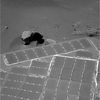
SOL622-2P181586736EFFAERFP2296L7M1.jpgStones - Sol 62255 visiteAnche in questo frame troviamo una Singolarità: la roccia che campeggia accanto ai pannelli solari di Spirit presenta delle caratteristiche esteriori le quali, a nostro parere, la rendono decisamente interessante laddove vista in rapporto al resto del paesaggio. Portate il frame sino al full-size e poi guardate attentamente la sommità di questo sasso: è un dato del tutto chiaro che la pietra in oggetto costituisce un frammento di una roccia più grande e che l'età della frattura posta sul suo lato superiore è una frattura (relativamente) recente. Curiosissima ci appare anche la postura di questa roccia (poggia al suolo o è "conficcata" nel terreno?); inoltre, se riuscite ad ingrandire l'immagine senza degradarla, dovreste essere anche in grado di vedere un residuo di rivestimento (di origine e caratteristiche ignote) posto sul suo lato Sx e che si vede sia a causa dello "spessore" che lo caratterizza - e che è visibile -, sia perchè l'albedo del lato "ricoperto" è molto più alta rispetto al resto del sasso.
Che cosa stiamo guardando?
|
|

Dione-N00041239.jpgDione's Fly-By (14): from about 3.300 Km55 visitenessun commento
|
|

Dione-N00041240.jpgDione's Fly-By (15): from about 2.800 Km55 visitenessun commento
|
|

Dione-N00041243.jpgDione's Fly-By (16): from about 1.835 Km55 visitenessun commento
|
|

Mimas-W00011156.jpgMimas in the night55 visiteOriginal caption:"W00011156.jpg was taken on October 13, 2005 and received on Earth October 14, 2005. The camera was pointing toward MIMAS - at approximately 710.418 Km away - and the image was taken using the CB2 and IRP90 filters. This image has not been validated or calibrated".
|
|

Prometheus-N00041980.jpg"Family Group": Prometheus, Dione and Titan55 visiteOriginal caption:"N00041980.jpg was taken on October 17, 2005 and received on Earth October 18, 2005. The camera was pointing toward PROMETHEUS - approximately 2.358.256 Km away - and the image was taken using the CL1 and CL2 filters. This image has not been validated or calibrated".
|
|

SOL634-2P182648204EFFAEVOP2385R4M1.jpgThe rocks of "Hillary Outcrop" (1) - Sol 63455 visiteNASA - Official Status Report:"Spirit is healthy and spent the week examining a rock called Hillary at the true summit of Husband Hill.
The first attempt to approach Hillary ended with a small pebble under Spirit's left front wheel, and the stability of the Rover was uncertain.
A set of wheel wiggles was performed to stabilize the Rover before deployment of the Robotic Arm (RA). Once the wheel was in good contact with the ground, Spirit began a conservative RA campaign that started with Mössbauer Spectrometer and Alpha Particle X-ray Spectrometer integrations".
|
|
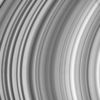
The Rings-PIA07610.jpgClose look at the "B-Ring"55 visiteOriginal caption:"This detailed view of Saturn's mid-B ring shows intriguing structure, the cause of which has yet to be explained by ring scientists. The image shows a radial location located between approx. 107.200 to 115.700 Km (about 66.600 to 71.900 miles) from Saturn.
The image was taken with the Cassini spacecraft narrow-angle camera on Sept. 3, 2005, at a distance of approx. 1,1 MKM (roughly 700.000 miles) from Saturn using a filter sensitive to wavelengths of infrared light centered at 752 nnmts. The image scale is 6 Km (about 4 miles) per pixel".
|
|
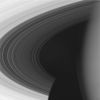
The Rings-PIA07613.jpgThe C-Ring55 visiteOriginal caption:"The Cassini spacecraft looks close at Saturn to frame a view encompassing the entire C-Ring. In the dark region closer to the planet lies the much dimmer D-Ring. The bright B-Ring wraps around the left side of the scene, while Saturn's shadow darkens the Rings at bottom. For reference, Saturn’s Ring sequence from its surface outwards is "D", "C", "B", "A", "F", "G" then "E".
The image was taken in visible light with the Cassini spacecraft wide-angle camera on Sept. 4, 2005, at a distance of approx. 627.000 Km (390.000 miles) from Saturn. The image scale is 34 Km (about 21 miles) per pixel".
|
|

SOL639-2R183091705EFFAH60P1301L0M1.jpgVarious views (2) - Sol 63955 visiteLa prima immagine era piuttosto anonima; decisamente meglio è questo secondo frame il quale ci propone - cerchiata in rosso - una roccia di forma piuttosto curiosa e che sembra avere qualcosa (poggiato?) nella (sulla) sua sezione centrale.
Tutte le elaborazioni che abbiamo effettuato, però, non sono decisive a causa della non buona risoluzione del frame.
|
|
| 25353 immagini su 2113 pagina(e) |
 |
|
|
|
|
1992 | |
|
|
|
|





