| Piú viste |
Rhea&Dione-N00056093.jpgIn-transit: Dione and Rhea (7)55 visitenessun commento
|
|
Rhea&Dione-N00056096.jpgIn-transit: Dione and Rhea (10)55 visitenessun commento
|
|

Propellers-000-PIA07792.jpgThe "Propellers" of the Rings (1) - HR55 visiteThis collection of 3 Cassini images provides context for understanding the location and scale of some "propeller-shaped features" observed within Saturn's A-Ring.
Careful analysis of the HR images taken by Cassini's cameras as the spacecraft slipped into Saturn orbit revealed the 4 faint, propeller-shaped double-streaks in an otherwise bland part of the mid A-Ring. Imaging scientists believe the "propellers" provide the first direct observation of the dynamical effects of moonlets which are approx. 100 mt (such as about 300 feet) in diameter.
The propeller moonlets represent a so far unseen size-class of particles orbiting within the Rings.
The 2nd panel provides broad context within the Rings, and shows the B-Ring, the Cassini Division, the A-Ring and the F-Ring. Image scale in the radial, or outward from Saturn, direction is about 45 Km (about 28 miles) per pixel; because the Rings are viewed at an angle, the image scale in the longitudinal - or circumferential - direction is several times greater.
|
|

Propellers-001-PIA07792.jpgThe "Propellers" of the Rings (2) - HR55 visiteThis image is a closer view of the A-Ring, showing the radial locations where "Propeller Features" were spotted. The view is approx. 1.800 Km across (such as about 1.100 miles), from top to bottom, and includes a large density wave at the bottom (caused by the moons Janus and Epimetheus), as well as two smaller density waves.
The footprints of the Propellers are between density waves, in bland, quiescent regions of the Ring.
The Propellers appear as double dashes in the two close-up discovery images and they have been circled. The unseen moonlets, each roughly the size of a football field, lie in the center of each structure. These two images were taken during Saturn orbit insertion on July 1, 2004, and are presented here at one-half scale. Resolution in the original images was 52 mt (about 171 feet) per pixel.
The horizontal lines in the image represent electronic noise and do not correspond to any actual Ring features.
|
|

Propellers-002-PIA07790.jpgThe "Propellers" of the Rings (3) - HR55 visiteThe Propellers are about 5 Km (approx. 3 miles) long from tip to tip, and the radial offset (the "leading" dash is slightly closer to Saturn) is about 300 mt (about 1000 feet).
The Propellers structures are unchanged as they orbit around Saturn.
In that way, they are much like the wave pattern that trails after a speedboat as it skims across a smooth lake. Such a pattern is hard to discern in a choppy sea (---> mare increspato). In much the same way, scientists think other effects may be preventing Cassini from seeing the Propellers except in very bland parts of the Rings.
|
|

SOL799-2F197299111EFFAQHAP1211R0M1.jpgIn the "salty" kingdom (1) - Sol 79955 visiteUna serie di immagini che mostrano non solo l'enorme quantitativo di (ipotetici) cristalli di sale che giacciono appena al di sotto della superficie su cui Spirit si sta muovendo, ma anche - frame 3 - l'incredibile voragine che il Rover è riuscito a scavare. Già: una trincea di proporzioni (almeno in apparenza) talmente grandi da farci - ancora una volta - dubitare profondamente circa la correttezza della temperatura superficiale del Pianeta Rosso, come ufficialmente dichiarata da NASA ed ESA (sarete d'accordo con noi che un terreno a temperatura media abbodantemente sotto lo zero, e con punte notturne fra i -50 ed i -70°C, non dovrebbe essere tanto semplice da intaccare, eppure...).
|
|

SOL799-2N197299701EFFAQHAP0605R0M1.jpgIn the "salty" kingdom (2) - Sol 79955 visitenessun commento
|
|
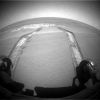
OPP-SOL778-1F197252060EFF67G2P1224R0M1.jpgCrossing the dunes... - Sol 77855 visiteCaption originale:"Right Front HazCam Non-linearized Full frame EDR acquired on Sol 778 of Opportunity's mission to Meridiani Planum at approximately 12:24:25 MLT".
|
|
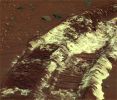
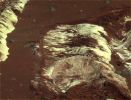
SOL788-PIA08038-1.jpgSaltland, in false colors (1) - Sol 78855 visiteSolo un commento: in relazione a quanto visto in passato nei frames in true o approximately true colors della Regione di Gusev Crater, queste elaborazioni in falsi colori delle trincee scavate da Spirit nei pressi della collina McCool ci sembrano - ancora una volta - di gran lunga più belle, realistiche e convincenti delle relative versioni in colori naturali o, come dicono alla NASA, "approssimativamente veri".
Da notare inoltre il totale silenzio NASA sulle modalità adottate nonchè sulla facilità (almeno apparente) con cui queste enormi trincee sono state scavate dal "menomato" Rover Spirit. Un vero peccato che le domande ai quesiti davvero interessanti non trovino mai - ma proprio MAI! - una risposta...
|
|
SOL788-PIA08038-2.jpgSaltland, in false colors (2) - Sol 78855 visitenessun commento
|
|
SOL802-2P197563205EFFAQI8P2403R1M1-2.jpgBright light on Mars: photoartifact or Fast Moving Object? (5) - Sol 80255 visitenessun commento
|
|

Q-T-TerraCimmeria-PIA08052_modest.jpgTerra Cimmeria55 visiteThis scene in a Region of Mars named Terra Cimmeria shows a variety of ancient and recent geologic processes. In the upper portion of the image, a twisting ridge of raised ground may outline the location of a subsurface thrust fault. This type of fault results in the compression and crumpling of a Planet's surface. This crumpling of the Planet's surface has squeezed two originally circular craters on the ridge into oval-shaped craters. Valleys are also present throughout the image, suggesting that water flowed across this area a long time ago. Many valleys and craters in the image are now filled by deposits of dust or debris. This debris mantle is common over the middle latitudes of Mars and is a geologically recent deposit.
This image was taken by the High Resolution Imaging Science Experiment (HiRISE) camera onboard NASA's Mars Reconnaissance Orbiter spacecraft on March 25, 2006. The image is centered at 40,64° South latitude, 144,39° East Longitude. It is oriented such that North is 7° to the left of up. The range to the target was 2.038 Km (1.266 miles). At this distance the image scale is 2,04 meters (6,69 feet) per pixel, so objects as small as 6,1 mt (20 feet) are resolved. In total this image is 12,34 Km (such as about 7,67 miles) or 6.045 pixels wide and 34,68 Km (such as about 21,55 miles) or 17.003 pixels long. The image was taken at a Local Mars Time of 07:28 and the scene is illuminated from the upper right with a solar incidence angle of 82,0° (this meaning that the Sun was about 8,0° above the horizon).
|
|
| 25353 immagini su 2113 pagina(e) |
 |
|
|
|
|
1989 | |
|
|
|
|





