| Piú viste |

PHOE-SOL049-13039-13040-13041-2-comp.jpgPhoenix Scoop Inverted Showing Rasp (credits: NASA/JPL/Univ. of Arizona - Dx - and Dr Barca & Lunexit - Sx)55 visiteCaption NASA:"This image taken by the Surface Stereo Imager on Sol 49, or the 49th Martian Day of the mission (July 14, 2008), shows the silver colored rasp protruding from NASA's Phoenix Mars Lander's Robotic Arm Scoop.
The Scoop is inverted and the rasp is pointing up. Shown with its forks pointing toward the ground is the Thermal and Electrical Conductivity Probe, at the lower right.
The Robotic Arm Camera is pointed toward the ground".MareKromium
|
|

SOL689-1.jpgLonely Boulder - Sol 689 (natural colors + MULTISPECTRUM; credits: Dr G. Barca & Lunexit)55 visitenessun commentoMareKromium
|
|

SOL688-2.jpgDusty Outcrop - Sol 688 (natural colors + MULTISPECTRUM; credits: Dr G. Barca & Lunexit)55 visitenessun commentoMareKromium
|
|
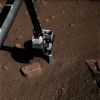
PHOE-SOL055-lg14553-14577-14614-1.jpgPhoenix Scoop Inverted Showing Rasp - Sol 55 (Superdefinition and natural colors + MULTISPECTRUM; credits: Dr Barca & Lunexit)55 visitenessun commentoMareKromium
|
|

SOL055-1.gifWorking on "Humphrey"... (GIF-Movie; credits: Dr Marco Faccin)55 visiteAttenzione: la leggera "coloritura" dei frames che formano il filmato NON l'abbiamo aggiunta noi...MareKromium
|
|

OPP-SOL143-GIF.gifExploring "Endurance" - Sol 143 (GIF-Movie; credits: Dr Marco Faccin)55 visiteAttenzione: anche in questo caso, la leggera (ma evidente) "coloritura" dei frames che formano il filmato NON l'abbiamo aggiunta noi... MareKromium
|
|
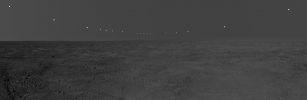
PHOE-SOL054-MidnightSun-PIA10976.jpgMidnight Sun on Mars - Sol 5455 visiteCaption NASA:"This panorama mosaic of images was taken by the Surface Stereo Imager on board NASA's Phoenix Mars Lander. This mosaic documents the Midnight Sun during several days of the mission.
The foreground and sky images were taken on Sol 54, or the 54th Martian Day of the mission (July 20, 2008). The solar images were taken between 22:00 and 02:00 M.L.T., during the nights of Soles 46 to 56. During this period of 11 Soles, the Sun's path got slightly lower over the Northern Horizon, causing the lack of smoothness to the curve. This pan captures the polar nature of the Phoenix Mission in its similarity to time lapse pictures taken above the Arctic Circle on Earth". MareKromium
|
|

PHOE-SOL058-0.jpgThe "Colors" of Mars... - Sol 58 (natural but enhanced colors; credits: Dr M. Faccin)55 visiteEcco i "Colori di Marte" che la NASA non Vi farà vedere MAI...L'ultimo e splendido Lavoro del bravissimo Marco Faccin, per Lunar Explorer Italia.MareKromium
|
|

19981223.jpgViews of 433-Eros55 visiteThis montage of images of the asteroid Eros was assembled from images acquired by the Near Earth Asteroid Rendezvous (NEAR) Spacecraft on December 23, 1998, as the Spacecraft flew by the asteroid at a distance of 2300 miles (3800 Km) at 1:43 PM EST. Shown are nine early views out of 29 that were obtained during the flyby. These images were taken between 10:44 AM and 12:44 PM EST, as the Spacecraft range closed from 7300 miles (such as abou 11.100) Km, to 3300 miles (such as approx. 5300 Km).
During that time, the Asteroid completed nearly half of a rotation. The smallest resolved detail is approximately 1650 feet (500 meters) across.
A firing of the main engine at 17:00, EST, on December 20, 1998, designed to slow the Spacecraft for insertion into orbit around the Asteroid, was aborted by the Spacecraft. Contact with ground controllers was temporarily lost, but was regained at 20:00 EST on December 21, when autonomous Spacecraft safety protocols took over and transmitted a signal to the ground. All spacecraft systems were determined to be healthy and operational.
Within hours, a flyby observation sequence was developed and uploaded to the Spacecraft.
1026 images were acquired by the Multispectral Imager, to determine the size, shape, morphology, rotational state, and color properties of Eros, and to search for small moons.
The Infrared Spectrometer measured spectral properties of the Asteroid to determine what minerals were present, and the Magnetometer searched for a natural Magnetic Field.
Analysis of the Spacecraft radio signal were also used to determine the asteroid's mass and density.
The main engine was fired successfully on January 3, 1999, placing NEAR on-course for a February 2000 rendezvous.
Eros is NEAR's second asteroid encountered. On June 27, 1997, NEAR flew by the Main-Belt Asteroid Mathilde at a range of approx. 1212 Km (750 miles).MareKromium
|
|

20000225.jpgThe "Two Faces" of Eros... (natural colors; credits: Lunexit)55 visiteOn February 23, 2000, the NEAR spacecraft obtained a sequence of image mosaics showing Eros' surface as the asteroid rotated under the Spacecraft. At that time the range to the surface was approx. 355 Km (about 220 miles). These two mosaics, part of that sequence, show the stark beauty of the two opposite hemispheres.
The smallest detail visible is 35 meters (120 feet) across. The top mosaic shows wavy brightness banding exposed in the interior walls of the Saddle. In the bottom mosaic, similar banding is visible in one of the craters near the limb at left. To the right, the angle of the illumination accentuates the quasi-linear troughs near the Terminator.
Successful firing of NEAR's thrusters yesterday, February 24, placed the Spacecraft on course for insertion into the next lower orbit, at a 200 Km (about 120 miles) altitude. Images from that orbit, commencing in early March, will have nearly twice the spatial resolution of data returned so far.
(Product compiled from images 0126712790, 0126713054, 0126713230, 0126723526, 0126723790, 0126723878)
MareKromium
|
|

20000320.jpgThe North Polar Region of 433-Eros (natural colors; credits: Lunexit)55 visiteOn March 11, 2000, this image of Eros' North Polar Region was acquired by the imager on the NEAR Shoemaker Spacecraft, from a range of 206 Km (127 miles).
The area shown in the image is 10 Km (6,2 miles) across. Most of the North Polar Region is heavily cratered but the region to the left (part of the "Saddle") has a lower crater density, indicating that the surface has been modified since it first formed.
Eros' rotational axis lies nearly parallel to its orbital plane, much as with the planet Uranus, giving the asteroid exaggerated "seasons".
Now, it is Northern Summer and the North Pole is in continuous sunlight. The Sun will set there this June, at Eros' equivalent of Earth's Autumnal Equinox. At that time, Eros' South Pole will begin 12 months of continuous illumination while the North Pole shall remain in darkness.
(Image 0128166012)MareKromium
|
|
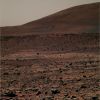
SOL1170-1.jpgMartian Landscape - Sol 1170 (natural colors; credits: Dr G. Barca)55 visitenessun commentoMareKromium
|
|
| 25353 immagini su 2113 pagina(e) |
 |
|
|
|
|
1978 | |
|
|
|
|





