| Piú viste |

SOL859-2P202622513EFFAS00P2298R1M1-1.jpg"Lookout Rock", boulders and razor-blades - Sol 859 (natural colors; credits: Dr G. Barca)55 visitenessun commentoMareKromium
|
|

SOL962-GB-LXTT.jpgSolar Panels and Circuits - Sol 962 (true colors; credits: Dr G. Barca)55 visitenessun commentoMareKromium
|
|

SOL993-2.jpgRover Tracks and Sulphates - Sol 993 (true colors; credits: Dr G. Barca)55 visitenessun commentoMareKromium
|
|

SPIRIT-FOGGYLANDSCAPE-4-2P140650025EFF6900P2375R1M1_crop-A170R1.jpgHigh TAU (possible True Colors; credits: Lunexit)55 visiteLa "monocromaticità" di Marte, sebbene solo tendenziale, potrebbe effettivamente verificarsi in ipotesi di elevatissima Opacità Atmosferica (AO o "Tau"), e cioè allorchè TUTTA la luce solare in arrivo su una specifica Regione del Pianeta (o sull'intero Pianeta, nell'ipotesi - non rarissima - di Global Dust Storm), si trovasse a dover attraversare uno strato piuttosto denso di micropolveri in sospensione (che sappiamo essere di color arancio/giallo ocra, nelle Regioni Equatoriali e peri-Equatoriali; rosso scuro o addirittura nero, nelle Regioni Vulcaniche e di color bianco/giallastro opaco, alle Alte Latitudini).
Nella nostra ricostruzione, ipotizziamo che la tempesta di sabbia si sia placata, ma l'O.A. risulti ancora sufficientemente elevata da conferire al paesaggio ed al cielo, una tinta gialla opaca, blanda ed uniforme, in accordo al tipo ed al colore delle micropolveri presenti nella Regione di Gusev Crater.
ATTENZIONE: il risultato visivo che potete apprezzare in questo frame è una semplice simulazione basata sulle conseguenze, in tema di luminosità media del paesaggio e di colorazione del medesimo, di una tempesta di sabbia la quale potrebbe occorrere in un'area desertica sabbiosa e rocciosa terrestre.MareKromium
|
|

19981223.jpgViews of 433-Eros55 visiteThis montage of images of the asteroid Eros was assembled from images acquired by the Near Earth Asteroid Rendezvous (NEAR) Spacecraft on December 23, 1998, as the Spacecraft flew by the asteroid at a distance of 2300 miles (3800 Km) at 1:43 PM EST. Shown are nine early views out of 29 that were obtained during the flyby. These images were taken between 10:44 AM and 12:44 PM EST, as the Spacecraft range closed from 7300 miles (such as abou 11.100) Km, to 3300 miles (such as approx. 5300 Km).
During that time, the Asteroid completed nearly half of a rotation. The smallest resolved detail is approximately 1650 feet (500 meters) across.
A firing of the main engine at 17:00, EST, on December 20, 1998, designed to slow the Spacecraft for insertion into orbit around the Asteroid, was aborted by the Spacecraft. Contact with ground controllers was temporarily lost, but was regained at 20:00 EST on December 21, when autonomous Spacecraft safety protocols took over and transmitted a signal to the ground. All spacecraft systems were determined to be healthy and operational.
Within hours, a flyby observation sequence was developed and uploaded to the Spacecraft.
1026 images were acquired by the Multispectral Imager, to determine the size, shape, morphology, rotational state, and color properties of Eros, and to search for small moons.
The Infrared Spectrometer measured spectral properties of the Asteroid to determine what minerals were present, and the Magnetometer searched for a natural Magnetic Field.
Analysis of the Spacecraft radio signal were also used to determine the asteroid's mass and density.
The main engine was fired successfully on January 3, 1999, placing NEAR on-course for a February 2000 rendezvous.
Eros is NEAR's second asteroid encountered. On June 27, 1997, NEAR flew by the Main-Belt Asteroid Mathilde at a range of approx. 1212 Km (750 miles).MareKromium
|
|

19981105.jpgThe "First Image" of Eros55 visiteThis first image of the Asteroid 433 Eros was acquired by the Multispectral Imager on the Near Earth Asteroid Rendezvous (NEAR) Spacecraft on November 5, 1998, at a distance of 2,5 MMS (about 4 MKM) from the Asteroid.
Eros, located at the center of the image and circled, appears against the star background in a single illuminated pixel.
At the time of the image, NEAR was located 200 MMs (about 321 MKM) from Earth, and the radio signal which transmitted the image from the Spacecraft, took nearly 18 minutes to reach Earth.
The image is a part of a 5,3-hour sequence of images that show Eros over one full rotation.
Repeated imaging of Eros through January, 1999, were used to refine knowledge of NEAR's trajectory relative to the Asteroid and to plan firings of the Spacecraft's engines to slow the craft and place it into orbit.
At the time, NEAR was approaching Eros at a rate of 2100 mph (945 meters per second). Three firings of NEAR's engines, which begun on December 20, 1998, slew the Spacecraft velocity relative to the Asteroid to approx. 10 miles per hour (such as 5 meters per second), until the orbit insertion, which occurred on January 10, 1999.MareKromium
|
|
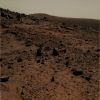
SOL1118-1.jpgRocky Landscape - Sol 1118 (natural colors; credits: Dr G. Barca)55 visitenessun commentoMareKromium
|
|

20000307.jpgLooking at "The Saddle" (natural colors; credits: Lunexit)55 visiteThis image of the interior of Eros' "Saddle Area", taken at a range of 204 Km (about 127 miles), displays a paucity of craters compared to the surface on the right hand side of the image. The Saddle displays many interesting structural features. Visible on the left wall are a series of closely spaced grooves that follow the terrain downslope. Opposite, on the upper right wall, trending towards the back of the saddle is a prominent ridge. Boulders are visible throughout this image.
Features as small as 20 meters (65 feet) are discernable.
(Image 0127521108)MareKromium
|
|
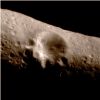
20000306.jpgLarge Crater (natural colors; credits: Lunexit)55 visiteThis image mosaic of the "Large Crater" at Eros' center was taken on March 3, 2000, during an optical navigation imaging sequence from a range of 127 miles (about 204 Km). This same area was imaged following orbit insertion at a range of approx. 210 miles (about 330 Km) on February 14th (Feb 14 G).
This picture resolves features as small as 65 feet (20 meters) across compared to the resolution of 100 feet (30 meters) in the earlier image. The shadow cast by the boulder near the floor of the crater is now visible. The walls of the crater display some distinctive variations in their albedo or reflectivity. The upper part of the walls tend to be bright, while the lower portions of the walls and the crater floor show patches of darker or less reflective materials. These albedo patterns are also visible on other crater walls. To the right of the large crater, two sets of closely spaced orthogonal grooves are visible.
(Mosaic of images 0127531846, 0127531908, 0127532094, 0127532156)MareKromium
|
|

PHOE-SOL045-PIA11007.jpgFull-circle panorama (Approx. True Colors - credits: NASA)55 visiteCaption NASA:"This view combines more than 400 images taken during the first several weeks after NASA's Phoenix Mars Lander arrived on an arctic plain at 68,22° North Lat., 234,25° East Long. on Mars.
The full-circle panorama in approximately true color shows the polygonal patterning of ground at the landing area, similar to patterns in permafrost areas on Earth. The center of the image is the westward part of the scene. Trenches where Phoenix's robotic arm has been exposing subsurface material are visible in the right half of the image. The spacecraft's meteorology mast, topped by the telltale wind gauge, extends into the sky portion of the panorama.
This view comprises more than 100 different camera pointings, with images taken through three different filters at each pointing. It is presented here as a cylindrical projection".MareKromium
|
|
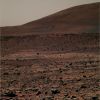
SOL1170-1.jpgMartian Landscape - Sol 1170 (natural colors; credits: Dr G. Barca)55 visitenessun commentoMareKromium
|
|
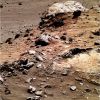
SOL1147-1.jpgRocks and Boulders - Sol 1147 (natural colors; credits: Dr G. Barca)55 visitenessun commentoMareKromium
|
|
| 25353 immagini su 2113 pagina(e) |
 |
|
|
|
|
1941 | |
|
|
|
|





