| Piú viste |
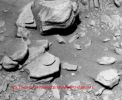
SOL1360-6.jpgThe "Evolution" of the Vent... (3) - Sol 136055 visitenessun commentoMareKromium
|
|
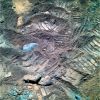
SOL1387-2P249497499EFFAWNSP2552L6M1-1.jpgRover Tracks and colored Pebbles - Sol 1387 (natural colors; elab. Dr Marco Faccin)55 visitenessun commentoMareKromium
|
|
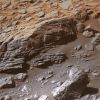
SOL278.jpgDusty Rocks - Sol 278 (MULTISPECTRUM; elab. Dr Marco Faccin & Lunexit)55 visitenessun commentoMareKromium
|
|

SOL054-2P131160375EFF1129P2429L6M1-1.jpgHumphrey - Sol 54 (natural colors - elab. Dr Marco Faccin)55 visitenessun commentoMareKromium
|
|
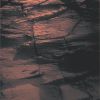
OPP-SOL1363-2.jpgVictoria's Paving (MULTISPECTRUM; elab. Lunexit) - Sol 136355 visitenessun commentoMareKromium
|
|

SOL813-GIFMovie.gifWaiting for "something" to happen... - Sol 813 (GIF-Movie; credits: Dr Marco Faccin)55 visiteDurante le peregrinazioni dei due Rover (ma, soprattutto, durante la marcia di Spirit) ci siamo imbattuti tante volte i rilievi curiosi i quali, se li avessimo trovati sulla Terra, non avremmo esitato un solo istante a definirli "tane". Già, se fossimo stati sulla Terra. Ma su Marte? Come fare a parlare di "tane" su Marte, senza risultare - quanto meno... - un pò "naif" e sprovveduti? Eppure, dato che a noi piace, di quando in quando, essere "naif", abbiamo deciso di lanciarVi una provocazione: e se il rilievo che vediamo in questo frame fosse REALMENTE una tana? E se l'ipotesi "tana" l'avessero avanzata anche i nostri Amici di Pasadena? Come spiegare, altrimenti, la ripresa effettuata da Spirit e che viene qui montata in un suggestivo GIF-Movie dal bravissimo Dr Faccin?
Ma lasciamo che sia Marco a parlare e poi Voi, se vorrete, scriveteci quello che pensate:"...l'"aspetto" è una tecnica di pesca subacquea, praticata dagli apneisti: ci si posiziona in prossimità di una tana tra gli scogli, si sta fermi, con l'arbalete puntato, a pelo d'acqua e con il boccaglio - ovviamente - fuori, così l'attesa può proseguire anche per parecchio tempo. Qua Pasadena ha fatto la stessa cosa:
l'"aspetto" alla tana. Ovviamente non è uscito un pesce, ma i tecnici - a mio parere - aspettavano.....qualcosa. Le riprese vanno dalle ore 11:55:24 alle 12:02:57 MLT.
E questi sono i fatti: il Rover era fermo e si nota il dondolio provocato dal vento o dall'oscillazione indotta dai suoi movimenti "interni" (anche se sono propenso per il vento - del resto la pancam offre un certo effetto "vela". E questo è tutto".
E, a nostro avviso, questo è già moltissimo. Forse da Pasadena non si aspettavano, come dice l'ottimo Dr Faccin, un "pesce" ma - chissà? - un getto di fumo, del vapore, un "segno" di vita o di movimento di un qualche tipo, insomma.
La nostra sensazione - e lo sapete da tempo - è che esista qualcosa di "vivo" (o, quantomeno, di "attivo" e di "mobile") al di sotto della superficie di Marte. E, sempre a nostro parere, una tale sensazione ce l'hanno anche a Pasadena...Sebbene non lo vogliano ammettere (e, probabilmente, non lo ammetteranno mai).
Complimenti al Dr Faccin, quindi: splendido Lavoro e splendida "provocazione"!...MareKromium
|
|
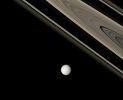
Tethys-PIA09788.jpgTrue Colors?55 visiteCaption NASA:"As seen from the side not illuminated by the Sun, Saturn's thinner Rings are highlighted in shades of brown and gold, contrasting with the more neutral appearance of the icy moon Tethys. The A-Ring and Cassini Division are separated by the optically thick B-Ring, which does not permit sunlight to penetrate and appears as the broad, dark lane between them in this view.
This view looks toward the anti-Saturn side of Tethys.
North is up and rotated 35° to the right.
The view looks toward the unilluminated side of the rings from about 2° above the Ring-Plane.
Images taken using red, green and blue spectral filters were combined to create this natural color view. The view was acquired with the Cassini spacecraft narrow-angle camera on Oct. 29, 2007, at a distance of approx. 2,1 MKM (about 1,3 MMs) from Tethys and at a Sun-Tethys-spacecraft, or phase, angle of 21°.
Image scale is roughly 12 kilometers (8 miles) per pixel".MareKromium
|
|

as16-107-17422.JPGAS 16-107-17422 - Beautiful Desolation (3)55 visitenessun commentoMareKromium
|
|

as16-107-17451.JPGAS 16-107-17451 - Angular Rock55 visitenessun commentoMareKromium
|
|
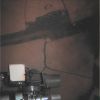
OPP-SOL1377-5.jpgMI and Victoria's Paving (natural colors e MULTISPECTRUM; credits: Dr Gianluigi Barca & Lunexit)55 visitenessun commentoMareKromium
|
|

as16-107-17473.JPGAS 16-107-17473 - The "Sample Container"55 visiteThis picture is showing the Rover in the background, while the SCB that John Young brought to hold individual sample bags is in the foreground. Charlie is at the back of the Rover. Note the footprints that John made as he made his way up to the Station 4 Crater.
MareKromium
|
|
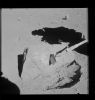
as16-107-17579.JPGAS 16-107-17579 - After the sampling...55 visite148:18:45 MT - In this "after" photograph of the sample John Young chipped off the tipped boulder, Charlie Duke is pointing to the place from which John removed the chip.
MareKromium
|
|
| 25353 immagini su 2113 pagina(e) |
 |
|
|
|
|
1932 | |
|
|
|
|





