| Piú viste |

Japetus-PIA08376-1.jpgRising Japetus (false colors - elab. NASA)55 visiteThe slim crescent of Iapetus looms before the Cassini spacecraft as it approaches the mysterious moon.
Iapetus, 1,468 kilometers (912 miles) across, seen here in false color, is unique in its dramatic variation in brightness between the northern polar region and the middle and low latitudes. Equally prominent is the moon's equatorial ridge of towering mountains. The profile of the ridge against the darkness of space reveals that it is topped by a cratered plateau approximately 15 kilometers (9 miles) wide. Further west, the profile of the ridge changes from a long plateau to discrete peaks.
The mosaic consists of four image footprints across the surface of Iapetus and has a resolution of 489 meters (0.3 miles) per pixel.
A full-resolution clear filter image was combined with half-resolution images taken with infrared, green and ultraviolet spectral filters (centered at 752, 568 and 338 nanometers, respectively) to create this full-resolution false color mosaic.
The color seen in this view represents an expansion of the wavelength region of the electromagnetic spectrum visible to human eyes. The intense reddish-brown hue of the dark material is far less pronounced in true color images. The use of enhanced color makes the reddish character of the dark material more visible than it would be to the naked eye. In addition, the scene has been brightened to improve the visibility of surface features.
This view was acquired with the Cassini spacecraft narrow-angle camera on Sept. 10, 2007, at a distance of about 83,000 kilometers (51,600 miles) from Iapetus.
MareKromium
|
|

Enceladus-N00093907.jpgThe Gem in the Sky of Saturn... (possible true colors; elab. Lunexit)55 visitenessun commentoMareKromium
|
|

Enceladus-N00093896.jpgThe Gem in the Sky of Saturn... (possible true colors; elab. Lunexit)55 visiteE così come è stato per Marte ed il Paving di Victoria Crater, oggi abbiamo il piacere e l'onore di proporVi quella che - ovviamente a nostro parere - riteniamo essere la migliore interpretazione dei Colori (e delle sfumature...) di Encelado: un'autentica Gemma di Neve che splende nel Cielo di Saturno.
Attendiamo i Vostri commenti!MareKromium
|
|

APOLLO_10_AS_10-35-5217.jpgAS 10-35-5217 - Earthrise with "something flying away"... (1)55 visitenessun commentoMareKromium
|
|

Tethys-PIA08401.jpgThe Edge of Tethys55 visiteThe cold, cratered landscape of Saturn's moon Tethys shines in stark relief in this crescent view. Aside from its obvious aesthetic beauty, this particular Cassini mosaic was obtained mainly to understand important details about how the surface of Tethys reflects light at high phase angles (the Sun-Tethys-Spacecraft viewing angle). The beautiful interplay of light with surface topographic features is an important factor in this regard. The surface is heavily cratered, and at this oblique angle the craters give the surface a highly scalloped appearance.
Unlike some HR crescent views of Saturn's moons, this image truly gives Tethys the appearance of being composed of ice and frost. There appear to be numerous sun glints sparkling across the surface. Some of these might be specular (or mirror-like) reflections off of exposed walls of solid ice inside craters, or they might be uniformly large, frosty or icy-particle covered facets of topography that are so oriented as to give exceptionally bright but diffuse reflections.
The shadows cast by most craters in the scene are not dark, but rather, they are illuminated by light bouncing off of their sunlit walls and those of other craters. This light, which has been scattered multiple times, makes visible some details along the shadowed walls and floors of craters that would not otherwise be visible in this viewing geometry.
This mosaic was assembled from four clear filter, narrow-angle camera images, with low resolution, wide-angle camera data filling a small gap in coverage. The view is an orthographic projection and has a resolution of 211 meters (692 feet) per pixel. An orthographic view is most like the view seen by a distant observer looking through a telescope. North is up.
The view was obtained by the Cassini spacecraft on June 29, 2007, from a distance of approximately 38.000 Km (about 24.000 miles) and at a Sun-Tethys-Spacecraft, or phase, angle of 152°.
MareKromium
|
|
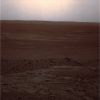
SOL1346-2P245863641EFFAVHPP2402L7M1.jpgLate in the Day (2) - Sol 1346 (natural colors - elab. Lunexit)55 visitenessun commentoMareKromium
|
|
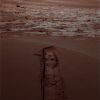
OPP-SOL607-1-182068954-6.jpg"Section" of a Side-Winder - Sol 60755 visitenessun commentoMareKromium
|
|
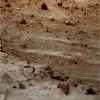
SOL1349-2P246122985EFFAVLFP2404L2M1-00.jpgExtremely bizarre Surface Features - Sol 134955 visiten. 1: una intrigante - e semisepolta - "sbarra" (rocciosa?) individuata dal Dr Barca, la cui sezione ci potrebbe ricordare quella delle nostre "rotaie";
n. 2: un esempio (tanto apparentemente insignificante, quanto incredibilmente ovvio) di "roccia impossibile".
Mentre la porzione superiore, infatti, si apre e snoda assecondando una forma-configurazione (a nostro avviso) del tutto innaturale (nonchè prospetticamente indefinibile), esiste anche una radicale incongruità (in termini di forme, tessiture e rilievi superficiali continui) del versante Est della roccia rispetto al suo versante Sud. Lo "spigolo" che divide questi due versanti, infine, sembra essere il prodotto di un malfatto "taglia&cuci digitale" (basta operare una modesta magnificazione per cogliere l'esistenza di qualche ulteriore incongruità).
n. 3: la crepa scura che vedete in basso (prossima al numero "3") sembra - ma qui potremmo sbagliarci - che si estenda BEN OLTRE il limite della roccia alla quale essa accede e di cui essa formerebbe parte; inoltre la porzione superiore Dx della roccia stratiforme (o "a gradini") la quale va a terminare con una sorta di spuntone a "becco", sembra davvero che assomigli - per texture e conformazione - ad una sorta di manufatto andato in pezzi, piuttosto che ad una semplice parete rocciosa formatasi attraverso quel processo geologico noto come "layering".
Tutte provocazioni, ovviamente, ma di materiale per discutere, come vedete, Marte ne offre in continuazione...
MareKromium
|
|

LLN-Itokawa-ST_2539429953_v.jpgThe unbelievable surface of 25143-Itokawa (HR - possible natural colors; elab. Lunexit)55 visiteIl piccolo Asteroide Itokawa si mostra ancora una volta per ciò che è: un piccolo mondo senza crateri e, apparentemente, senza polveri, la cui superficie - come questa splendida immagine HR ottenuta dalla Sonda JAXA "Hayabusa" - sembra risolversi in una serie di strati "a squame", tutti sensibilmente inclinati rispetto al piano dell'asteroide e, forse, piuttosto affilati (ci ricordano, in versione più grande, i "Razorblades" dei Crateri Endurance e Victoria (Marte).
Un piccolo mondo che, dopo un breve periodo di "fama", è ripiombato nell'oblìo collettivo, dopo che la Sonda JAXA "Hayabusa" ha malfunzionato (in circostanze e per cause ancora abbastanza oscure).
I Giapponesi, come ovvio, hanno preso molto male questo incidente, ma la coltre di silenzio che è caduta sulla Missione - la quale, come saprete, ha mostrato alla Terra il primo (ed unico?) Corpo Celeste PRIVO di crateri (un altro "schiaffo" per uno dei Maggiori Dogmi dell'Astronomia Convenzionale) - ha lasciato tutti molto perplessi.MareKromium
|
|

LLN-Itokawa-ST_2506540935_v.pngApproaching Itokawa (2 - natural colors; elab. Lunexit)55 visitenessun commentoMareKromium
|
|

LLO-Itokawa-ST_2563511720_v.jpgThe unbelievable surface of 25143-Itokawa (HR5 - possible natural colors; elab. Lunexit)55 visitenessun commentoMareKromium
|
|
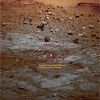
SOL1352-2P246395581EFFAVPBP2407L7M1-1.jpgExtremely "High-Albedo" Surface Feature (possible Surface Anomaly; context frame n. 1)55 visiteUna nuova (possibile) Anomalìa di Superficie - anche se, al momento, saremmo più propensi a considerarla come una Singolarità - ci viene segnalata dal sempre più bravo ed attento Dr Gianluigi Barca.
Il Sol di riferimento è il 1352: Spirit sta preparandosi al suo Terzo Inverno Marziano; l'area di riferimento è sempre la stessa: siamo vicini ad Home Plate.
Ed è proprio in onore di Home Plate che, dopo aver visionato questi frames, abbiamo deciso di battezzare il rilievo cerchiato in rosso come "Silver Plate".
Di che cosa si tratta? Il dettaglio è indefinibile ma estremamente curioso: l'albedo del piccolo rilievo è alta e la prima sensazione che ne abbiamo ricavato è stata quella di avere davanti una "piastrella" (rectius: quel che ne rimane...). Ma una simile albedo è propria anche delle superfici metalliche, ci siamo detti! Vero, ma che cosa ci può essere di metallico in questa zona che Spirit sta visitando da mesi? Altri detriti spaziali, tipo "Heat-Shield"? Diremmo proprio di no...
Forse si tratta di una porzione dissestata e parzialmente sollevata del Pavimento Marziano che circonda il dettaglio ma...l'albedo è l'elemento che, in questo caso, fa la differenza, e le due albedo sono assolutamente - ed evidentemente - incongrue.
Neppure la colorizzazione ci aiuta a capire "che cosa" stiamo guardando, tuttavia è proprio la nostra Colorizzazione Razionale che ci permette di meglio evidenziare la grande differenza esistente anche nella texture del dettaglio anomalo rispetto al paesaggio al quale esso accede.
Insomma: una nuova Martian Oddity, ancora una volta scoperta dal Dr Barca.
Il suo nome, lo ripetiamo, ispirato alla zona della "scoperta", è "Silver Plate".MareKromium
|
|
| 25353 immagini su 2113 pagina(e) |
 |
|
|
|
|
1931 | |
|
|
|
|





