| Piú viste |

021-Vesta-3.jpgMoments of 4-Vesta55 visiteTo prepare for the Dawn spacecraft's visit to Vesta, astronomers used Hubble's Wide Field Planetary Camera 2 to snap new images of the asteroid. These images were taken on May 14 and 16, 2007. Each frame shows time in hours and minutes based on Vesta's 5,34-hour rotation period. Using Hubble, astronomers mapped Vesta's Southern Hemisphere, a Region dominated by a giant impact crater formed by a collision billions of years ago. The crater is 285 miles (456 Km) across, which is nearly equal to Vesta's 330-mile (530-Km) diameter.
Hubble's sharp "eye" can see features as small as about 37 miles (60 Km) across. The images show the difference in brightness and color on the asteroid's surface. These characteristics hint at the large-scale features that the Dawn spacecraft will see when it arrives at Vesta in 2011.
Hubble's view reveals extensive global features stretching longitudinally from the Northern Hemisphere to the Southern Hemisphere.
The images also show widespread differences in brightness in the east and west, which probably reflects compositional changes. Both of these characteristics could reveal volcanic activity throughout Vesta. The size of these different regions varies. Some are hundreds of miles across.
The brightness differences could be similar to the effect seen on the Moon, where smooth, dark regions are more iron-rich than the brighter highlands that contain minerals richer in calcium and aluminum. When Vesta was forming 4.5 billion years ago, it was heated to the melting temperatures of rock. This heating allowed heavier material to sink to Vesta's center and lighter minerals to rise to the surface.
Astronomers combined images of Vesta in two colors to study the variations in iron-bearing minerals. From these minerals, they hope to learn more about Vesta's surface structure and composition. Astronomers expect that Dawn will provide rich details about the asteroid's surface and interior structure.
MareKromium
|
|
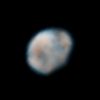
021-Vesta-2.jpg4-Vesta, from HST55 visiteHubble observation of Vesta: picture taken with the Wide Field Planetary Camera 2 on May 14 and 16, 2007.
MareKromium
|
|

006-Ceres.jpg1-Ceres (natural colors, from HST - credits: NASA/ESA et al.)55 visiteThe Hubble image of Ceres on the reveals bright and dark regions on the asteroid's surface that could be topographic features, such as craters, and/or areas containing different surface material. Large impacts may have caused some of these features and potentially added new material to the landscape. The Texas-sized asteroid holds about 30 to 40% of the mass in the Asteroid Belt.
Ceres' round shape suggests that its interior is layered like those of terrestrial planets such as Earth. The asteroid may have a rocky inner core, an icy mantle, and a thin, dusty outer crust. The asteroid may even have water locked beneath its surface. It is approx. 590 miles (950 Km) across and was the first asteroid discovered in 1801.
The observation was made in visible and ultraviolet light between December 2003 and January 2004 with the HST Advanced Camera for Surveys. The color variations in the image show either a difference in texture or composition on Ceres' surface.
Astronomers need the close-up views of the Dawn spacecraft to determine the characteristics of these regional differences.
MareKromium
|
|

Tethys-N00085215.jpgTethys' surface, in the Saturn-shine (4 - natural colors - elab. Lunexit)55 visiteCaption NASA:"N00085215.jpg was taken on June 27, 2007 and received on Earth June 28, 2007. The camera was pointing toward Tethys that, at the time, was approx. 22.287 Km away. The image was taken using the CL1 and CL2 filters.
This image has not been validated or calibrated". MareKromium
|
|

Tethys-N00085214.jpgTethys' surface, in the Saturn-shine (3 - natural colors - elab. Lunexit)55 visiteCaption NASA:"N00085214.jpg was taken on June 27, 2007 and received on Earth June 28, 2007. The camera was pointing toward Tethys that, at the time, was approx. 21.046 Km away. The image was taken using the CL1 and CL2 filters.
This image has not been validated or calibrated".MareKromium
|
|

Tethys-N00085225.jpgTethys' surface, in the Saturn-shine (7 - natural colors - elab. Lunexit)55 visiteCaption NASA:"N00085225.jpg was taken on June 27, 2007 and received on Earth June 28, 2007. The camera was pointing toward Tethys that, at the time, was approx. 78.979 Km away. The image was taken using the CL1 and CL2 filters.
This image has not been validated or calibrated".MareKromium
|
|

Enceladus-N00085267.jpgEnceladus (2) - (natural colors - elab. Lunexit)55 visiteCaption NASA:"N00085267.jpg was taken on June 28, 2007 and received on Earth June 29, 2007. The camera was pointing toward Enceladus that, at the time, was approx. 293.113 Km away. The image was taken using the CL1 and IR1 filters.
This image has not been validated or calibrated".MareKromium
|
|

as17-147-22509.JPGAS 17-147-22509 - Up-Sun55 visiteEVA-1 at the LM. 4 o'clock pan. Up-Sun with the crater that Gene (Cernan) thought it might be "Poppie".
Note the footprints he made when he walked out to it during the first few minutes of the EVA.MareKromium
|
|

Tethys-N00086711.jpgThe cratered Lands of Tethys (5)55 visitenessun commentoMareKromium
|
|

Tethys-N00086706.jpgThe cratered Lands of Tethys (3)55 visitenessun commentoMareKromium
|
|
Enceladus-N00086740.jpgIcy Enceladus...55 visitenessun commentoMareKromium
|
|

Tethys-N00086750.jpgThe cratered Lands of Tethys (7)55 visitenessun commentoMareKromium
|
|
| 25353 immagini su 2113 pagina(e) |
 |
|
|
|
|
1928 | |
|
|
|
|





