| Piú viste |

PHOE-SOL045-PIA11007.jpgFull-circle panorama (Approx. True Colors - credits: NASA)55 visiteCaption NASA:"This view combines more than 400 images taken during the first several weeks after NASA's Phoenix Mars Lander arrived on an arctic plain at 68,22° North Lat., 234,25° East Long. on Mars.
The full-circle panorama in approximately true color shows the polygonal patterning of ground at the landing area, similar to patterns in permafrost areas on Earth. The center of the image is the westward part of the scene. Trenches where Phoenix's robotic arm has been exposing subsurface material are visible in the right half of the image. The spacecraft's meteorology mast, topped by the telltale wind gauge, extends into the sky portion of the panorama.
This view comprises more than 100 different camera pointings, with images taken through three different filters at each pointing. It is presented here as a cylindrical projection".MareKromium
|
|
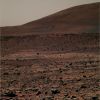
SOL1170-1.jpgMartian Landscape - Sol 1170 (natural colors; credits: Dr G. Barca)55 visitenessun commentoMareKromium
|
|
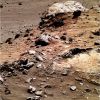
SOL1147-1.jpgRocks and Boulders - Sol 1147 (natural colors; credits: Dr G. Barca)55 visitenessun commentoMareKromium
|
|
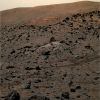
SOL1174-1.jpgGusev's Landscape - Sol 1174 (natural colors; credits: Dr G. Barca)55 visitenessun commentoMareKromium
|
|
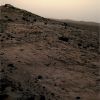
SOL1173-1.jpgGusev's Landscape - Sol 1173 (natural colors; credits: Dr G. Barca)55 visitenessun commentoMareKromium
|
|
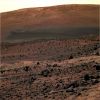
SOL1171-1.jpgThe "El Dorado Dunefield" - Sol 1171 (natural colors; credits: Dr G. Barca)55 visitenessun commentoMareKromium
|
|

20000410.jpgDifferent Lights, Different Visions55 visiteDuring the 28 days the NEAR Shoemaker Spacecraft circled Eros in a 200-Km (such as approx. 124-mile) altitude orbit, it imaged parts of the surface under a variety of lighting and viewing conditions.
The different views of the surface allow study of small-scale morphology, analysis of albedo and color variations, and construction of topographic models from stereo images.
This image, taken April 2, 2000, from a range of 199 Km (about 123 miles), shows the effects of lighting changes. At the bottom of the frame, sunlight illuminates the surface at a grazing angle. The strong shadows bring out subtle landforms like the gentle undulations in the surface, visible at the lower center.
At the top of the frame, sunlight strikes the surface at a high angle and shadows become subdued, bringing out brightness variations like those on the wall of the large, 5,5-Km (3,4-mile) diameter crater at left.
(Image 0130112939)MareKromium
|
|
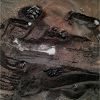
SOL1181-1.jpgRover Tracks, Colourful Dust and White Sulphates - Sol 1181 (True Colors; credits: Dr G. Barca)55 visitenessun commentoMareKromium
|
|
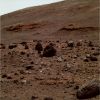
SOL1179-1.jpgBoulders and Skyline - Sol 1179 (natural colors; credits: Dr G. Barca)55 visitenessun commentoMareKromium
|
|
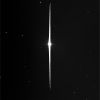
Enceladus-W00048456.jpgJust like a "Star"!55 visiteUno strabiliante "effetto goccia" (da over-saturation) per l'oggetto celeste la cui albedo è la più alta nell'intero Sistema Solare: Encelado, la "Luna di Neve".
Caption NASA:"W00048456.jpg was taken on August 11, 2008 and received on Earth August 11, 2008. The camera was pointing toward ENCELADUS that, at the time, was approx. 444.673 Km away.
The image was taken using the CL1 and CL2 filters and it has not been validated or calibrated".MareKromium
|
|
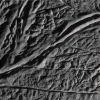
Enceladus-N00118365.jpgThe Unbelievable Surface of Enceladus, from about 2000 Km!55 visiteCaption NASA:"N00118365.jpg was taken on August 11, 2008 and received on Earth August 12, 2008. The camera was pointing toward ENCELADUS that, at the time, was approximately 2628 Km away.
The image was taken using the CL1 and CL2 filters and it has not been validated or calibrated".MareKromium
|
|

SOL1229-1~0.jpgThe "Purple-Reddish" color of Gusev's Surface - Sol 1229 (True Colors; credits: Dr G. Barca)55 visitenessun commentoMareKromium
|
|
| 25353 immagini su 2113 pagina(e) |
 |
|
|
|
|
1920 | |
|
|
|
|





