| Piú viste |

OPP-SOL864-1R204885908EFF73K0P1375R0M1.jpgThe way behind (1) - Sol 86455 visiteCinque frames semiconsecutivi i quali ci mostrano, in rapida successione, come i paesaggi PanCam e NavCam, nella loro artificiale bellezza, sìano oltremodo ingannevoli: a quanto pare, infatti, Opportunity sta marciando su un'area relativamente piatta mentre le altre immagini che ci vengono mostrate (quelle PanCam e NavCam, appunto) "suggeriscono" (diciamo così) un cammino, da Erebus verso Beagle e Victoria Crater, quanto mai complesso e costellato di insidie (dune soffici e molto alte).
La verità? Impossibile esserne certi ma, sapendo che i frames Front e Rear HazCam sono più affidabili, diremmo che la marcia verso i due suddetti crateri potrebbe non essere stata per nulla difficile...
"Right Rear HazCam Non-linearized Full frame EDR acquired on Sol 864 of Opportunity's mission to Meridiani Planum at approx. 12:36:18 MLT".
|
|

OPP-SOL864-1R204888156EFF73NMP1375L0M1.jpgThe way behind (4) - Sol 86455 visite"Left Rear HazCam Non-linearized Full frame EDR acquired on Sol 864 of Opportunity's mission to Meridiani Planum at approx. 13:12:46 MLT"
|
|
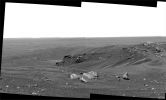
SOL603-A-P2374_R1-A603R1.jpgThe "Sand-Strewn" Summit of Husband Hill (1) - Sol 60355 visiteOriginal caption:"Undulating bands of dark and light sand, sloping dunes, and scattered cobbles form an apron around a ridge of light-colored rock that stands in bold relief against distant plains, as viewed by NASA's Spirit Rover from the top of Husband Hill on Mars. "The view of the summit is spectacular where we are right now", said geologist Larry Crumpler, with the New Mexico Museum of Natural History and Science, Albuquerque.
From here, Spirit is looking North-North/East en route to examining more of the local geology of the Columbia Hills in Gusev Crater. A few days after taking this picture, Spirit investigated the small, sinuous drifts on the left, located north-northeast of the rover's position in this image. The last previous time Spirit examined a drift was on the rim of Bonneville Crater almost 500 Soles ago, in March 2004".
|
|
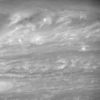
Saturn-PIA08212.jpgSaturnian Clouds55 visiteCaption NASA originale:"Cassini images of Saturn's dynamic atmosphere, like this detailed view, will be combined with data from the spacecraft's two infrared-sensing instruments (the Visible and Infrared Mapping Spectrometer - VIMS - and the Composite Infrared Spectrometer - CIS) to measure correlations among cloud features at many altitudes and infer heat flow across the Planet.
The numerous small, white blobs generally indicate disturbed and turbulent regions.
The image was taken with the Cassini spacecraft wide-angle camera on May 22, 2006 at a distance of approx. 331.000 Km (such as approx. 206.000 miles) from Saturn. The image was obtained using a spectral filter sensitive to wavelengths of infrared light centered at 752 nanometers. Image scale is roughly 16 Km (just 10 miles) per pixel".
|
|

OPP-SOL864-1N204890475EFF73O9P1795L0M1.jpgDeep tracks... - Sol 86455 visitenessun commento
|
|
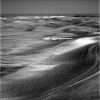
OPP-SOL869-1P205337116EFF73U6P2438L2M1.jpgIf this is not a fake... (2) - Sol 86955 visiteValgono i commenti svolti in precedenza...
Caption NASA:"Left PanCam Non-linearized Full frame EDR acquired on Sol 869 of Opportunity's mission to Meridiani Planum at approximately 14:36:16 MLT; camera commanded to use Filter 2 (753 nm)".
|
|

Triton-PIA01994.jpgStrange "surface features" on Triton (clouds?!?)55 visiteCaption NASA originale"Already intriguing patterns of unknown origin appear on the surface of Neptune's largest satellite, Triton, in this image returned by Voyager 2. The image was taken Aug. 22, 1989, from a distance of about 4 MKM (approx. 2.5 MMs). Voyager images show that Triton's diameter is about 2.720 Km (approx. 1.690 miles) and that it is one of the brightest objects in the Solar System, reflecting about 70% of the sunlight that strikes it. This is the Hemisphere of Triton that always faces away from Neptune. The South Pole is near the bottom of the image. Triton's rotation axis is tilted so that the latitude at the center of the disk is 55° South. Dark regions at the top of the disk extend from roughly the equator to beyond 20° North. The margin between the bright and dark regions varies with longitude around the satellite. The gray, featureless area just to the right of the center of the disk is due to a reseau (reticule mark) in the camera".
|
|

Mimas-PIA08223.jpgLand of Darkness...55 visiteCaption NASA originale:"The narrow and twisted F-Ring lights up this scene, which features Mimas against the unlit side of Saturn's Ring-Plane.
The F-Ring contains a great deal of fine, icy particles that are quite effective at scattering Sunlight at "high phase" angles.
Mimas (about 397 Km - approx. 247 miles - across) is seen as a mere crescent in the center of this haunting view.
The image was taken in visible light with the Cassini spacecraft narrow-angle camera on June 13, 2006 at a distance of approx. 3,9 MKM (such as about 2,4 MMs) from Mimas and at a Sun-Mimas-spacecraft, or phase, angle of 156°. Image scale is roughly 23 Km (about 15 miles) per pixel".
|
|
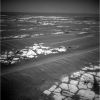
OPP-SOL883-1N206575633EFF74G2P0695L0M1.jpgBeagle Crater's Area (2) - Sol 88355 visitenessun commento
|
|
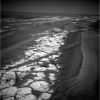
OPP-SOL883-1N206575684EFF74G2P0695R0M1.jpgBeagle Crater's Area (3) - Sol 88355 visitenessun commento
|
|
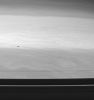
Saturn-PIA08227.jpgA shadow's over Saturn!55 visiteCaption NASA originale:"The shadow of Epimetheus, one of Saturn's co-orbital moons, races across the Planet's restless cloud tops. Epimetheus cruises along beyond the orbits of the narrow F-Ring and its shepherd moons.
Farther south on Saturn, the swirls and eddies are obscured by the shadow of the outer A-Ring and its two prominent, moon-containing gaps, Encke (bottom) and Keeler (dim, at the A-Ring edge).
The image was taken with the Cassini spacecraft wide-angle camera using a spectral filter sensitive to wavelengths of infrared light centered at 728 nnmts. The view was obtained on June 30, 2006, from a distance of approximately 335.000 Km (about 208.000 miles) from Saturn.
Image scale is approx. 16 Km (a little less than 10 miles) per pixel".
|
|

Rhea&Enceladus-PIA08229.jpgCrescent Moons...55 visiteCaption NASA originale:"Rhea and Enceladus shared the sky just before the smaller moon passed behind its larger, cratered sibling.
This image is part of a "mutual event" series in which one moon passes close to or in front of another. These sequences help scientists refine the orbits of Saturn's moons.
Cratered Rhea is 1.528 Km (about 949 miles) across and presumed to be geologically dead. While much smaller, Enceladus (505 Km, or about 314 miles across) is geologically active today.
The image was taken in visible light with the Cassini spacecraft narrow-angle camera on July 4, 2006 at a distance of approx. 1,4 MKM (such as about 800.000 miles) from Rhea and 1,9 MKM (such as about 1,2 MMs) from Enceladus. The view was obtained at a Sun-moon-spacecraft, or phase, angle of about 142°, relative to both moons.
Image scale is 8 roughly Km (about 5 miles) per pixel on Rhea and roughly 11 Km (about 7 miles) on Enceladus".
|
|
| 25353 immagini su 2113 pagina(e) |
 |
|
|
|
|
1915 | |
|
|
|
|





