| Piú viste |
PHOE-SOL114-lg33630-33659-33660-2.jpgMore "Ice" in the "Trench"? - Sol 114 (Superdefinition and natural colors; credits: Dr G. Barca)55 visitenessun commentoMareKromium
|
|

Rhea-PIA10474.jpgRhea55 visiteCaption NASA:"The sun's low angle near the Terminator highlights the topography of craters within Rhea's wispy terrain. (...)
This view looks toward the Trailing Hemisphere of Rhea (approx. 1528 Km, or 949 miles across). North is toward the top of the image.
The image was taken in visible light with the Cassini Spacecraft narrow-angle camera on June 10, 2008. The view was acquired at a distance of approx. 758.000 Km (such as about 471.000 miles) from Rhea and at a Phase Angle of 51°.
Image scale is roughly 5 Km (a little more than 3 miles) per pixel".MareKromium
|
|

Saturn-PIA10476.jpgSaturn in the Ringshine (natural colors; credits: NASA)55 visiteCaption NASA:"Large regions of Saturn's night side are illuminated by the Planet's gleaming Rings. Except for a sliver of the sunlit crescent at left, this view shows a part of the Planet lit almost entirely by "Ringshine".
The Southern Hemisphere, at bottom, receives its illumination from sunlight that strikes the Rings' southern face and is reflected onto the Planet. The Northern Hemisphere, at top, is lit by the feeble light that wends its way through countless ring particles to emerge on the Rings' north face. Despite the dim lighting on the northern part of the Planet, many cloud features can be seen there nevertheless.
This view was acquired from about 44° above the Ring-Plane. At bottom, the Planet's shadow stretches across the D and C-Rings.
Images taken using red, green and blue spectral filters were combined to create this natural color view. The images were obtained with the Cassini Spacecraft wide-angle camera on April 23, 2007 at a distance of approx. 901.000 Km (about 560.000 miles) from Saturn.
Image scale is roughly 50 Km (about 31 miles) per pixel".MareKromium
|
|

JanusandPan-PIA10475.jpgOne is "Surrounded" and the other is "Free": Pan and Prometheus55 visiteCaption NASA:"Two of Saturn's moons coast along the outer edge of the Main Ring System. The orbits of seven small moons cluster just outside the F-Ring -- between the orbits of Pan and the co-orbital moons Janus and Epimetheus.
Pan (approx. 28 Km, or about 17 miles across at its widest point) appears as a bright dot within the Encke Gap, right of center. Janus (about 179 Km, or approx. 111 miles across at its widest point) lies outside the A and F-Rings, below center.
This view looks toward the sunlit side of the rings from about 2° below the Ring-Plane. The image was taken in visible light with the Cassini Spacecraft narrow-angle camera on Aug. 22, 2008. The view was obtained at a distance of approx. 1,3 MKM (such as about 808.000 miles) from Janus.
Image scale is roughly 8 Km (5 miles) per pixel".MareKromium
|
|

Saturn-PIA10478.jpgSaturn and Mimas (natural colors; credits: NASA/JPL/Space Science Institute )55 visiteCaption NASA:"The Cassini Spacecraft looks beyond Saturn's limb toward the icy face of Mimas, the innermost of the Planet's major moons.
This view looks toward the sunlit side of the rings from about 3° below the Ring-Plane. Mimas is about 396 Km (approx. 246 miles) across.
Images taken using red, green and blue spectral filters were combined to create this natural color view. The images were acquired with the Cassini Spacecraft narrow-angle camera on Sept. 4, 2007 at a distance of approx. 2,7 MKM (such as about 1,7 MMs) from Saturn and 2,8 MKM (such as about 1,8 MMs) from Mimas.
Image scale is roughly 16 Km (about 10 miles) per pixel on Saturn and approx. 17 Km (such as about 11 miles) per pixel on Mimas". MareKromium
|
|
SOL772-2P194897737EFFAPBCP2595.jpgSmall, but Colourful, Outcrop - Sol 772 (Natural Colors; credits for the additional process. and color.: Dr Marco Faccin - Lunexit Team) 55 visitenessun commentoMareKromium
|
|

OPP-SOL043-MF-LXT2.JPGThe "Early Berries" of Meridiani - Sol 43 (natural colors; credits: Dr M. Faccin)55 visitenessun commentoMareKromium
|
|
OPP-SOL0985-3D-2_copia.jpgVictoria's Capes - Sol 985 (Hi-Def3-D - credits and Copyright: Dr G. Barca and Lunar Explorer Italia)55 visitenessun commentoMareKromium
|
|
OPP-SOL0953-3D-2_copia.jpgVictoria's Capes - Sol 953 (Hi-Def3-D - credits and Copyright: Dr G. Barca and Lunar Explorer Italia)55 visitenessun commentoMareKromium
|
|

Saturn-PIA10487.jpgMany Colors for Many Moons... (natural colors; credits: NASA)55 visiteCaption NASA:"Four moons huddle near Saturn's multi-hued disk.
The coloration of the planet's northern hemisphere has changed noticeably since the Cassini Spacecraft's arrival in orbit in mid-2004. Imaging scientists are working to understand the causes of this change, which is suspected to be a seasonal effect.
Giant Titan (5150 Km, or approx. 3200 miles across), with its darker Winter Hemisphere, dominates the smaller moons in the scene. Beneath and left of Titan is Janus (181 Km, or about 113 miles across). Mimas (397 Km, or approx. 247 miles across) appears as a bright dot close to the Planet and beneath the Rings. Prometheus (102 Km, or about 63 miles across) is a faint speck hugging the Rings between the two small moons.
This view looks toward the unilluminated side of the Rings from less than 1° above the Ring-Plane.
Images taken using red, green and blue spectral filters were combined to create this natural color view. The view was acquired with the Cassini spacecraft wide-angle camera on Oct. 26, 2007, at a distance of approx. 1,5 MKM (such as about 920.000 miles) from Saturn and 2,7 MKM (about 1,7 MMs) from Titan.
Image scale is roughly 89 Km (approx. 55 miles) per pixel on Saturn and 164 Km (about 102 miles) per pixel on Titan".MareKromium
|
|
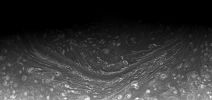
Saturn-PIA10486.jpgTwo sides of Saturn's "Hexagon"55 visiteCaption NASA:"Saturn's North Polar Hexagon appears to be a long-lived feature of the Atmosphere, having been spotted in images of Saturn in the early 1980s, again in the 1990s, and then by the Cassini Spacecraft in the past several years.
The persistent nature of the Hexagon in imaging observations implies that it is present throughout Saturn's 29-year seasonal cycle. Two sides of the Hexagon are seen here.
This view was obtained from about 67° above the Equator. The image was taken with the Cassini Spacecraft wide-angle camera on Aug. 25, 2008 using a spectral filter sensitive to wavelengths of infrared light centered at 752 nanometers. The view was acquired at a distance of approx. 566.000 Km (about 352.000 miles) from Saturn.
Image scale is roughly 31 Km (about 19 miles) per pixel".MareKromium
|
|
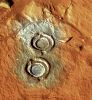
SOL0200-MF-LXT.jpgDouble Abrasion - Sol 200 (Hi-Def3-D; possible True Colors - credits and Copyright: Dr M. Faccin and Lunar Explorer Italia)55 visiteIndossate gli "occhialini" e poi rispondete onestamente: non Vi viene la tentazione di provare a "toccare" i buchetti scavati dal RAT di Spirit?MareKromium
|
|
| 25353 immagini su 2113 pagina(e) |
 |
|
|
|
|
1914 | |
|
|
|
|





