| Piú viste |

ZZ-ZZ-ZZ-Martian_Small_Rock.jpgRocks (possible natural colors)55 visitenessun commentoMareKromium
|
|
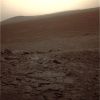
SOL1332-2P244621550EFFAVCBP2398R1M1-1.jpgGusev Crater's Panorama - Sol 1332 (possible natural colors; elab. Lunexit)55 visitenessun commentoMareKromium
|
|

PSP_005419_1380_RED_browse-00.jpgFlow-like Features in Promethei Terra (context frame)55 visiteThis image, part of the south-facing slopes of a massif in Promethei Terra in the Southern Highlands, shows flow-like features (tongue-shaped lobes, parallel ridges) that indicate movement of surface materials downhill and towards the South-West, following the regional slope.
The difference in elevation between the ridge (near the top or northern-most portion of the image) and the valley (to the South) is over 2200 meters (7,200 feet).
These flow-like features are reminiscent of those observed in terrestrial landslides and rock glaciers , in which the downhill movement of rocks and soils is facilitated by an agent (most commonly water in landslides, ice in glaciers) that acts as a lubricant and provides cohesion. Theoretical calculations predict that under current and recent Martian climate conditions, neither water nor ice would be stable near the surface for extended periods of time in this Region.
The temperatures are so low that water would freeze, and then quickly sublime, because the air is very thin and dry. Ice could, though, be stable at present approximately 1 meter (3 feet) or more below the surface.
MareKromium
|
|

ZZ-Pluto-PIA09234.gifPluto! From New Horizons (GIF-Movie)55 visiteCaption NASA:"The Long Range Reconnaissance Imager (LORRI) on New Horizons acquired images of the Pluto field 3 days apart in late September 2006, in order to see Pluto's motion against a dense background of stars. LORRI took 3 frames at 1-second exposures on both Sept. 21 and Sept. 24.
Because it moved along its predicted path, Pluto was detected in all six images.
These images are displayed using false-color to represent different intensities: the lowest intensity level is black, different shades of red mark intermediate intensities, and the highest intensity is white. The images appear pixilated because they were obtained in a mode that compensates for the drift in spacecraft pointing over long exposure times. LORRI also made these observations before operators uploaded new flight-control software in October; the upgraded software package includes an optical navigation capability that will make LORRI approximately three times more sensitive still than for these Pluto observations".MareKromium
|
|

Japetus-PIA08376-1.jpgRising Japetus (false colors - elab. NASA)55 visiteThe slim crescent of Iapetus looms before the Cassini spacecraft as it approaches the mysterious moon.
Iapetus, 1,468 kilometers (912 miles) across, seen here in false color, is unique in its dramatic variation in brightness between the northern polar region and the middle and low latitudes. Equally prominent is the moon's equatorial ridge of towering mountains. The profile of the ridge against the darkness of space reveals that it is topped by a cratered plateau approximately 15 kilometers (9 miles) wide. Further west, the profile of the ridge changes from a long plateau to discrete peaks.
The mosaic consists of four image footprints across the surface of Iapetus and has a resolution of 489 meters (0.3 miles) per pixel.
A full-resolution clear filter image was combined with half-resolution images taken with infrared, green and ultraviolet spectral filters (centered at 752, 568 and 338 nanometers, respectively) to create this full-resolution false color mosaic.
The color seen in this view represents an expansion of the wavelength region of the electromagnetic spectrum visible to human eyes. The intense reddish-brown hue of the dark material is far less pronounced in true color images. The use of enhanced color makes the reddish character of the dark material more visible than it would be to the naked eye. In addition, the scene has been brightened to improve the visibility of surface features.
This view was acquired with the Cassini spacecraft narrow-angle camera on Sept. 10, 2007, at a distance of about 83,000 kilometers (51,600 miles) from Iapetus.
MareKromium
|
|

Enceladus-N00093907.jpgThe Gem in the Sky of Saturn... (possible true colors; elab. Lunexit)55 visitenessun commentoMareKromium
|
|

Enceladus-N00093896.jpgThe Gem in the Sky of Saturn... (possible true colors; elab. Lunexit)55 visiteE così come è stato per Marte ed il Paving di Victoria Crater, oggi abbiamo il piacere e l'onore di proporVi quella che - ovviamente a nostro parere - riteniamo essere la migliore interpretazione dei Colori (e delle sfumature...) di Encelado: un'autentica Gemma di Neve che splende nel Cielo di Saturno.
Attendiamo i Vostri commenti!MareKromium
|
|

APOLLO_10_AS_10-35-5217.jpgAS 10-35-5217 - Earthrise with "something flying away"... (1)55 visitenessun commentoMareKromium
|
|
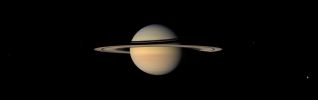
Saturn-PIA08387.jpgA View from Japetus55 visiteWhile on final approach for its Sept. 2007 close encounter with Saturn's moon Japetus, Cassini spun around to take in a sweeping view of the Saturn System.
Japetus is the only major moon of Saturn with a significant inclination to its orbit. From the other major satellites, the Rings would appear nearly edge-on, but from Japetus, the Rings usually appear at a tilt, as seen here.
This natural color mosaic consists of 15 red, green and blue spectral filter images acquired in five wide-angle camera footprints that swept across the scene.
Moons visible in this image: Dione at center left, Enceladus near the left side ansa (or ring edge), Mimas is a speck against the ring shadows on Saturn's Western Limb, Rhea can be seen against the bluish backdrop of the Northern Hemisphere, Tethys is near the right ansa, and Titan near lower right.
The images were obtained on Sept. 10, 2007, at a distance of approx. 3,3 MKM (such as about 2,1 MMs) from Saturn at a Sun-Saturn-Spacecraft, or phase, angle of 33°. Image scale is about 195 Km (approx. 121 miles) per pixel on the Planet. MareKromium
|
|

Tethys-PIA08401.jpgThe Edge of Tethys55 visiteThe cold, cratered landscape of Saturn's moon Tethys shines in stark relief in this crescent view. Aside from its obvious aesthetic beauty, this particular Cassini mosaic was obtained mainly to understand important details about how the surface of Tethys reflects light at high phase angles (the Sun-Tethys-Spacecraft viewing angle). The beautiful interplay of light with surface topographic features is an important factor in this regard. The surface is heavily cratered, and at this oblique angle the craters give the surface a highly scalloped appearance.
Unlike some HR crescent views of Saturn's moons, this image truly gives Tethys the appearance of being composed of ice and frost. There appear to be numerous sun glints sparkling across the surface. Some of these might be specular (or mirror-like) reflections off of exposed walls of solid ice inside craters, or they might be uniformly large, frosty or icy-particle covered facets of topography that are so oriented as to give exceptionally bright but diffuse reflections.
The shadows cast by most craters in the scene are not dark, but rather, they are illuminated by light bouncing off of their sunlit walls and those of other craters. This light, which has been scattered multiple times, makes visible some details along the shadowed walls and floors of craters that would not otherwise be visible in this viewing geometry.
This mosaic was assembled from four clear filter, narrow-angle camera images, with low resolution, wide-angle camera data filling a small gap in coverage. The view is an orthographic projection and has a resolution of 211 meters (692 feet) per pixel. An orthographic view is most like the view seen by a distant observer looking through a telescope. North is up.
The view was obtained by the Cassini spacecraft on June 29, 2007, from a distance of approximately 38.000 Km (about 24.000 miles) and at a Sun-Tethys-Spacecraft, or phase, angle of 152°.
MareKromium
|
|
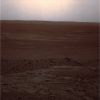
SOL1346-2P245863641EFFAVHPP2402L7M1.jpgLate in the Day (2) - Sol 1346 (natural colors - elab. Lunexit)55 visitenessun commentoMareKromium
|
|
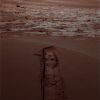
OPP-SOL607-1-182068954-6.jpg"Section" of a Side-Winder - Sol 60755 visitenessun commentoMareKromium
|
|
| 25353 immagini su 2113 pagina(e) |
 |
|
|
|
|
1913 | |
|
|
|
|





