| Piú viste |
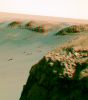
OPP-SOL0985-3D-2_copia.jpgVictoria's Capes - Sol 985 (Hi-Def3-D - credits and Copyright: Dr G. Barca and Lunar Explorer Italia)55 visitenessun commentoMareKromium
|
|
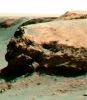
OPP-SOL0953-3D-2_copia.jpgVictoria's Capes - Sol 953 (Hi-Def3-D - credits and Copyright: Dr G. Barca and Lunar Explorer Italia)55 visitenessun commentoMareKromium
|
|

Saturn-PIA10487.jpgMany Colors for Many Moons... (natural colors; credits: NASA)55 visiteCaption NASA:"Four moons huddle near Saturn's multi-hued disk.
The coloration of the planet's northern hemisphere has changed noticeably since the Cassini Spacecraft's arrival in orbit in mid-2004. Imaging scientists are working to understand the causes of this change, which is suspected to be a seasonal effect.
Giant Titan (5150 Km, or approx. 3200 miles across), with its darker Winter Hemisphere, dominates the smaller moons in the scene. Beneath and left of Titan is Janus (181 Km, or about 113 miles across). Mimas (397 Km, or approx. 247 miles across) appears as a bright dot close to the Planet and beneath the Rings. Prometheus (102 Km, or about 63 miles across) is a faint speck hugging the Rings between the two small moons.
This view looks toward the unilluminated side of the Rings from less than 1° above the Ring-Plane.
Images taken using red, green and blue spectral filters were combined to create this natural color view. The view was acquired with the Cassini spacecraft wide-angle camera on Oct. 26, 2007, at a distance of approx. 1,5 MKM (such as about 920.000 miles) from Saturn and 2,7 MKM (about 1,7 MMs) from Titan.
Image scale is roughly 89 Km (approx. 55 miles) per pixel on Saturn and 164 Km (about 102 miles) per pixel on Titan".MareKromium
|
|
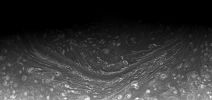
Saturn-PIA10486.jpgTwo sides of Saturn's "Hexagon"55 visiteCaption NASA:"Saturn's North Polar Hexagon appears to be a long-lived feature of the Atmosphere, having been spotted in images of Saturn in the early 1980s, again in the 1990s, and then by the Cassini Spacecraft in the past several years.
The persistent nature of the Hexagon in imaging observations implies that it is present throughout Saturn's 29-year seasonal cycle. Two sides of the Hexagon are seen here.
This view was obtained from about 67° above the Equator. The image was taken with the Cassini Spacecraft wide-angle camera on Aug. 25, 2008 using a spectral filter sensitive to wavelengths of infrared light centered at 752 nanometers. The view was acquired at a distance of approx. 566.000 Km (about 352.000 miles) from Saturn.
Image scale is roughly 31 Km (about 19 miles) per pixel".MareKromium
|
|
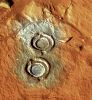
SOL0200-MF-LXT.jpgDouble Abrasion - Sol 200 (Hi-Def3-D; possible True Colors - credits and Copyright: Dr M. Faccin and Lunar Explorer Italia)55 visiteIndossate gli "occhialini" e poi rispondete onestamente: non Vi viene la tentazione di provare a "toccare" i buchetti scavati dal RAT di Spirit?MareKromium
|
|
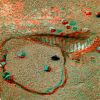
OPP-SOL0111-1-3D-3.jpgMartian Trapdoor - Sol 111 (Hi-Def3-D - Natural Colors; credits and Copyright: Dr G. Barca and Lunar Explorer Italia)55 visitenessun commentoMareKromium
|
|

OPP-SOL0111-1-3D-2.jpgMartian Trapdoor - Sol 111 (Hi-Def3-D - Natural Colors; credits and Copyright: Dr G. Barca and Lunar Explorer Italia)55 visitenessun commentoMareKromium
|
|
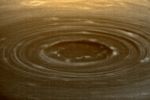
Saturn-SP-PIA11103.jpgSouthern Turbulence (natural colors; credits: Lunexit)55 visiteCaption NASA:"Shadows reveal the topography of Saturn's South Polar Vortex. At high resolution, a new, inner ring of isolated, bright clouds is seen. These clouds are localized regions of convective upwelling, an important clue to understanding how heat energy is transported in Saturn's Atmosphere.
See PIA11104 for a high-resolution Cassini view that looks more directly down onto the vortex, compared to this oblique perspective. Sunlight illuminates the scene from upper right, and the higher altitude rings of clouds surrounding the pole cast shadows toward lower left. North on Saturn is up.
The image was taken with the Cassini Spacecraft narrow-angle camera on July 15, 2008, with a combination of spectral filters sensitive to wavelengths of polarized infrared light centered at 746 and 938 nanometers. The grainy quality of the image is due primarily to the low signal-to-noise ratio of images taken with the 938 nanometer spectral filter, which is near the upper limit of the wavelength range the camera can see. "Signal-to-noise" is a term scientists use to refer to the amount of meaningful or useful information (signal) in their data versus the amount of background noise. A higher signal-to-noise ratio yields sharper, clearer views of features in the atmosphere.
The view was acquired from 24° below the Ring-Plane, at a distance of approx. 778.000 Km (about 483.000 miles) from Saturn.
The Sun-Saturn-Spacecraft, or Phase, Angle is about 30°.
Image scale is 4 Km (about 3 miles) per pixel".MareKromium
|
|

Saturn-RingPlane_cassini_big.jpgAlong the Ring-Plane of Saturn (natural colors; credits: NASA)55 visiteCaption NASA originale:"When Saturn's appendages disappeared in 1612, Galileo did not understand why. Later that century, it became understood that Saturn's unusual protrusions were Rings and that when the Earth crosses the Ring-Plane, the edge-on rings will appear to disappear.
This is because Saturn's Rings are confined to a plane many times thinner, in proportion, than a razor blade. In modern times, the Cassini Spacecraft orbiting Saturn now also crosses Saturn's Ring-Plane. A series of plane crossing images from late February (2006) was dug out of the vast online Cassini raw image archive by interested Spanish amateur Fernando Garcia Navarro.
Pictured above, digitally cropped and set in representative colors, is the striking result. Saturn's thin Ring-Plane appears in blue, bands and clouds in Saturn's Upper Atmosphere appear in gold and dark shadows of the Rings curve across the top of the Gas Giant Planet. Moons appear as bumps in the Rings". MareKromium
|
|

OPP-SOL0099-1-3D.jpgEndurance Rim - Sol 99 (Hi-Def3-D; False Colors - credits and Copyright: Dr G. Barca and Lunar Explorer Italia)55 visiteUna nuova e splendida visione del bordo interno (Inner Rim) dell'(ormai) lontano Cratere Endurance...MareKromium
|
|

OPP-SOL0094-1-3D.jpgEndurance Rim, from about 100 meters - Sol 94 (Hi-Def3-D; False Colors - credits and Copyright: Dr G. Barca and Lunar Explorer Italia)55 visiteEd anche questa immagine è - semplicemente - spettacolare: osservate, infatti, la leggera ondulazione del suolo ed i minuscoli "hollows" che caratterizzavano gli ultimi 100 metri (circa) di distanza che passano fra Opportunity ed il bordo esterno del Cratere Endurance...MareKromium
|
|

Craters-Unnamed_Crater-Utopia_Planitia-PCF-LXTT-1.jpgUnnamed Crater with Gullies and Small Dunefield in Utopia Planitia (Saturated Natural Colors; credits for the additional process. and color.: Dr Paolo C . Fienga - Lunar Explorer Italia)55 visitenessun commentoMareKromium
|
|
| 25353 immagini su 2113 pagina(e) |
 |
|
|
|
|
1909 | |
|
|
|
|





